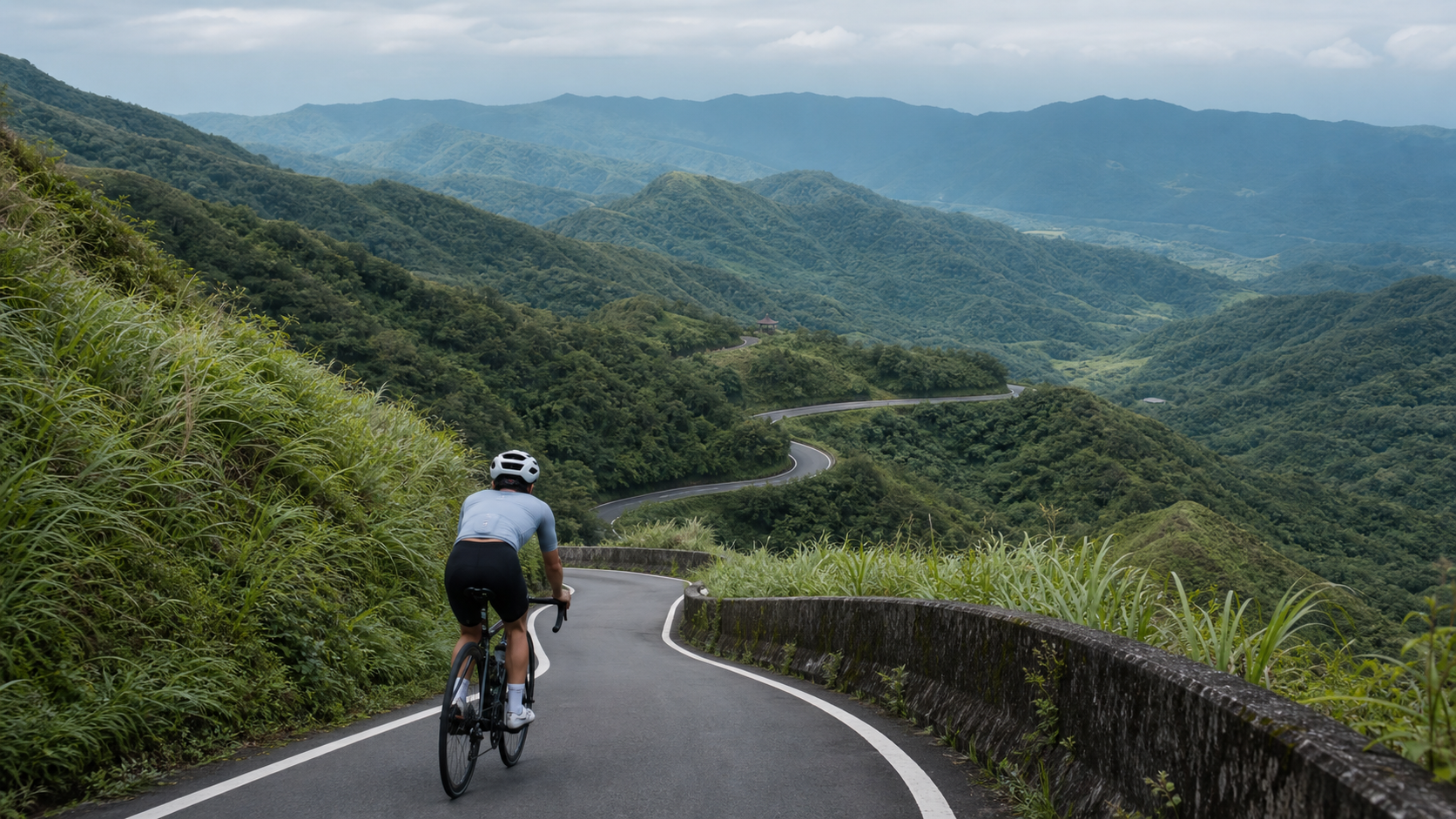
The Wind at Buyan Pavilion: Solitude and Vastness Amid the Rolling Hills of Shuangxi
Summary: The Buyan Pavilion route in Shuangxi spans 9.7 kilometers, with undulating terrain and an actual elevation gain of 939 meters. This is a cycling journey through the hills and valleys of Northeast Taiwan’s corner, searching for rhythm and tranquility along winding country roads that rise and fall unexpectedly. The name of the terminal pavilion, “Buyan,” itself captures the charm of this landscape that leaves visitors endlessly captivated.
Shuangxi District in New Taipei City is a relatively low-key yet uniquely scenic mountain town in Taiwan’s northeast corner. It lacks the fame of Yangmingshan, nor does it draw the endless streams of tourists like Jiufen or Jinguashi. But precisely because of this, Shuangxi retains a tranquil character that stays closer to the land’s original appearance. The Buyan Pavilion route in Shuangxi spans 9.7 kilometers, with data showing a total elevation gain of 939 meters—far exceeding the theoretical climbing value implied by the average gradient of 4.7%. This indicates a country mountain road that winds through hills and valleys with repeated ascents and descents. The endpoint is a scenic pavilion named “Buyan,” and the name alone is enough to inspire longing for this journey—“Buyan” means never tiring of the view, worth returning to again and again. It is one of the most affectionate expressions that Taiwan’s hiking and cycling enthusiasts use when naming places they hold dear.
Shuangxi: A Serene Town Embraced by Streams and Hills
The name Shuangxi derives from the convergence of two streams in the area—the Mudan Creek and the Pinglin Creek—hence its name. This valley, embraced by streams and hills, has been one of the important footholds for Han Chinese settlers developing the northeast corner since the Qing Dynasty. In its early years, thriving coal mining and camphor industries made it a prosperous mountain settlement. As industries transformed and the population migrated away, Shuangxi gradually returned to being a slow-paced mountain town retaining a strong traditional settlement character. Traces of early Min-style architecture can still be seen on the old streets, and at street corners, the occasional aroma of wood-fired rice or sun-dried grain drifts by—a pace of life utterly different from the city, which forms the most touching essence of Shuangxi.
Departing from downtown Shuangxi to take on the Buyan Pavilion route, you first pass through this neighborhood preserving the look of past settlements. Weathered brick walls of old houses and gently flowing streams compose a serene and poetic opening scene. As you gradually leave the town center and venture deeper into the hills, the scenery shifts from human settlements to layered mountain forests and fields. This gradual transition of landscape makes the rider feel as though, with the rising terrain, they are steadily leaving behind the clamor of the world and entering a state of mind closer to nature.
The Cycling Philosophy of Finding Rhythm Amid the Ups and Downs
The most distinctive feature of the Buyan Pavilion route in Shuangxi is its repeatedly undulating terrain—climb, descend, climb again, in endless cycles. For riders accustomed to routes with a single continuous climb, this rhythm may initially bring confusion or even frustration, because every brief respite from a descent is immediately interrupted by the next ascent, as if true relaxation is never attainable. But it is precisely this characteristic that gives the Buyan Pavilion route a unique philosophical meaning—it teaches riders that true rhythm lies not in pursuing constant, unchanging stability, but in learning to find your own breathing and pedaling cadence amid change.
As you gradually adapt to this terrain of constant rises and falls, you’ll find yourself becoming more adept at anticipating the road ahead—from subtle changes in road gradient, the direction of distant mountain ridges, and even shifts in wind and light, all becoming clues for reading the terrain. This process of building rapport with the landscape is, in a sense, a dialogue with nature. You are no longer unilaterally conquering the slopes, but learning to yield, to understand, and to find your own balance within it.
Wild Charm and Ecology in the Valley Depths
Because the hills and valleys around Shuangxi have seen relatively low levels of development, they retain a rich natural ecology. Along the ride, bird calls and insect sounds frequently emanate from the forests on both sides. With luck, you might catch a glimpse of a Taiwan blue magpie sweeping through the woods with its long tail feathers, or hear bamboo partridges calling crisply from the undergrowth. Occasionally, egrets can be seen standing along the streams foraging, their leisurely demeanor forming an amusing contrast with the rider’s somewhat hurried breathing rhythm.
In spring and summer, the forests flanking the Shuangxi valley gradually take on a lush green hue, with the occasional fragrance of wild ginger lilies or shell ginger drifting on the breeze. In autumn and winter, the swaying silvergrass on the hills presents a different scene—bleak yet poetic. This natural landscape, transforming with the changing seasons, ensures that even after repeated rides on the Buyan Pavilion route, one always discovers details and scenery unnoticed on previous trips. This is also a significant reason why many seasoned riders are willing to return here time and again.
Buyan Pavilion: The Affection and Wisdom Within a Name
The name “Buyan Pavilion” is believed to originate from the exceptional panoramic views from this elevated vantage point—views one never tires of. This naming logic is quite common in the tradition of naming scenic overlook pavilions at high points across Taiwan, often embodying the namer’s heartfelt admiration and attachment to the landscape. The moment you arrive at Buyan Pavilion, the suddenly opening vista indeed makes you understand the deeper meaning behind the name. Gazing out from the pavilion, layered ridgelines of hills extend into the distance. On clear days, you can even make out the contours of more distant mountain ranges. Such a vast and serene view is enough to soothe the fatigue accumulated from struggling through the undulating terrain just moments before.
Standing at Buyan Pavilion, the mountain breeze gently blows, carrying away the sweat and heat, leaving behind only an indescribable sense of groundedness and fulfillment. Many riders describe that while Buyan Pavilion’s view lacks the towering, cloud-wreathed grandeur of Wuling or Hehuan Mountain, it possesses a beauty that is closer to the land, gentler and more understated—it does not seek to awe you, but rather invites you to sit quietly and savor the homeland scenery before you, tenderly wrapped by streams and hills.
The Meaning of Solitary Riding: Time for Dialogue with Oneself
Compared to popular routes with heavy traffic and gatherings of cyclists, such as Yangjin Highway or Beiyi Highway, the Buyan Pavilion route in Shuangxi, due to its remote location and relatively lower profile, often feels exceptionally quiet during the ride, even carrying a hint of solitude. For many riders who live amid urban clamor, this solitude is instead a rare and precious gift. Without the chatter of fellow riders, without the disturbance of busy traffic, only your own breathing, heartbeat, and the occasional birdsong or stream sound compose the purest soundtrack of the entire journey.
This process of facing the undulating terrain alone, digesting fatigue and frustration alone, and ultimately arriving at Buyan Pavilion alone to greet the vast view, is in a sense also a journey of dialogue with your inner self. Many riders share that in such relatively solitary riding conditions, they find it easier to sort through the tangled thoughts of daily life and discover the direction their hearts truly seek. For many cyclists, therefore, Buyan Pavilion in Shuangxi is not merely a training route, but a hidden corner where one can settle the mind and reconcile with oneself anew.
Settlements and Local Warmth Along the Way
Although most sections of the Buyan Pavilion route in Shuangxi wind through hills and forests, you will still pass a few scattered rural settlements along the way. These settlements are small in scale, with residents mostly making a living from farming—growing tea, vegetables and fruits, or traditional rice. This way of life, closely tied to the land, appears especially precious in Taiwan’s rapidly urbanizing society. As you ride past, you might occasionally see elders working in the fields, looking up at passing cyclists and offering simple, friendly smiles. That unadorned warmth of human connection is one of the most touching undertones of this land in Shuangxi.
If time permits, consider visiting the traditional market or food stalls in downtown Shuangxi before or after the ride, sampling local home-style dishes and produce, and experiencing the distinctive rhythm of life in this mountain town. While Shuangxi’s products may not be as abundant or varied as those of other major tourist towns, the local flavors—unpackaged by excessive commercialization and preserved in their original essence—leave an especially memorable impression.
A Seasonal Ode to the Hills
The hill landscapes along the Buyan Pavilion route in Shuangxi wear different expressions in each season. In spring, fresh greenery emerges across the forests, and with occasional drizzling rain, the entire valley is shrouded in a thin mist, resembling a Chinese ink painting. Summer is the season of the densest, most saturated greenery, with cicadas chirping in succession, adding a lively vibrancy to the otherwise tranquil mountain road. In autumn, silvergrass tassels begin to sway in the wind on some slopes, their golden tones combined with the gradually cooling air making the riding experience especially comfortable and pleasant. In winter, the northeast monsoon brings abundant rainfall, and the mountain areas are prone to fog with reduced visibility—but this also often presents opportunities to capture the hazy, ethereal beauty of clouds and mist swirling through the valley, offering a poetic charm all its own.
Suggested Itinerary: Making Buyan Pavilion Part of a Deeper Shuangxi Trip
If you want to experience the full charm of Shuangxi, we recommend combining your cycling challenge with nearby attractions into a deeper local excursion. Around Shuangxi Station, several Japanese-era architectural remnants remain, well worth a leisurely stroll to explore. The Mudan Station area is also a quiet little stop well known among railway enthusiasts. If time permits, consider arranging half a day for riding and half a day for wandering, alternating between the intense climbing challenge and relaxed exploration, to feel the perfect balance between fast and slow in this mountain town of Shuangxi.
Final Thoughts: The Reason It Never Gets Old
After riding up to Buyan Pavilion in Shuangxi, standing in the pavilion and gazing at the layered ridgelines in the distance, you may come to understand why this pavilion is named “Buyan”—not because the scenery here is overwhelmingly grand or breathtaking, but because this land possesses a gentle power that endures through time and deserves repeated visits. Every ride, the undulating terrain still brings challenges and setbacks, yet the expansive view and inner calm at the moment of arrival always make people willingly return again and again. This, perhaps, is the most profound insight and gift that the name “Buyan” leaves for every visitor.
One Rider’s Early Morning Solo Ride
A rider who has long cycled in the Shuangxi area once shared an experience like this. On a weekday morning, overwhelmed by work-related stress to the point of barely being able to breathe, he decided on a whim to take the day off and ride alone to Buyan Pavilion to clear his mind. When he set off, the sky was not yet fully light, and the streetlights of downtown Shuangxi reflected off the thin mist, the whole town seemingly still asleep. He climbed along familiar routes, enduring test after test of rolling terrain, and at one point, exhausted, nearly gave up and turned back. But just as he was about to stop, a short gentle stretch of road appeared before him, allowing him to regain his pedaling rhythm and rekindle the drive to keep going.
When he reached Buyan Pavilion, the morning light happened to break through the clouds and spill across the valley, making the ridgelines before him look especially soft in the gentle glow. He said that at that moment, all the worries and pressure from work seemed to be thoroughly diluted by the vast, tranquil scenery, replaced by a long-missed sense of calm and groundedness. Since then, whenever he faces a low point in life that is hard to resolve, he thinks of that morning light at Buyan Pavilion and sets out again on this undulating yet healing route, treating each pedal stroke as a ritual of making peace with himself.
The Life Metaphor Taught by Rolling Terrain
The repeated climbs and descents of Buyan Pavilion in Shuangxi are, in a way, a microcosm of life itself—we always assume that after striving upward, a long stretch of flat, easy road will follow, but reality often shows that just as we adapt to a period of smooth sailing, another wave of challenges arrives. Many riders who have long frequented this route admit that it is precisely this rhythm, so similar to the essence of life, that has forged an emotional connection to Buyan Pavilion that transcends mere exercise.
Learning to navigate terrain that rises and falls—not becoming overly relaxed during brief descents, nor resentful of the climbs that follow, but instead focusing on the quality and rhythm of each pedal stroke in the present moment—this training of the mind may well be the most precious intangible reward this route offers, beyond physical conditioning. When you can accept the undulations of the terrain with equanimity and find your own coping rhythm, it also means, to some extent, that you are better equipped to face the unpredictable, recurring challenges and trials of life.
Night Riding and Stargazing: Another Face of Buyan Pavilion
Beyond early morning and daytime rides, some experienced, well-equipped riders also choose to visit Buyan Pavilion in the evening or at night during certain seasons. Because the Shuangxi area has relatively little light pollution, on clear, cloudless nights, looking up at the sky from the high point often reveals stars far more clearly than in urban areas. Of course, night riding carries higher risks—difficulty reading road conditions, a higher chance of encountering wildlife, sudden drops in temperature, and other factors—all requiring more thorough gear preparation and more careful risk assessment. It is by no means a ride for beginners or those without proper equipment.
If you truly wish to experience the serene beauty of the starry sky at Buyan Pavilion, we strongly recommend going with companions, equipping yourself with a proper lighting system, warm clothing, and emergency communication tools, and making sure to check weather and road conditions in advance to minimize safety risks. Only then can you truly enjoy, in peace, the unique stillness and vastness of this mountain town at night.
For Those Who Want to Take on Buyan Pavilion
If you are tired of the monotonous concrete jungle of the city and long to rediscover, through each pedal stroke, time spent in dialogue with nature and in solitude with yourself, Buyan Pavilion in Shuangxi is a choice worth serious consideration. It lacks the fame of Yangjin Highway or the bustling atmosphere of crowds of riders, yet it possesses a quiet charm more rooted in the essence of the land and more suited to settling one’s thoughts. If you are ready to face the challenge of relentless rolling terrain and ready to have an honest conversation with yourself in solitude, then the vast and gentle scenery of Buyan Pavilion is waiting quietly for you on the other side of the mountain.
Echoes of the Valley: The Resonance of Two Wheels and Flowing Water
Throughout the ride to Buyan Pavilion in Shuangxi, the company of streams is rarely far away. Mudan Creek and Pinglin Creek wind their way through the hill valleys, sometimes hugging the road closely, sometimes hidden deep in the shade of trees, leaving only the sound of babbling water to remind riders of their presence. This sense of companionship with the streams—sometimes near, sometimes distant—is a rather unique experience on the Buyan Pavilion route. When you are gasping for breath on a climb, hearing the crisp sound of flowing water nearby can, in a way, bring a touch of psychological coolness and comfort, as if the stream is cheering on your efforts in its own way.
After summer rains, the stream volume increases noticeably, and the sound of the water grows more powerful and vigorous, interweaving with the rider’s heavy breathing and the whirring of gears to form a primal, life-filled concerto. In the dry season, as the water recedes, exposed rocks and shallows create a different, tranquil and serene picture. This ever-changing appearance of the streams with the seasons and rainfall makes every ride to Buyan Pavilion feel like listening to a slightly different piece of nature’s music—never monotonous or dull.
Handcrafted Memories in Old Settlements
Around downtown Shuangxi, some old shops still uphold traditional handcrafted techniques, such as handmade noodles, traditional rice pastries, or general stores that have continued for decades. These shops may be small in scale and plain in decor, yet they carry decades of unchanging life wisdom and human warmth from this mountain town. After your cycling challenge, if time permits, step into these old shops, order a simple but carefully made traditional snack, and while savoring the challenges and rewards of the rolling terrain you just conquered, feel the town’s unique, slow, and grounded pace of life.
This combination of athletic challenge and local cultural experience is precisely what makes the Buyan Pavilion route in Shuangxi meaningful beyond mere gradient statistics. It reminds every visitor that the value of cycling has never been limited to the pursuit of physical numbers, but encompasses the sum total of everything seen, heard, felt, and thought along the way. And Shuangxi, this understated yet culturally rich mountain town, is the ideal setting capable of fully carrying such multifaceted value.
Leave a Letter to Yourself for the Next Visit
Many seasoned riders have a habit of writing down their feelings and reflections after completing a deeply meaningful ride, as a letter to their future selves. If you are also planning to take on Buyan Pavilion in Shuangxi, consider pausing at the moment you reach the pavilion, facing the mountain breeze and gazing at the vast ridgelines, to quietly record how you feel in that moment—whether it is the sense of accomplishment from completing the challenge, the insights gained from the rolling terrain, or simply the fleeting emotion of being moved by the scenery before you.
Years later, when you open this record again and revisit the shifts in your state of mind, you may be surprised to discover how dramatically you have grown—physically, mentally, and even in the course of your life. And Buyan Pavilion, that viewing pavilion that has witnessed your repeated visits and repeated transformations, stands quietly in the depths of the Shuangxi hills, waiting to meet you again at every stage of your life. This emotional connection that spans time and repeated returns may be the most profound and gentle annotation of the name “Buyan”—no matter how the years pass, no matter what stage of life you reach, these hills, this stream, and this pavilion remain where they have always been, willing once more to listen quietly to your story, and willing once more, with their most honest rolling terrain, to accompany you through every journey where you need to rediscover your rhythm, until you too can learn, like the terrain itself, to remain composed and gentle on roads that rise and fall, treating every climb and descent as the most natural rhythm of life, accepting it with equanimity and enjoying it with ease. This is the most precious and enduring gift that the landscape of Buyan Pavilion in Shuangxi leaves for every visitor—one worth receiving slowly and cherishing carefully over a lifetime of years.
Related Reading
- Shuangxi Buyan Pavilion Practical Guide: Slope Traps and Pacing Solutions on the 9.7 km Rolling Route
- Buyan Pavilion and the Lonely Road: Taiwan’s Tuscany Between Shuangxi and Ruifang
- What Wangfeng Pavilion Sees Is More Than the Chianan Plain: A Cycling Reflection on the Meishan Foothills
- Northeast Coast Route 102 Seaside Ride: A Hidden Gem of Twin Cities Where Mountains Meet the Sea
水金九不厭五分 10度寒流冷到不願停!feat. 卡卡 / 公路車 / CT Yeh
6 個月前
大武山後門26%歡樂陡坡!JJSC南台灣單車行Day2 / 被颱風追著跑 / 公路車 / CT Yeh
2 年前
觀霧 變好騎了! | 北高車友爆笑大會師 | 公路車 | 單車旅遊 Taiwan Cycling Route GuanWu
6 年前
台北闊瀨陡坡 騎旅 / 日本單車雜誌編輯車友臨時加入!/ 髮香才是最強的 / feat. 北迴歸線小隊 / 公路車 CT Yeh
6 個月前
微東進 太魯閣 蘇花 單車兩日遊 ! 颱風過後路況超刺激 行程大亂 | 最狂的鹹酥雞訂單 | CT Yeh | 4K 高畫質空拍絕景!
4 年前
半日 小台灣 極限單車路線挑戰實錄
7 年前
大武山20%魔王陡坡【JJSC南台灣遊騎Day2】!屁股真的要裂開了...凡士林抹滿也沒用?神秘金教堂還有超便宜夜市
3 個月前
5 ℃ 櫻花之旅 / 75萬單車直接雨中洗車.../ 平菁街 / 北迴歸小隊 / 公路車 / CT Yeh
5 個月前