Road Bike Saddle Buying Guide and Sit-Bone Width Measurement: The Complete Guide to Ending Saddle Pain
Equipment Review
文章導覽
Why Does the Saddle Matter So Much?
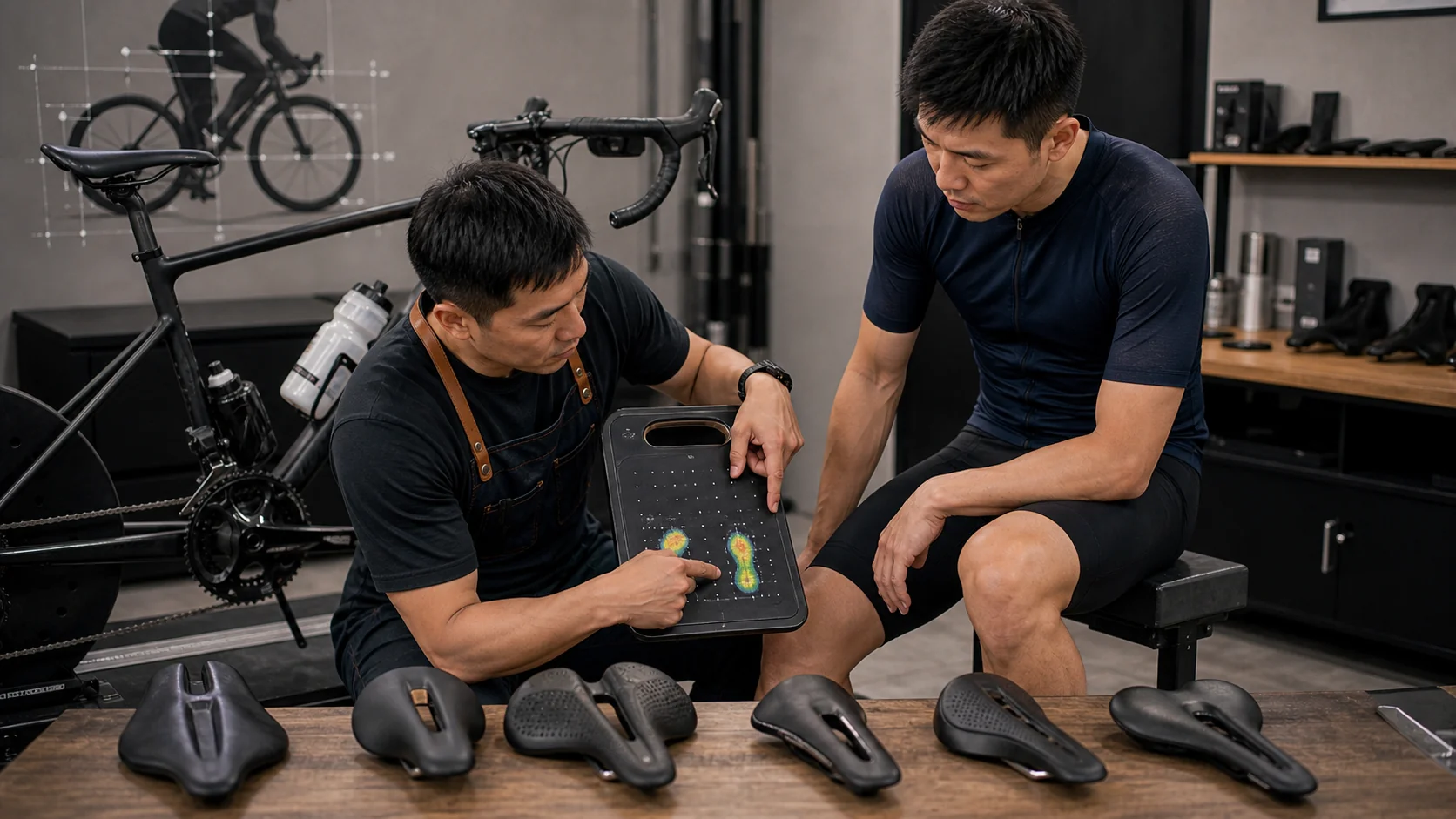
The saddle is one of your three contact points with the bike (the other two being the handlebars and pedals), yet it bears most of your body weight. An ill-fitting saddle not only affects comfort but can also lead to:
- Perineal numbness
- Sit-bone pain
- Skin chafing
- Long-term urological issues
Measuring Sit-Bone Width
Why Does Sit-Bone Width Matter?
A saddle is designed so that your sit bones (ischial tuberosities) bear your weight, rather than the soft tissue. If a saddle is too narrow, your sit bones will fall off the edges of the saddle, forcing the soft tissue to absorb excessive pressure.
How to Measure
- Prepare a piece of corrugated cardboard
- Place it on a hard chair and sit on it for about 10 minutes
- Stand up and look for the two indentation marks on the cardboard
- Measure the distance between the centers of the two indentations
- Add 20-25mm = your recommended saddle width
The average adult male has a sit-bone width of about 110-150mm, while females average about 120-160mm.
Saddle Shapes
Flat Saddles
- Suited to riders with a more aggressive forward pelvic tilt (a low, aero position)
- Provide more room for side-to-side movement
- Suited to a race-oriented riding position
Curved Saddles
- Suited to a more upright riding position
- Provide better stability
- Suited to comfortable long-distance riding
Center Channel / Cutout Saddles
- Relieve pressure on the perineal area
- Suitable for nearly everyone
- The mainstream design of modern saddles
Short-Nose Saddles
- Designed specifically for a more forward-leaning riding position
- A popular choice for triathlon and time-trial bikes
- Offer more room for fore-aft adjustment
Saddle Angle Adjustment
Basic Principles
- Starting position: Level the saddle (confirm with a spirit level)
- Fine-tuning: Tilting the nose down slightly by 1-2 degrees is often more comfortable
- Fore-aft position: The knee should be positioned directly above the pedal spindle
- Height: The knee should be bent about 25-30 degrees at the bottom of the pedal stroke
Common Mistakes
- Saddle nose tilted down too much → you keep sliding forward, increasing pressure on the hands
- Saddle nose tilted up → excessive pressure on the perineal area
- Saddle too high → the pelvis rocks side to side
- Saddle too far forward → increased pressure on the knees
Recommended Brands (2025)
- Fizik: Argo Vento / Argo Tempo (short-nose), Antares (traditional)
- Specialized: Power (short-nose), Romin (traditional), paired with Retul fitting
- PRO: Stealth / Griffon series
- Selle Italia: SLR Boost (short-nose), Flite Boost
Advice for Beginners
- Measure your sit-bone width first — this is the most fundamental step
- Prioritize saddles with a center channel or cutout design
- Don’t chase the lightest saddle — comfort always comes first
- Give a new saddle at least 5-10 rides to break in
- If discomfort persists, consider a professional bike fitting
