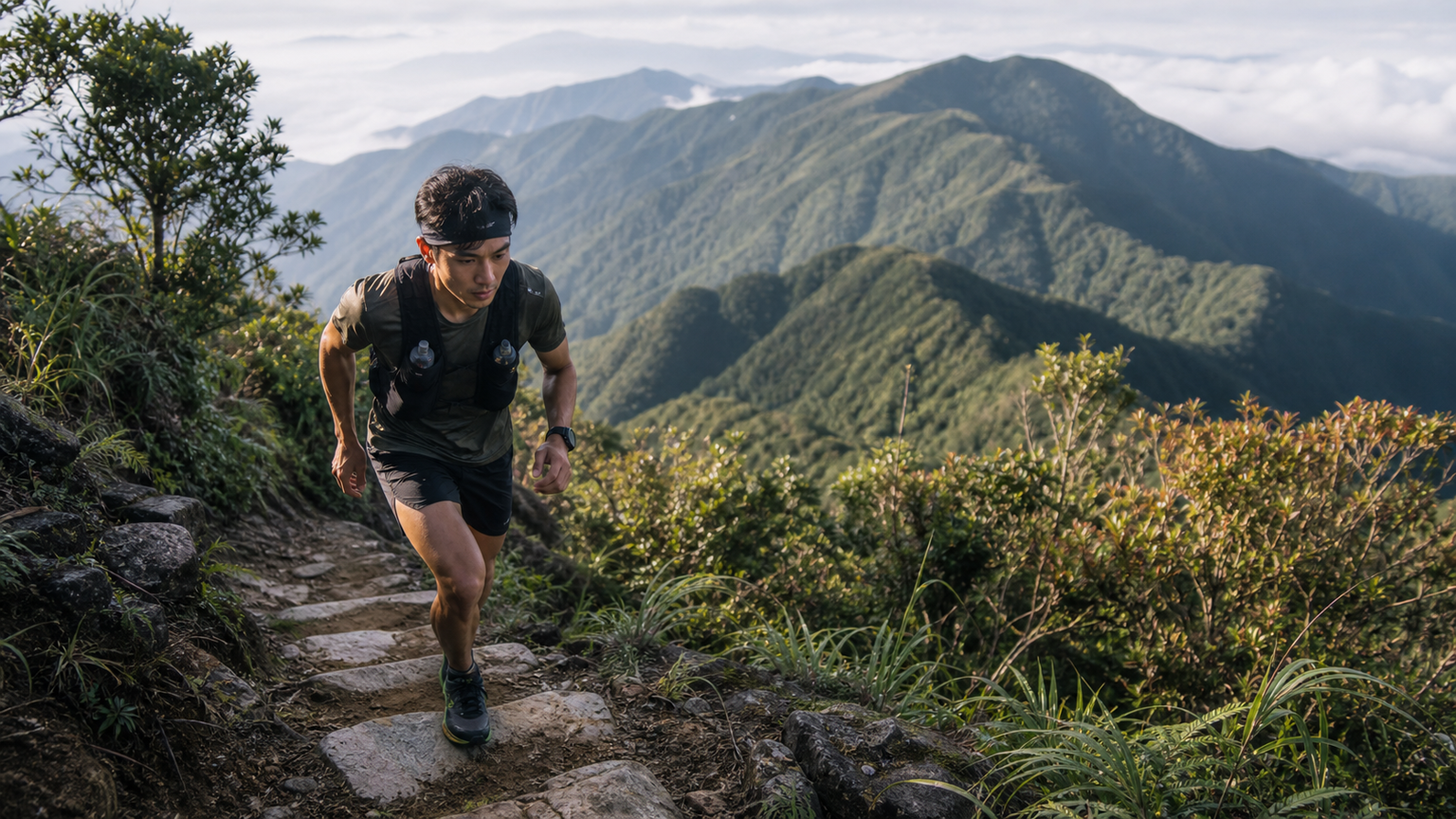
Mountain Marathon Training: Climbing Power, Technique, and How to Prepare in Taiwan
Mountain marathons (Mountain Marathon / Trail Running) are not just about running — they are a dialogue between the runner and the mountain. Complex terrain, high elevation gain, and technical sections make mountain marathons one of the most demanding and fascinating disciplines in the running world.
The Fundamental Differences Between Mountain and Road Marathons
| Comparison Item | Road Marathon | Mountain Marathon |
|---|---|---|
| Performance measurement | Absolute time | Time + elevation-gain weighting |
| Pacing strategy | Mostly even pace | Dynamically adjusted to terrain |
| Physical demands | Aerobic endurance dominant | Climbing power + technique combined |
| Gear | Running shoes suffice | Trail shoes + mandatory gear |
| Weather impact | Minor | Very significant (unpredictable mountain weather) |
Building Climbing Power
What Is Climbing Power?
Climbing power is the ability to maintain efficient movement on slopes, encompassing:
- Uphill running power: Maintaining a run on gradients below 10%
- Power-hiking efficiency: On gradients above 10%, fast hiking is often more energy-efficient than running
- Climbing endurance: The ability to sustain long, high-elevation climbs (1,000 meters or more)
Climbing Training Methods
1. Hill Repeats
Find a slope with an 8–15% gradient and 300–500 meters in length:
- Run hard uphill, then jog back down easily (recover on the descent, no rest)
- Sets: 6–12 repetitions
- Frequency: 1–2 times per week
- Effect: Develops explosive uphill power in fast-twitch muscle fibers
2. Long-Climb Endurance Training
Find a route with a continuous climb of 500–1,000 meters:
- Maintain a comfortable aerobic pace (conversational pace) the entire way up
- Frequency: Once per week
- Effect: Builds climbing endurance and muscular efficiency
3. Vertical Kilometer (VK) Training
A session covering 1,000 meters of vertical gain within 1 kilometer of horizontal distance:
- This is the standard test for assessing climbing ability
- Elite runners: Complete a VK in 40–50 minutes
- Average amateurs: 60–90 minutes
Climbing Training Routes in Taiwan
| Route | Elevation Gain | Highlights |
|---|---|---|
| Qixing Mountain, Yangmingshan | Approx. 600 m | Most convenient climbing training in Taipei |
| Datun Mountain | Approx. 800 m | Expansive views |
| Hehuan Mountain trailhead–Wuling | Approx. 2,000 m | High-altitude acclimatization |
| Xue Mountain Main Peak | Approx. 2,400 m | Technical mountaineering |
| Qilai Main & North Peaks | Approx. 2,000 m | Advanced trail training |
Downhill Technique
Why Downhill Technique Matters
Many runners train uphill diligently but neglect downhill technique. In reality, descents account for 30–40% of total race time in mountain marathons, and downhill running is the biggest source of muscle damage — particularly to the quadriceps.
Key Elements of Downhill Running Technique
1. Stride Adjustment
- Shorten your stride (30–40% shorter than on flat ground)
- Increase cadence
- Land on the midfoot, avoiding hard heel strikes
2. Body Position
- Lean slightly forward (do not lean back — leaning back is a braking posture)
- Extend your arms to aid balance
- Look 1–2 meters ahead to read the terrain
3. Technical Sections
- Rocky terrain: Step on the stable surfaces of rocks; do not hesitate
- Muddy terrain: Slow down, shorten your stride, and use grass roots and rocks as footholds
- Steep slopes (over 30%): Consider switchbacking or using your hands as well
Downhill Training Methods
Beginners: Practice relaxed downhill running on gentle slopes (10–15%), twice a week, 10–15 minutes per session
Intermediate: Perform technical descents on moderate slopes (20–25%), focusing on stride and posture
Advanced: Challenge your speed limits on steep slopes (30%+) or technical rocky sections
Mandatory Gear and Safety
Most mountain marathons require runners to carry mandatory gear:
| Gear | Function |
|---|---|
| Emergency blanket | Emergency warmth |
| First-aid kit | Basic wound care |
| Extra food (300+ kcal) | Emergency fuel |
| Waterproof jacket | Wind and rain protection |
| Headlamp (with spare batteries) | Nighttime safety |
| Mobile phone (fully charged) | Emergency contact |
| Map / route instructions | Navigation |
Mountain Marathon Events in Taiwan
| Event | Distance | Elevation Gain | Difficulty |
|---|---|---|---|
| Taroko Gorge Marathon | 42 km | 600 m | ★★★★☆ |
| Beidawu Mountain Trail Run | 50 km | 3,000 m | ★★★★★ |
| Hehuan Mountain Ultra Race | 30 km | 1,500 m | ★★★★☆ |
| Qilai Mountain Run | 25 km | 2,000 m | ★★★★★ |
| Alishan Forest Trail Run | 20 km | 800 m | ★★★☆☆ |
Key Takeaways for Race Preparation
- Prioritize climbing power: It is the most essential physical quality for mountain marathons
- Downhill technique: Train descents systematically to protect your knees and improve your time
- Taiwan’s terrain advantage: Taiwan is mountainous, so quality trail training grounds are always within reach
- High-altitude acclimatization: If the race is above 2,000 meters, acclimatize in advance
- Gear familiarity: Do long training runs in your full race-day kit before the event
Taiwan’s abundant mountain resources make it a natural training ground for developing trail-running ability. From the hills of Yangmingshan to the rugged peaks of the Central Mountain Range, Taiwan’s runners enjoy an unmatched training environment!
Related Reading
- Trail Race Guide: Trail Technique, Hydration Packs, and Calculating Elevation Gain
- Climbing Training for Ultramarathons: How to Prepare for High-Cumulative-Gain Trail Races
- Trail Running Technique and Strategy: A Complete Guide to Uphill/Downhill Running, Terrain Reading, Gear, Navigation, and Safety
- Climbing Endurance Training: Sustained Output on Long Climbs and Cardiorespiratory Adaptation
2025 乘鞍岳登山賽 比賽全紀錄篇 / 完整路線攻略介紹 / 日本版武嶺 公路最高點 / 高山空拍絕景 / 明年會開團! / 公路車 / CT Yeh
10 個月前
一日北高前的高裝檢 | 北高 360 | 挑戰11小時的裝備 | 一日雙塔 | 補給
6 年前
FTL 與 SYB 車隊專訪 西進武嶺 實用攻略分享! 2小時 如何練?!你不知道的眉角!新手準備武嶺必看 EP1 | 實力派女車友 | 精華版 | 公路車 | CTYeh
4 年前
日本公路最高登山賽,台灣首位YT挑戰實錄,乘鞍登山賽40週年,賽前篇完整版,請到我的YT收看 #公路車 #cycling
11 個月前
2025 乘鞍 KOM 登山賽挑戰實錄 / 日本公路最高 ! 賽前探路篇 / 比富士山厲害,無敵絕景!/ 40週年 / 中文YT首發 / 公路車 / CT Yeh #乘鞍ヒルクライム
11 個月前
西進武嶺 自製新版AI配速表產生器 x 賽前攻略 抱佛腳! 沒有功率計也可以產生配速表嗎?有什麼其他眉角賽前要注意的呢? | 西進武嶺 / 東進武嶺 KOM 攻略 | 公路車 | CT Yeh
4 年前
一日北高/長距離團騎 常見問題補充篇 / 組團或跟團的眉角 / 壯車友容易被瘦車友慢性拉爆 / 原來屁股痛可能是這個原因...? / 風場配速法 / 公路車 / CT Yeh
2 年前
西進武嶺 免費訓練分析服務 Intervals | 練不夠還是練過頭?你哪一種類型選手?AI模型告訴你! | 備戰神器 | 公路車 訓練 | CT Yeh
4 年前