Why Runners Need Specific Core Training
“Strengthen your core” is advice every runner has heard, but many people walk into the gym and start doing sit-ups and crunches. These movements work for six-pack abs, but they offer limited improvement in running efficiency and may even cause postural problems.
The core demands of running differ from bodybuilding or general fitness. During running, the core’s primary function is anti-rotation stability—maintaining pelvic and spinal stability against the impact of each footstrike, preventing energy loss through rotational twisting.
Three Key Functions of Core Stability for Runners
Function One: Pelvic Stability
With every footstrike, the ground delivers an impact force of 3–5 times body weight. If the gluteus medius (hip abductor) is not strong enough, the pelvis will drop on the landing side (Trendelenburg Gait), causing:
- Energy waste (lateral sway with every step)
- Iliotibial band syndrome (pain on the outside of the knee)
- Lower back pain
Function Two: Torso Anti-Rotation
During running, the arms swing forward and backward, driving the body forward. Elite runners can effectively convert the kinetic energy of the arms into propulsion, relying on the core’s anti-rotation stability: the obliques, erector spinae, and multifidus work together so that energy is not lost in twisting.
Function Three: Energy Transfer Between Upper and Lower Limbs
Propulsive force from the legs needs to be transmitted through a stable core to the upper body (and vice versa). For runners with an unstable core, part of the force generated by the legs dissipates through pelvic sway, reducing running efficiency.
Eight Most Effective Core Exercises for Runners
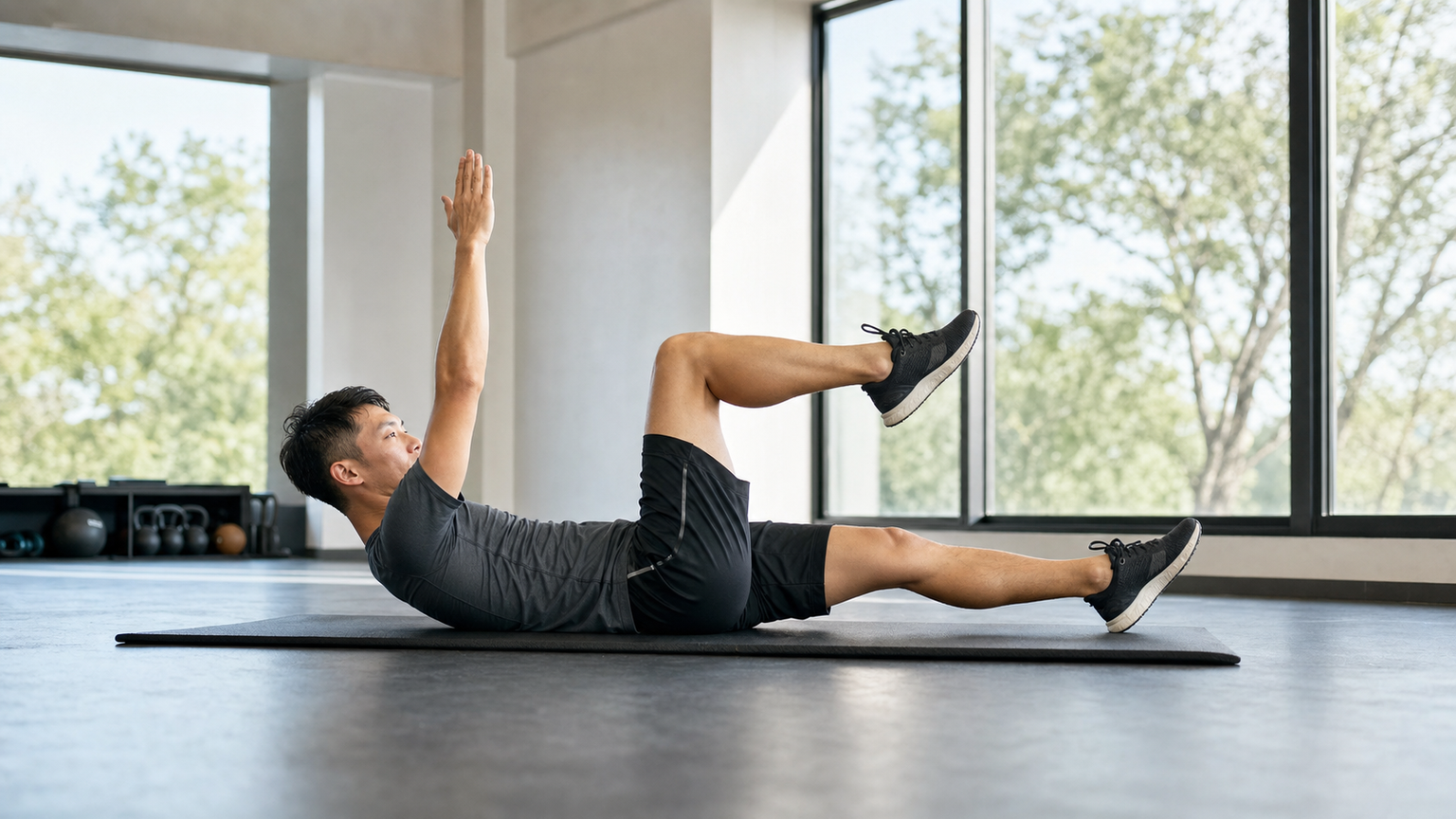
Exercise One: Dead Bug ⭐⭐⭐
Why it suits runners: Trains the abdominals to maintain spinal stability while the limbs move, closely mimicking the neuromuscular pattern of running.
How to perform:
- Lie on your back, arms pointing vertically toward the ceiling, legs raised with knees bent at 90 degrees
- Keep your lower back pressed firmly against the floor
- Slowly extend your right arm overhead while straightening your left leg forward
- Return to the starting position, then switch sides
- 10 reps per set, 3 sets
Key point: The lower back must not lift off the floor. This is the hardest part for most people when first attempting the Dead Bug.
Exercise Two: Plank ⭐⭐
Why it suits runners: Isometric training of the transversus abdominis, building the foundation of core stability.
Proper form:
- Elbows directly under the shoulders
- Body forms a straight line from head to heels
- Hips should not be too high or sagging
- Avoid holding your breath; breathe normally
- 30–60 seconds per set, 3 sets
Progression: Dynamic Plank (alternating elbow extension to push-up position)
Exercise Three: Side Plank ⭐⭐⭐
Why it suits runners: Directly trains the gluteus medius and obliques for pelvic stability, particularly effective for preventing iliotibial band syndrome.
How to perform:
- Lie on your side, supporting elbow under the shoulder
- Lift your hips so the body forms a straight line
- Hold for 60 seconds, then switch sides
- Repeat for 3 sets
Progression: Side Plank with Leg Raise (raise and lower the top leg to increase gluteus medius workload)
Exercise Four: Bird Dog ⭐⭐⭐
Why it suits runners: Trains diagonal muscle coordination, highly similar to the running gait pattern.
How to perform:
- Start on all fours, keeping the spine neutral
- Extend your right arm and left leg simultaneously
- Hold for 2–3 seconds, then return to the starting position
- Switch sides (left arm, right leg)
- 10 reps per set, 3 sets
Exercise Five: Glute Bridge ⭐⭐⭐
Why it suits runners: Strengthens the gluteus maximus and gluteus medius, the most important propulsive muscle groups for running.
How to perform:
- Lie on your back, knees bent, feet flat on the floor
- Lift your hips to form a straight line
- Squeeze the glutes at the top for 2 seconds
- Lower slowly
- 15 reps per set, 3 sets
Progression: Single-Leg Glute Bridge (more specific to running)
Exercise Six: Walking Lunges ⭐⭐
Why it suits runners: Dynamic single-leg support mimics the running stance while training the glutes and balance.
20 steps per set, 3 sets
Exercise Seven: Superman ⭐⭐
Why it suits runners: Strengthens the erector spinae in the lower back, effective for maintaining posture in the later stages of long runs.
How to perform:
- Lie face down, arms and legs extended
- Lift both arms and legs simultaneously
- Hold for 2 seconds, then lower
- 12 reps per set, 3 sets
Exercise Eight: Copenhagen Plank ⭐
Why it suits runners: Trains the hip adductors, an advanced exercise for preventing groin injuries. Suitable for those with a solid core training foundation.
Runner’s Core Training Program
| Training Days | Exercise Combination | Total Duration |
|---|---|---|
| 2–3 times per week | Dead Bug + Side Plank + Bird Dog + Glute Bridge | 20–25 minutes |
| Advanced Version | The above + Single-Leg Glute Bridge + Dynamic Plank | 30–35 minutes |
Best training timing: Immediately after a run, or on rest days. Not recommended before running (fatigue may compromise running form).
Common Core Training Myths
Myth One: Sit-ups are the best core training for runners
Sit-ups are effective for flexion movements, but running requires “anti-flexion stability.” Dead Bug and Plank better match the demands of running.
Myth Two: The core is only the abdominals
The running core includes the abdominals (transversus abdominis, rectus abdominis, obliques), the back (erector spinae, multifidus), and the glutes (gluteus maximus, gluteus medius) as a complete muscle group.
Myth Three: More core training is always better
Core stability training prioritizes quality over quantity. 2–3 times per week, 25–30 minutes per session, far outperforms doing sit-ups every day.
Conclusion
Core training for runners is “functional stability training,” not a pursuit of six-pack abs. Start with the Dead Bug, Side Plank, and Bird Dog. After 8–12 weeks of consistency, you will notice a more stable pelvis, greater lower back comfort, and more even pacing while running—this is the true value of core training for runners.
Related Reading
[教學] Premiere 影片 手震 修正 教學 防抖 單眼 影像 GoPro 穩定 Video Stabilization
8 年前
#公路車 #Fitting 靠人工智慧APP 幫你調整單車
6 年前
多機位拍片神器 DJI Action 2 拍出速度張力感 | 類空拍機視角 4陣列麥克風超強降風噪 實測! | 公路車 | CT Yeh
3 年前
實景訓練台) 彰化經典百K 高強度喵團 90分鐘 跟著一起練功 2019 Indoor workout Changhua Classic 100 Taiwan
7 年前
西進武嶺 免費訓練分析服務 Intervals | 練不夠還是練過頭?你哪一種類型選手?AI模型告訴你! | 備戰神器 | 公路車 訓練 | CT Yeh
4 年前
類空拍神器 Feiyu Pocket 2s (有優惠連結)三軸穩定 運動攝影機 開箱!比GoPro 還強的滑順視角!三小時長時間錄影 行車記錄器 | 環花東365實測 | 公路車 CT Yeh
4 年前
iPhone 13 Pro 電影級 VLOG 實拍測試!優缺點 原理分析! 夜間效果對決 GoPro10!蘋果沒有說的超強錄影體驗!? | CT Yeh
4 年前
大家都在開箱的...單車用藍芽對講耳機真的有幫助嗎? SENA BiKom 20 長距離旅遊 & 海鷗繞圈賽 實際體驗心得 / 公路車 / CT Yeh
9 個月前