Swimmer Dry-Land Strength Training: A Balanced Design for Shoulder Health, Posterior Chain Propulsion, and Core Alignment
The Core Contradiction of Dry-Land Training for Swimmers
Swimming propulsion relies heavily on the shoulder joint, yet swimming itself is a high-risk sport for shoulder overuse injuries (“swimmer’s shoulder,” shoulder impingement/rotator cuff tendinopathy). A swimmer may perform thousands of strokes per training session. Therefore, the primary goal of dry-land strength training is not “more pushing power,” but balance: while strengthening pulling propulsion, consolidate scapular stability and the posterior rotator cuff, pulling the shoulder joint back from the trajectory of imbalance and injury.
Three-Axis Design Framework
| Axis | Goal | Representative Exercises | Ratio |
|---|---|---|---|
| Shoulder Health | Scapular stability, external rotator balance | Face pulls, Y-T-W, external rotation bands | More than pushing |
| Pulling Propulsion | Lats, posterior deltoid pulling power | Pull-ups, cable lat pulldowns, straight-arm pulldowns | Main focus |
| Core Alignment | Streamline anti-rotation, anti-extension | Dead bugs, cable chops, advanced planks | Integration |
Golden Rule: Training volume for pulling and external rotation should be greater than pushing (bench-press type movements), to counteract the imbalance swimming itself creates—overdeveloping internal rotation and the anterior chain while weakening external rotation and the posterior chain. Many cases of swimmer’s shoulder stem from this imbalance being amplified by mistakenly adding more bench pressing on land.
Shoulder Health First: The Non-Negotiable Appetizer
Before the main session, schedule 8–10 minutes of shoulder preparation:
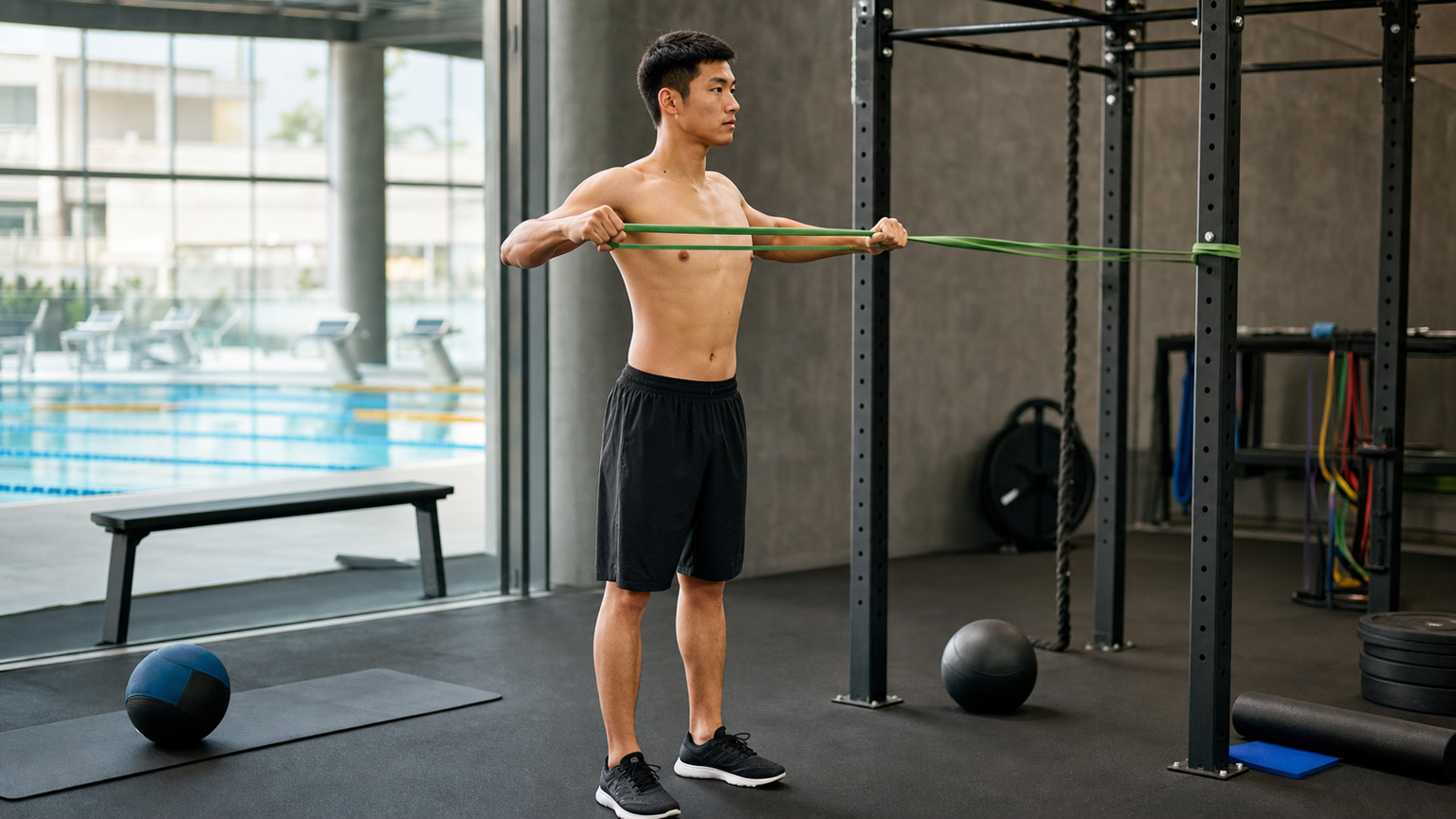
- Resistance band external rotation 3x15/side (controlled and slow—the rotator cuff is built on quality, not load)
- Prone Y-T-W scapular work 3x10 in each direction
- Face pulls 3x15, elbows above shoulder, emphasizing scapular retraction and depression
This is not a perfunctory warm-up; it is the highest-return segment of dry-land training for swimmers.
Main Session: Propulsive Strength
- Pull-ups / assisted pull-ups 4x6–8 (the lats are the primary propulsive muscle in freestyle)
- Cable straight-arm pulldowns 3x10, mimicking the high-elbow catch position of hand entry
- Single-arm dumbbell rows 3x8/side (also addressing anti-rotation core)
- Posterior chain: Romanian deadlifts 3x8, the lower-body strength foundation for wall pushes and starting block dives
Core Streamline Integration
Low water resistance in swimming comes from maintaining a straight body line while resisting torsional forces during roll:
- Dead bugs, opposite arm and leg 3x8 (anti-extension)
- Kneeling cable chops 3x10/side (anti-rotation, directly corresponding to not leaking power in the stroke)
- Plank with shoulder taps 3x20 seconds (anti-rotation + shoulder stability)
Lower-Body Explosiveness for Starts and Turns
Don’t overlook wall push-offs and dive starts—these are quantifiable time differences in competition:
- Box jumps / squat jumps 4x4 (explosive, with controlled posture)
- Isometric wall-sit peak holds 4x30 seconds (simulating the isometric tension of the starting block ready position)
Programming and Recovery
- Avoid stacking heavy shoulder-loading sessions on high-volume swimming days; rotator cuff recovery demands are high.
- Twice weekly dry-land sessions of 40 minutes each is sufficient; excessive dry-land work will erode recovery for pool technique training.
- Pre-competition tapering: keep the shoulder health appetizer as usual, reduce the main session volume while maintaining quality.
If there is only one thing to remember about dry-land training for swimmers, it is this: your shoulders are both the engine and the most fragile part—protect them first, then talk about propulsion.
“Swimmer’s shoulder is rarely broken in the pool; it’s often the result of an imbalance created on land by adding a bunch of bench presses while doing zero external rotation work. For swimmers, pulling must always outweigh pushing.” —An athletic trainer and strength coach for aquatic sports
Related Reading
- Dry-Land Strength Training for Swimmers: Balancing Shoulder Health and Pulling Propulsion
- Dry-Land Strength Training for Swimming: An Evidence-Based Menu for Lats, Core Anti-Rotation, and Shoulder Health
- Swimmer’s Shoulder Stability Training: Key Movements to Prevent Rotator Cuff Injuries
- Shoulder Strengthening for Swimming: Preventive Training for the Rotator Cuff
[教學] Premiere 影片 手震 修正 教學 防抖 單眼 影像 GoPro 穩定 Video Stabilization
8 年前
西進武嶺 免費訓練分析服務 Intervals | 練不夠還是練過頭?你哪一種類型選手?AI模型告訴你! | 備戰神器 | 公路車 訓練 | CT Yeh
4 年前
一起升級!海鷗盃LSD團練...JJSC Zone2招待 騎到手抖 / 公路車 / CT Yeh
2 天前
一日北高/長距離團騎 常見問題補充篇 / 組團或跟團的眉角 / 壯車友容易被瘦車友慢性拉爆 / 原來屁股痛可能是這個原因...? / 風場配速法 / 公路車 / CT Yeh
2 年前
CT 喇低賽) 武嶺牽車 才是王道 西進牽車四小時內秘訣 攝手位置 如何判斷 防抽筋小秘訣
7 年前
類空拍神器 Feiyu Pocket 2s (有優惠連結)三軸穩定 運動攝影機 開箱!比GoPro 還強的滑順視角!三小時長時間錄影 行車記錄器 | 環花東365實測 | 公路車 CT Yeh
4 年前
福隆鐵人團練隨拍
8 年前
FTL 與 SYB 車隊專訪 西進武嶺 實用攻略分享! 2小時 如何練?!你不知道的眉角!新手準備武嶺必看 EP1 | 實力派女車友 | 精華版 | 公路車 | CTYeh
4 年前