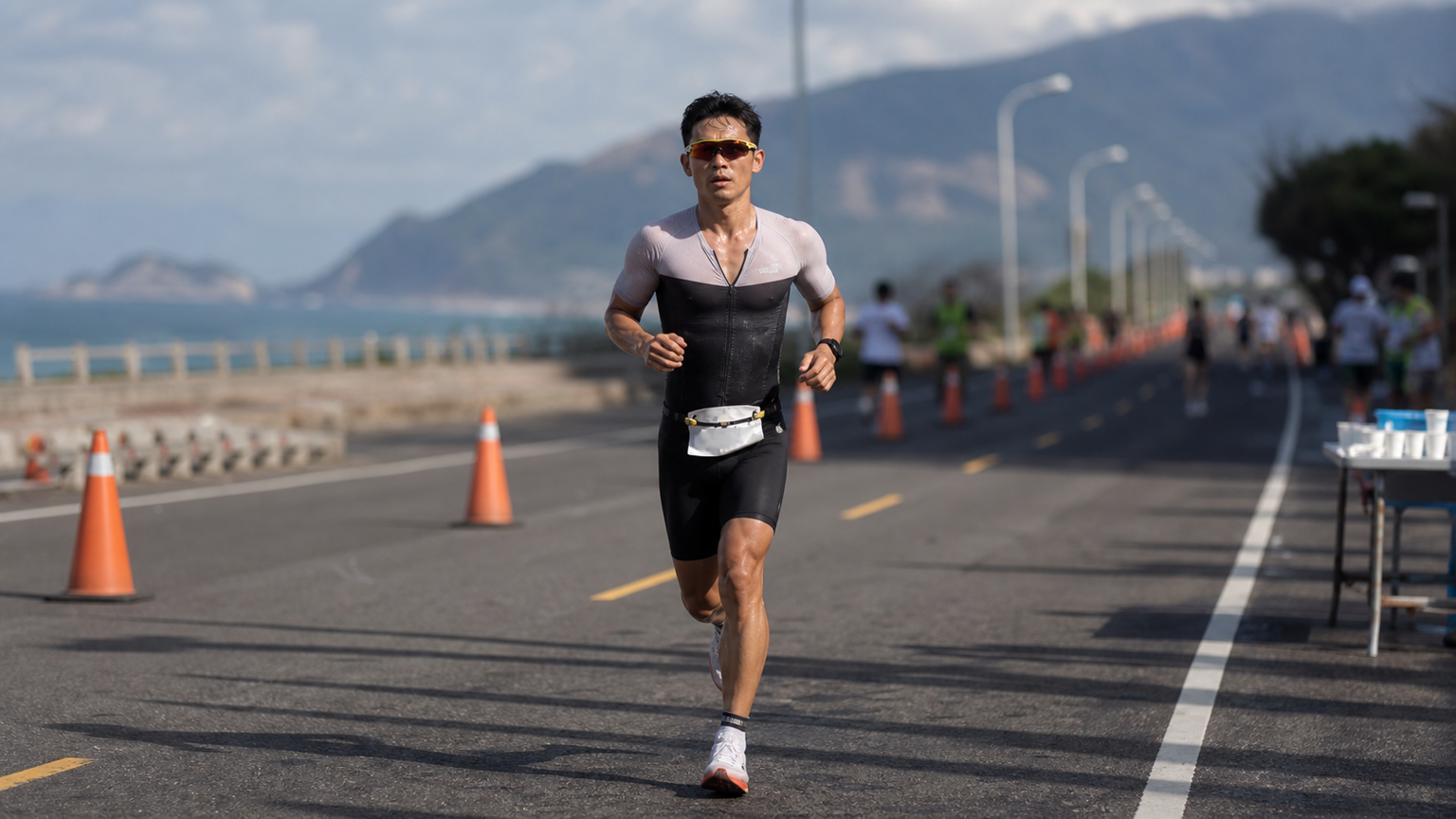
The Brain Is the Limiter
Central regulation theory suggests that the decision to “slow down” during fatigue comes from the brain’s assessment of risk, not from muscles that are truly unable to move. The mental skill in triathlon is learning to negotiate with this regulator.
Three Key Mental Tools
| Tool | Purpose | Application |
|---|---|---|
| Chunking | Break the whole into parts | Only think about the next aid station |
| Reframing inner dialogue | Stop the negative spiral | Replace “I’m dying” with “I chose to be here” |
| Rehearsing the dark place | Reduce panic | Prepare your go-to phrases before the race |
Chunking in Practice
Don’t think “28km to go”—think “just make it to the next utility pole” or “run this 1km, then drink.” Cut the marathon into eight 5km segments, and give yourself a small reward for each one completed (a sip of cola, a 20-second walk).
The Dark Place Coping Script
Every long-distance triathlon has a low point where you want to quit, usually hitting between 25–32km of the IM marathon. Before race day, write three phrases on a card and tuck it behind your race number: for example, “You’ve practiced this moment a thousand times,” “Slow is still forward,” and “Think of the person at the finish line.”
Reframing Inner Dialogue
Change “I can’t hold on” into a question—“What can I do right now to make myself more comfortable?”—because questions activate problem-solving mode, while statements reinforce a sense of victimhood.
Switching Between Three Attentional Strategies
Sports psychology divides attention into “associative” (focusing on bodily signals) and “dissociative” (distracting the mind). Elite athletes don’t rely on just one; they switch by race segment: use dissociation during steady bike sections (listen to the course, enjoy the scenery) to save mental energy; switch to association near aid stations or pacing checkpoints (watch power, check heart rate); and during the dark place, use “shortening the time scale”—locking attention onto “the next 60 seconds” or “the next light pole.” In practice, between 28–35km of an IM marathon, athletes who actively switch strategies lose 20%–30% less pace than those who just grit through.
Principles for Designing Dark-Place Phrases (Bad vs. Good Examples)
| Situation | Ineffective Phrase (reinforces victimhood) | Effective Phrase (triggers action) |
|---|---|---|
| Want to stop | “I can’t go on” | “Walk to the next aid station, then decide” |
| Pace collapsing | “It’s all ruined” | “The only thing I can control right now is cadence” |
| Pain | “Why me” | “Pain is expected—follow the script” |
| Falling behind target | “No hope” | “There are still 90 minutes left; a lot can change” |
Phrases must be written before the race and drilled in training until they come out reflexively—if you try to think of them in the moment, your oxygen-deprived brain won’t produce anything good.
In nearly twenty years of coaching athletes’ minds, my deepest lesson is this: people who collapse before the finish line often still have plenty left in their bodies—it’s the mind that surrenders first. Cut the pain into smaller pieces, change your language, and you’ll be amazed at how much farther you can run.
Related Reading
- Running Mental Skills: Pacing Segmentation, Self-Talk, and Pain Management
- Mental Strategies for Climbing: Segment Goal Setting and Mental Splitting Techniques
- The Mental Battle of Mountaineering: How to Persevere and Break Through in the Toughest Moments
- Climbing Mental Tactics: The Segmentation Method of Breaking Long Climbs into Small Goals
西進武嶺 免費訓練分析服務 Intervals | 練不夠還是練過頭?你哪一種類型選手?AI模型告訴你! | 備戰神器 | 公路車 訓練 | CT Yeh
4 年前
單車AI教練!全新 ChatGPT4o 幫你分析訓練成果!排武嶺課表,分析騎車姿勢! 太神了! / 公路車 / CT Yeh / feat. 緯緯
2 年前
FTL 與 SYB 車隊專訪 西進武嶺 實用攻略分享! 2小時 如何練?!你不知道的眉角!新手準備武嶺必看 EP1 | 實力派女車友 | 精華版 | 公路車 | CTYeh
4 年前
西進武嶺 自製新版AI配速表產生器 x 賽前攻略 抱佛腳! 沒有功率計也可以產生配速表嗎?有什麼其他眉角賽前要注意的呢? | 西進武嶺 / 東進武嶺 KOM 攻略 | 公路車 | CT Yeh
4 年前
CT 喇低賽) 武嶺牽車 才是王道 西進牽車四小時內秘訣 攝手位置 如何判斷 防抽筋小秘訣
7 年前
福隆鐵人團練隨拍
8 年前
Never Stop 西進武嶺 前後雙機 完整全程錄影 訓練台 實境
8 年前
ThinkRider 智騎 XXPRO 訓練台,高階機種功能 只要 1/3價格!? 實測功率對比、噪音實測 / 公路車 / CT Yeh
1 年前