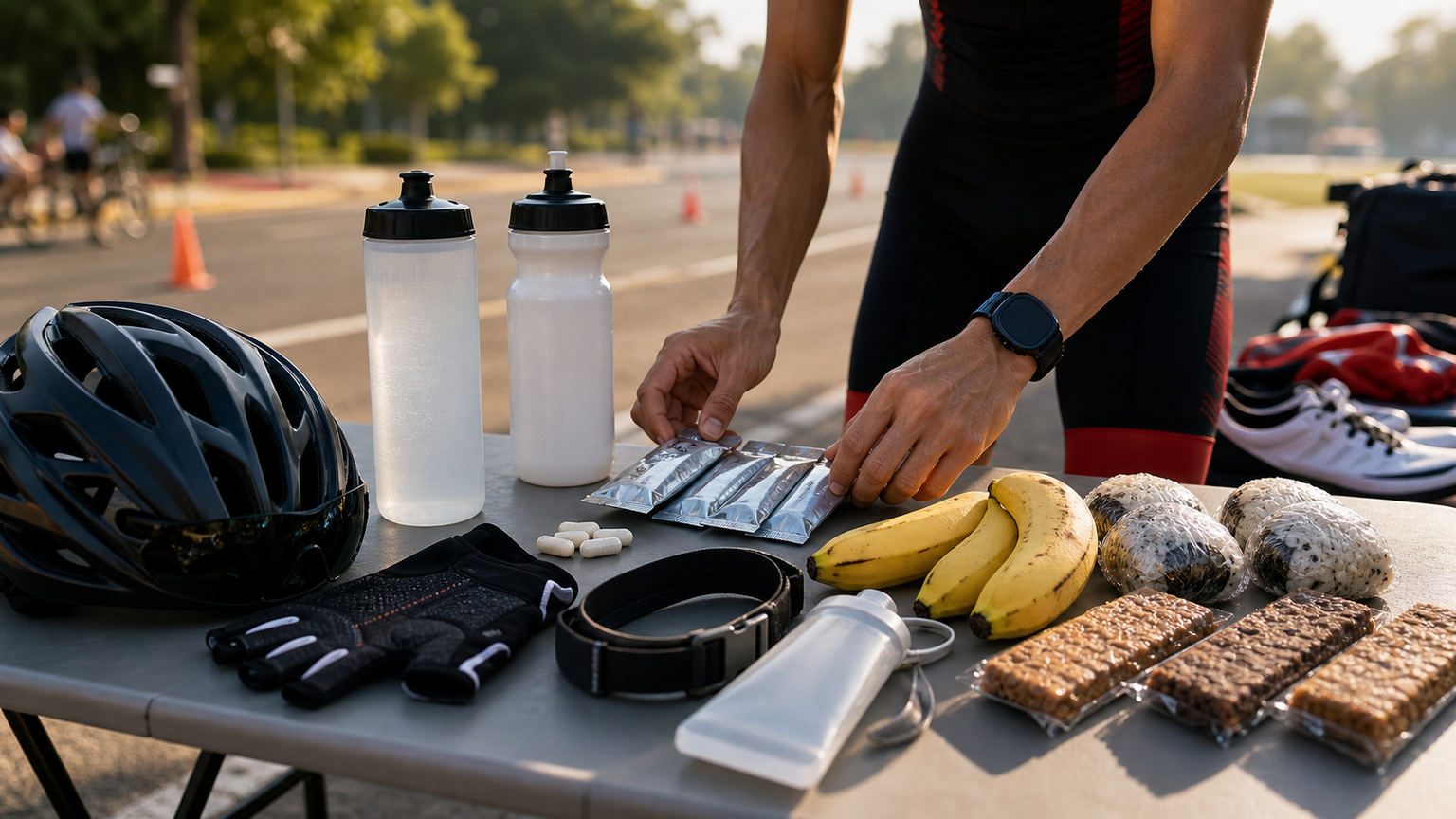
Treat the Race Like Bookkeeping: Income vs. Expenditure
Hitting the wall in an Ironman marathon is almost always the result of a carbohydrate “deficit” accumulated on the bike leg. Fueling during the 180km bike leg is the key to the entire race. At the same time, avoid the other extreme—drinking too much sodium-free water and developing hyponatremia.
Hourly Intake Targets
| Item | Bike Leg/Hour | Run Leg/Hour |
|---|---|---|
| Carbohydrates | 70–90g | 45–60g |
| Fluids | 500–750ml | 400–600ml |
| Sodium | 400–800mg | 300–600mg |
Solid-to-Liquid Ratio on the Bike Leg
Relying purely on energy gels for 5 hours will make you sick of them. It’s recommended that solids (energy bars, bananas, rice balls) make up 40% of carbohydrate intake on the bike leg, with liquids and gels at 60%. Eat more solids in the first half and switch to liquids in the second half.
Red Flags for Hyponatremia
If you only drink water without replacing sodium, combined with heavy sweating, you may experience headache, nausea, and confusion—this is hyponatremia, not dehydration, and drinking more water will make it worse. How to tell: your weight during the race shouldn’t drop significantly, nor should it rise more than 2%.
The “Eat When You Can” Principle for the Run Leg
Gastric emptying slows during the marathon, so switch to small, frequent meals: alternate half a cup of cola, salt tablets, and soup at each aid station, using variety to combat taste fatigue.
A Full Carbohydrate and Sodium Ledger for a 13-Hour Finish
Based on a 70kg athlete with a 5:30 bike + 5:00 marathon: the bike leg needs 5.5h × 80g/h ≈ 440g of carbohydrates and about 3000mg of sodium; the marathon leg needs 5h × 50g/h ≈ 250g of carbohydrates and about 2200mg of sodium. The total is roughly 690g of carbohydrates, 5200mg of sodium, and 9–11L of fluids. In real-world terms, that’s about 14 gels + 4 energy bars + 6 cans of sports drink + 10 salt tablets—this must be practiced before race day so you don’t find yourself unable to eat or forgetting supplies on the spot. Write it out as an itemized list for your transition bags and special needs bags, and check it off station by station.
Phase Shifts in the Solid-to-Liquid Ratio on the Bike Leg
| Bike Leg Time | Primary Source | Reason |
|---|---|---|
| 0–2h | 50% solids (rice balls/energy bars) | Stomach still tolerates it, needs solid satiety |
| 2–4h | 30% solids + gels + drinks | Starting to get sick of it, shift to semi-liquid |
| 4h to T2 | Mainly gels + drinks, ≤20% solids | Preserve stomach capacity for the run |
Taste fatigue is a real physiological phenomenon—be sure to prepare salty (salt crackers, soup) and sour (plums, cola) items to “reset” your palate, or every bite in the later stages will be torture.
Ironman isn’t a fitness race, it’s a digestion race. I’ve coached athletes who broke 10 hours, and they ate nonstop on the bike leg like it was a banquet. A stomach that can still absorb properly at 180km is worth more than legs with an extra 20W.
Related Reading
西進武嶺 免費訓練分析服務 Intervals | 練不夠還是練過頭?你哪一種類型選手?AI模型告訴你! | 備戰神器 | 公路車 訓練 | CT Yeh
4 年前
CT暗黑廚房) 車友必備 宇宙無敵鮮蚵湯 幫助訓練恢復 天然食補 好市多 超肥鮮蚵 破PR
7 年前
水金九不厭五分 10度寒流冷到不願停!feat. 卡卡 / 公路車 / CT Yeh
6 個月前
CT 喇低賽) 武嶺牽車 才是王道 西進牽車四小時內秘訣 攝手位置 如何判斷 防抽筋小秘訣
7 年前
#公路車 #西進武嶺 配速配瓦實驗 坡度分析 四小時內攻略 建大盃 NeverStop #西進武嶺攻略
6 年前
一日北高前的高裝檢 | 北高 360 | 挑戰11小時的裝備 | 一日雙塔 | 補給
6 年前
雨戰! 西進武嶺員工旅遊 加料 各路段大數據分析 | 同事端出5公斤的公路車來挑戰!? EP1
4 年前
半日 小台灣 極限單車路線挑戰實錄
7 年前