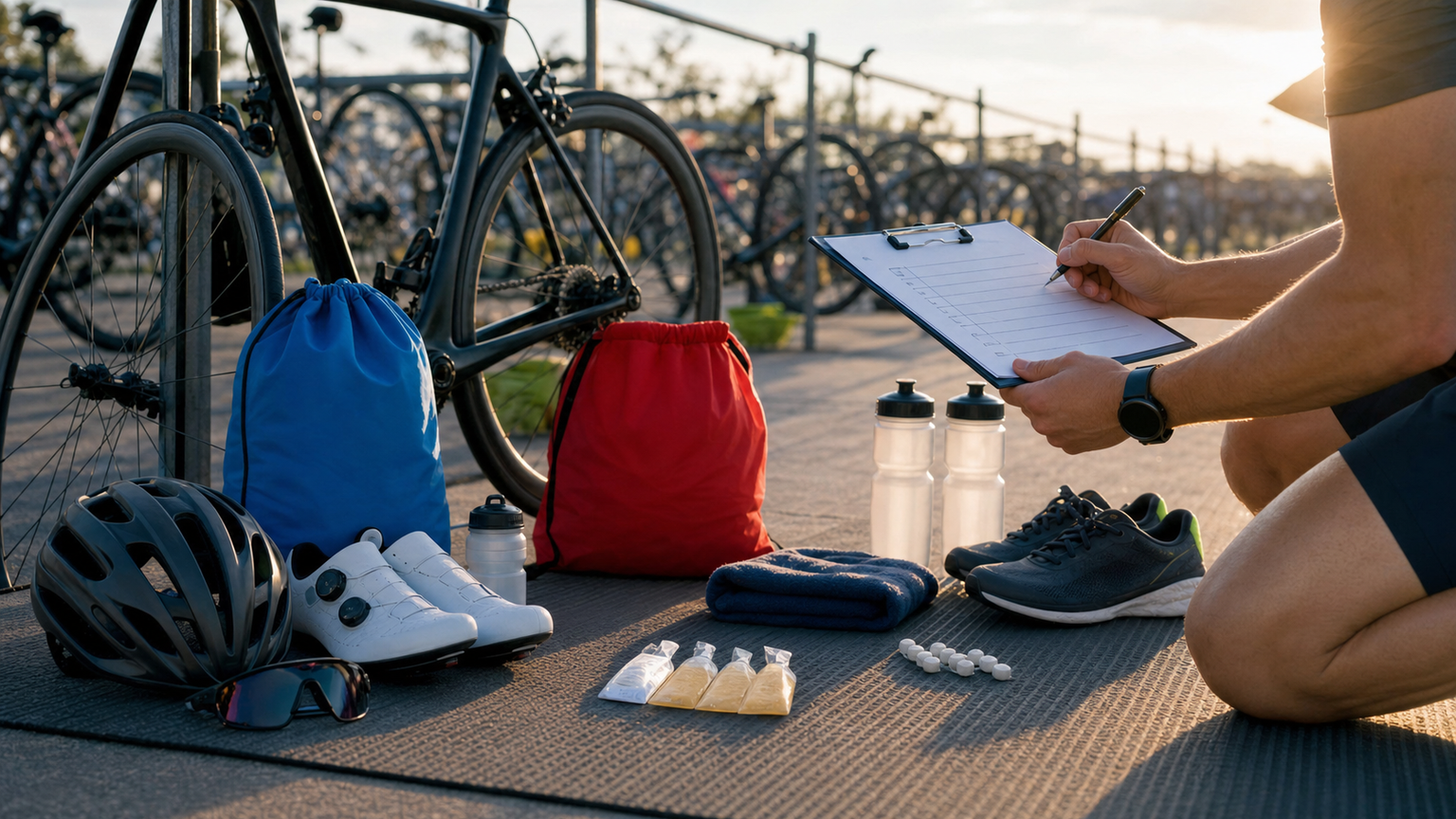
Logistics: The Least Glamorous Yet Most Critical Link
Many 70.3/IM races require you to drop off your bike and transition bags the day before. Packing with missing items, sending bags to the wrong place, or being unfamiliar with the process can create devastating chaos before the start—and all of this can be completely avoided with standardization.
Standard Transition Bag Checklist
| Bag | Contents |
|---|---|
| Bike Transition Bag (T1) | Helmet, sunglasses, cycling shoes, nutrition, sunscreen |
| Run Transition Bag (T2) | Running shoes, race belt, hat, nutrition, salt tablets |
| Post-Race/Special Needs Bag | Change of clothes, warm layers, cash, phone |
Packing Golden Rule: Checklist + Two-Person Verification
Check off each item on a paper checklist for every bag, and ideally have a teammate/family member double-check it. Most commonly forgotten: race belt, sunglasses, running shoe insoles, and post-race warm clothing.
Logistics Timeline
Day before the race: bike inspection → bike drop-off → transition bag drop-off → confirm transition area flow. Write down every check-in cut-off and arrive 30 minutes early—never cut it close.
Transition Area Flow Rehearsal
After dropping off your bags, actually walk the route: swim exit → T1 bag location → bike rack position → mount line → dismount line → T2 bag → run exit. Mentally rehearse your race-day movement path.
Race Morning Minimalist Principle
On race morning, only handle things that “can’t be done the day before” (topping up tire pressure, placing nutrition, warming up). Everything else should be completed the day before to reduce race-morning decision load.
Redundancy Mindset
Prepare backup items: swim goggles ×2, CO2/inflator, and 20% extra nutrition. The goal of logistics isn’t to have just enough—it’s to survive even when things go wrong.
Logistics Timeline: Arrive 30 Minutes Before Every Cut-off
Many 70.3/IM races require you to drop off your bike and transition bags the day before. Missing items, racking in the wrong spot, or being unfamiliar with the process can create devastating chaos before the start. The standardized approach: the day before, complete in order bike inspection → bike drop-off → transition bag drop-off → walk the transition area flow, and write down every check-in cut-off, arriving 30 minutes early—never cut it close. On race morning, only handle things that “can’t be done the day before” (topping up tire pressure, placing nutrition, warming up); everything else should be completed the day before to reduce race-morning decision load.
Standard Transition Bag Checklist
| Bag | Contents |
|---|---|
| T1 Bike Bag | Helmet, sunglasses, cycling shoes, nutrition, sunscreen |
| T2 Run Bag | Running shoes, race belt, hat, nutrition, salt tablets |
| Post-Race/Special Needs Bag | Change of clothes, warm layers, cash, phone |
Common Mistake: Logistics That Are “Just Enough” Rather Than “Survivable When Things Go Wrong”
One of the most painful sources of collapse is training to a top level, only to have your heart rate spiral out of control and ruin the entire race because your transition bag was racked in the wrong spot or you couldn’t find your bike on race morning. Check off each item on a paper checklist for every bag and have a teammate verify once (most commonly forgotten: race belt, sunglasses, running shoe insoles, post-race warm clothing). Redundancy mindset is key: swim goggles ×2, CO2/inflator as backup, and 20% extra nutrition. Logistics doesn’t require physical fitness—it only requires a checklist and doing things in advance. Executing this boring task flawlessly is the least you owe to eight months of training.
I’ve seen athletes who trained to a top level ruin their entire race because their transition bag was racked in the wrong spot or they couldn’t find their bike on race morning, sending their heart rate spiraling out of control. Logistics doesn’t require physical fitness—it only requires a checklist and doing things in advance. Executing this boring task flawlessly is the least you owe to eight months of training.
Related Reading
- Ironman Race Week Checklist: Don’t Let Details Ruin Eight Months of Training
- Triathlon Transition Bag Organization: Systematic Packing to Improve Race Efficiency
- Triathlon Transition Area Fully Deconstructed: T1, T2 Flow Design, Gear Placement, and Every Minute You Can Save
- Triathlon Race Day Gear Checklist and Inspection Process: One Table to Avoid Every Disaster
Live) 備戰2019彰化經典百K 賽前攻略 (已完賽請看新影片
7 年前
西進武嶺 免費訓練分析服務 Intervals | 練不夠還是練過頭?你哪一種類型選手?AI模型告訴你! | 備戰神器 | 公路車 訓練 | CT Yeh
4 年前
FTL 與 SYB 車隊專訪 西進武嶺 實用攻略分享! 2小時 如何練?!你不知道的眉角!新手準備武嶺必看 EP1 | 實力派女車友 | 精華版 | 公路車 | CTYeh
4 年前
#公路車 #西進武嶺 配速配瓦實驗 坡度分析 四小時內攻略 建大盃 NeverStop #西進武嶺攻略
6 年前
西進武嶺 自製新版AI配速表產生器 x 賽前攻略 抱佛腳! 沒有功率計也可以產生配速表嗎?有什麼其他眉角賽前要注意的呢? | 西進武嶺 / 東進武嶺 KOM 攻略 | 公路車 | CT Yeh
4 年前
一日北高前的高裝檢 | 北高 360 | 挑戰11小時的裝備 | 一日雙塔 | 補給
6 年前
3D 列印車褲墊 / 舒適改善? / 無痕 x 分區壓縮 / ATK & Decider系列 / JE22黑科技 / #公路車 #CTYEH
11 個月前
CT 喇低賽) 武嶺牽車 才是王道 西進牽車四小時內秘訣 攝手位置 如何判斷 防抽筋小秘訣
7 年前