文章導覽
Mental Toughness for Cyclists: How to Keep Moving Through Pain
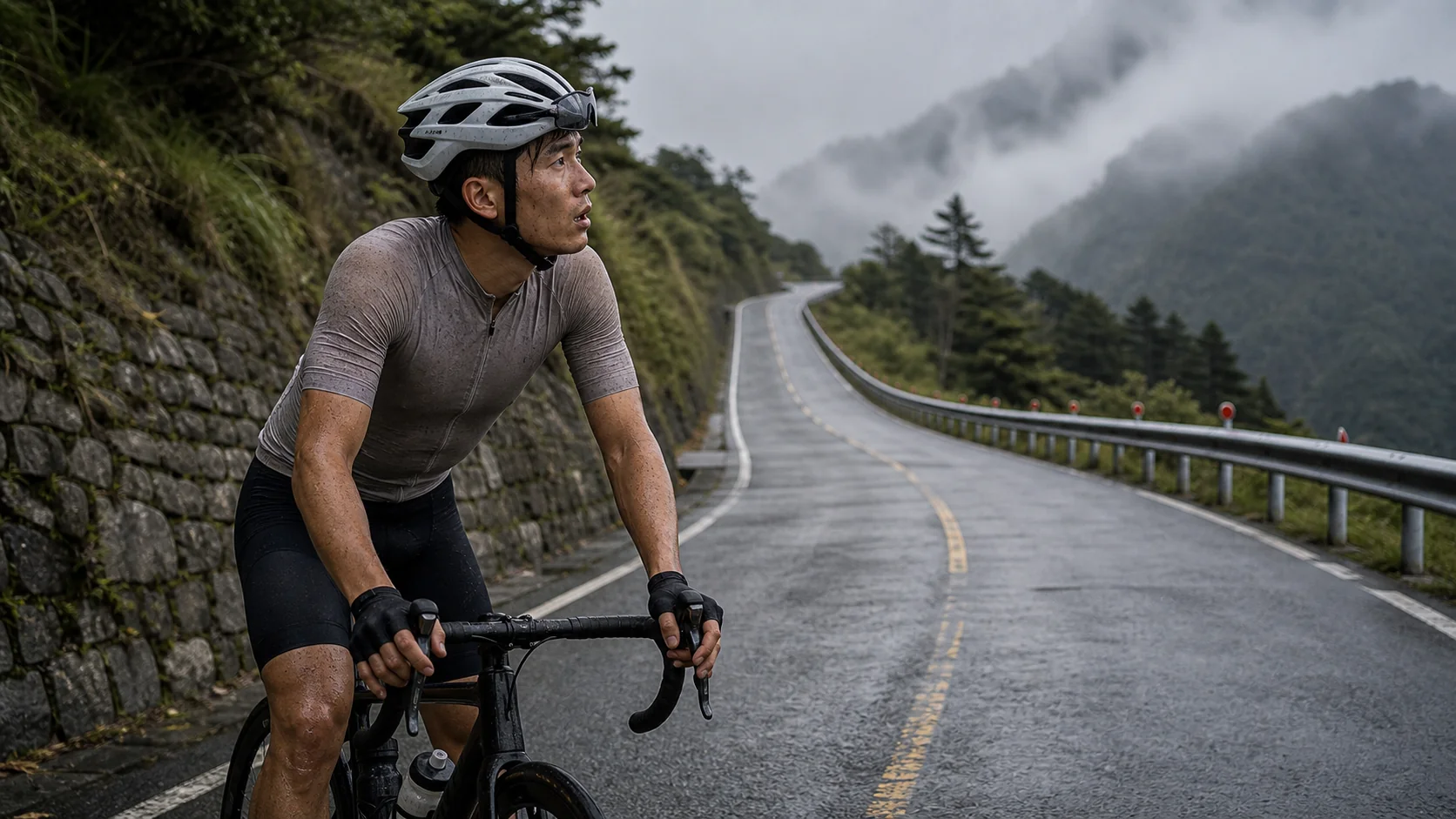
Cycling, especially long climbs and endurance events, is fundamentally a battle against your own mind. When your legs are burning and your lungs are gasping on the final 5 kilometers of Wuling, what usually makes you quit isn’t physical failure — it’s a psychological collapse. Mental toughness is cycling’s hidden edge.
The Basics of Sport Psychology
Rating of Perceived Exertion (RPE)
RPE (Rating of Perceived Exertion) is a self-perceived effort scale proposed by Dr. Borg in the 1970s, running from 6 (completely at rest) to 20 (maximum effort):
| RPE | Sensation | Corresponding Intensity |
|---|---|---|
| 6-8 | Very easy | Zone 1 |
| 9-11 | Easy | Zone 2 |
| 12-13 | Somewhat hard | Zone 3 |
| 14-15 | Hard | Zone 4 (FTP) |
| 16-17 | Very hard | Zone 5 |
| 18-19 | Extremely hard | Zone 6 |
| 20 | Total exhaustion | Maximal effort |
Modern research shows that RPE is actually a multi-factor composite indicator — it doesn’t only reflect physiological state, but also incorporates:
- Past experiences with similar efforts
- Remaining distance to the finish
- Emotional and motivational state
- Perception of external conditions (temperature, perceived gradient)
Central Governor Theory
South African exercise physiologist Tim Noakes proposed that your brain, not your muscles or heart, is the ultimate manager of fatigue.
When deciding “how much longer can you keep going,” the brain factors in:
- How far remains to the finish
- Current physiological reserves (energy, body temperature, hydration)
- The likelihood of successfully completing the task
- Memories of similar past situations
This explains why a “finish-line sprint” is possible — once the brain “knows” the finish is within sight, it releases more of its held-back reserves.
Common Psychological Challenges
1. Premature Quitting
Giving up before actually reaching a true physiological limit, usually because of:
- Pain exceeding what was expected
- A sense that “today just isn’t a good day”
- Frustration after comparing power or speed numbers
- Social pressure (not wanting others to see you suffering)
2. The “Tunnel Effect” on Climbs
Common psychological traps on long climbs:
- Constantly “calculating” how much distance is left
- Comparing against expected pace and growing increasingly pessimistic
- Fixating on the sensation of pain rather than on progress
3. Pre-Race Anxiety
Pre-race anxiety is a double-edged sword:
- Moderate anxiety: raises arousal and can aid performance
- Excessive anxiety: drains cognitive resources and impairs decision-making and execution
Strategies for Building Mental Toughness
1. Dissociation Techniques
Principle: Shift attention away from painful sensations toward external stimuli.
Practical methods:
- Take in the surrounding scenery (Taiwan’s mountain roads offer stunning views perfect for this)
- Notice the texture and changes of the road surface
- Listen to music (only when it’s safe to ride)
- Chat with riding companions
When to use it: Long Zone 2-3 rides, or whenever the level of pain remains manageable.
2. Association Techniques
Principle: Tune into and accept bodily sensations more deeply, rather than avoiding them.
Practical methods:
- Consciously “scan” through different parts of the body
- Monitor your breathing rhythm (how many pedal strokes per inhale/exhale)
- Feel the smoothness and rhythm of your pedal stroke
When to use it: High-intensity climbs that demand precise pacing.
3. Chunking (Goal Segmentation)
Principle: Break a long or difficult task down into manageable smaller goals.
Example (climbing to Wuling):
- “Just get to the next pavilion”
- “Once this steep section is done, there’s a downhill coming”
- “Five more minutes and I can refuel”
Psychological mechanism: Each time a small goal is completed, the brain releases dopamine, providing motivation to keep going.
4. Positive Self-Talk
Research support: A 2014 study found that guided positive self-talk could improve time-trial performance by 1-2%.
Types of effective self-talk:
| Type | Example | Effect |
|---|---|---|
| Instructional | “Hold the rhythm, relax your shoulders” | Improves technical execution |
| Motivational | “You’ve got this! Keep going!” | Boosts effort level |
| Acceptance-based | “It’s normal that this hurts, and I can handle it” | Reduces resistance to pain |
Avoid:
- “Why am I putting myself through this?”
- “I’m just having a terrible day”
- “I can’t do this anymore”
5. Mindful Cycling
Principle: Fully accept your present physical and mental state without judgment.
How to practice:
- Notice present sensations (heat, pain, breathlessness) without labeling them good or bad
- Pay attention to your breathing without trying to control it
- When your mind wanders, gently bring awareness back to the body
- Accept that “feeling terrible” is simply part of the riding experience, not a problem to escape
Long-term effect: Mindfulness training can lower the subjective intensity of pain and improve your ability to keep moving through discomfort.
Pre-Race Mental Preparation
Visualization
Professional riders frequently use visualization before races:
Steps:
- Find a quiet place and close your eyes
- Vividly imagine the race scenario (road surface, weather, crowds)
- Experience the difficult moments that might arise during the race
- Mentally rehearse executing your coping strategies
- Imagine the feeling of successfully finishing
Important: Visualization should include overcoming difficulty, not only images of success. Imagining only a flawless race leaves you unprepared when real difficulties arrive.
Building a Pre-Race Routine
A consistent pre-race routine helps you:
- Reach an optimal state of arousal
- Reduce anxiety caused by uncertainty
- Trigger your “race mode”
Example pre-race routine:
- The night before: lay out all your gear (10 minutes)
- Morning: a fixed breakfast (noodles + banana + coffee)
- Before departure: listen to a specific playlist
- Warm-up: a fixed 20-minute structured warm-up
Setting Realistic Expectations
The main source of anxiety is the gap between expectation and reality.
- Understand your condition on the day (HRV, sleep quality the night before)
- Set A/B/C goals based on your training data
- A goal: the best-case outcome if everything goes well
- B goal: a reasonable expectation
- C goal: the baseline of simply finishing
- Allow that your performance on the day may not match your training (weather, stress, and illness all play a role)
Psychological Challenges Unique to Taiwan
The Psychological Segments of Wuling
| Segment | Main Psychological Challenge | Suggested Strategy |
|---|---|---|
| Puli → Qingjing (0-25km) | Fatigue from sheer distance | Conservative pacing, enjoy the scenery |
| Qingjing → Kunyang (25-40km) | Mid-ride fatigue, uncertainty about what’s ahead | Goal segmentation, break it into 5km chunks |
| Kunyang → Wuling (40-46km) | “Jelly legs” from high-altitude hypoxia | Accept the hypoxic sensation, ease up on cadence |
| Final 1km | Seeing the finish but it still feels far | Focus on breathing, don’t surge too early |
The Psychological Layers of Two Towers
The psychological challenges of the Two Towers (Shuangta) 340km challenge are entirely different:
- First 150km: excitement, easy to go out too fast
- 150-250km: late-night fatigue, the start of hallucinatory fatigue
- 250-300km: the toughest psychological stretch, the body sending warning signals everywhere
- Final 40km: “completion momentum” takes over everything
Conclusion
The psychological dimension of cycling is often what separates amateur riders from advanced ones. Physical capacity can be improved through training, but mental toughness likewise needs to be deliberately cultivated.
Remember: the pain you feel is usually nowhere near your true physiological limit. That final signal to quit is often the brain’s protective mechanism, not a genuine physical emergency.
Learning to coexist with that boundary — and gently push past it — is one of the most valuable life lessons cycling has to offer.
Related Reading
- Mental Toughness Training for Cyclists: Focus During the Hardest Moments of a Race
- Mental Resilience Training: How Pro Riders Stay Focused Through Pain
- The Science of Enduring Pain: The Psychophysiology of Endurance Sport, and How to Train Your Brain’s “Brakes”
- Psychological Strategies for Cycling Climbs: Pain Segmentation and Goal Breakdown Techniques