文章導覽
Chasing the Wind: A Complete Guide to Crosswinds and Headwinds for Taiwanese Cyclists
Taiwan’s climate makes wind an opponent every cyclist has to reckon with — the outer circulation of summer typhoons, the winter northeast monsoon, the land-sea breezes of the western plains. Reading the wind and knowing how to respond to it is a technical skill that can’t be ignored when riding in Taiwan.
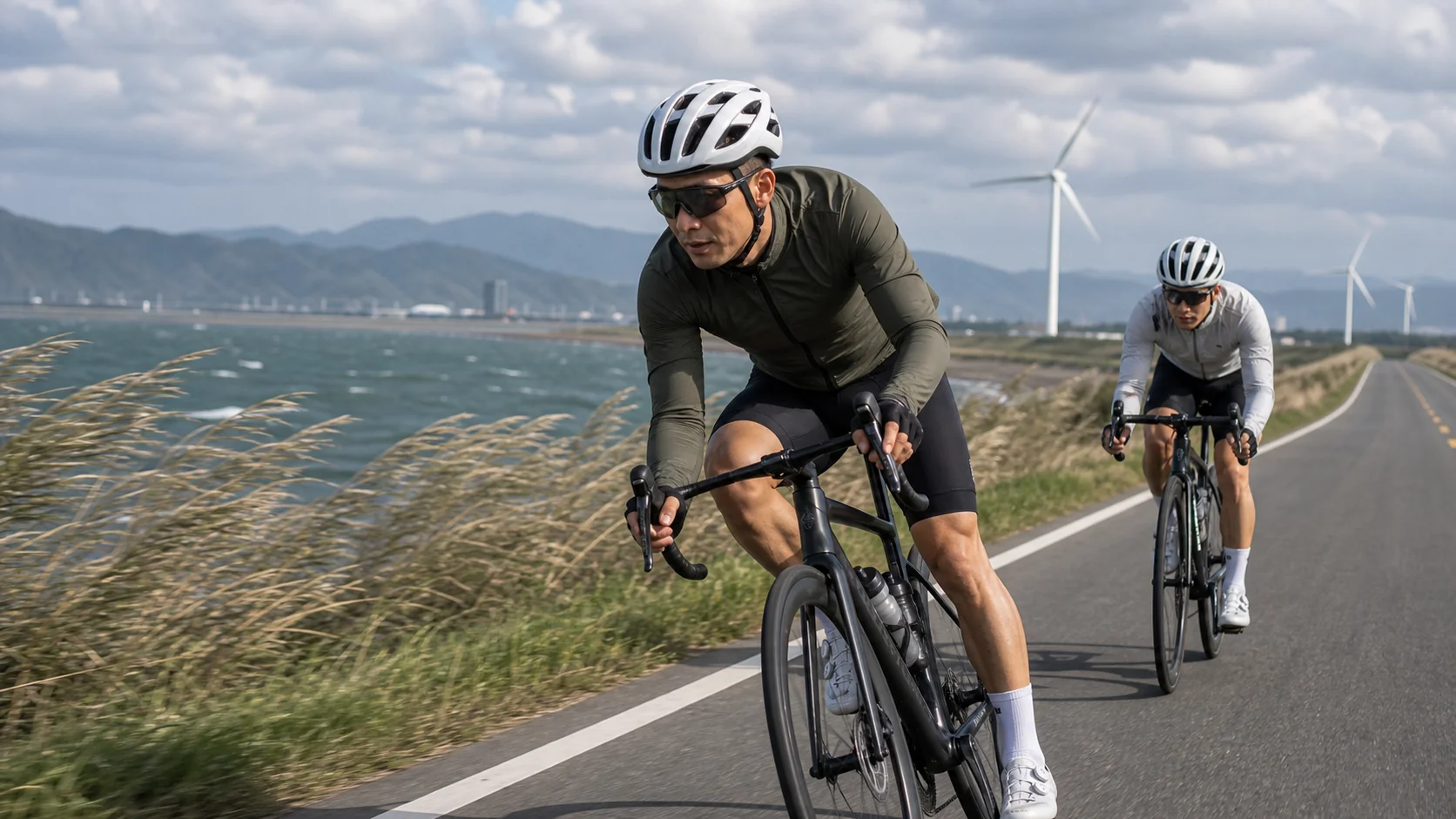
Taiwan’s Major Wind Patterns
The Northeast Monsoon (Winter–Spring)
Active period: October through March of the following year
| Feature | Description |
|---|---|
| Direction | Northeasterly (blowing from the northeast toward the southwest) |
| Strength | Typically 5–8 m/s (over 10 m/s when strong) |
| Affected areas | Strongest in the north and northeast; weaker in central and southern Taiwan |
| Riding impact | Riding north/northeast means a headwind; riding south/southwest means a tailwind |
Direct impact on riding:
- Taipei → Keelung (headwind): 15–25% slower than normal
- Keelung → Taipei (tailwind): 10–20% faster than normal
Land-Sea Breezes on Taiwan’s West Coast
Active period: Year-round, especially in spring and summer
| Time | Wind direction | Strength |
|---|---|---|
| Daytime (10am–6pm) | Sea breeze (easterly, blowing from sea to land) | 4–7 m/s |
| Nighttime | Land breeze (westerly, blowing from land to sea) | 1–3 m/s |
Application: When riding the flat plains of western Taiwan, you can use the land-sea breeze cycle to choose the most efficient departure time.
Typhoon Season (Summer–Autumn)
You should never ride during a typhoon. But under the outer circulation of a typhoon (when the storm is 200–500 km from Taiwan), unstable strong crosswinds are common and still require special attention.
Aerodynamics: The Basic Physics of Wind
The Concept of Apparent Wind
When you ride, what you feel isn’t the true environmental wind — it’s:
Apparent wind = environmental wind + the “headwind” created by your own forward motion
For example:
- You’re riding north at 30 km/h
- There’s a northeasterly environmental wind of 15 km/h, blowing from a slightly northerly direction
- The wind you feel: coming from almost directly ahead, at roughly 35–40 km/h
This is why the wind you feel while riding is usually stronger than the actual environmental wind.
The Nonlinear Relationship Between Wind Resistance and Speed
Air resistance ∝ the square of speed
This means:
- Going from 20 km/h to 25 km/h: resistance increases by 56%
- Going from 30 km/h to 35 km/h: resistance increases by 36%
Pushing to maintain speed into a headwind requires a far larger increase in power than the power you save from an equivalent tailwind.
Headwind Riding Technique
Adjusting Body Position to Reduce Drag
The most effective immediate improvement: lower your center of gravity
| Hand position | Effect |
|---|---|
| Hands on the tops | Highest position, most drag |
| Hands on the hoods | Slightly lower |
| Hands in the drops | Lowest position, least drag (reduces drag by 20–30%) |
Other drag-reduction tips:
- Lower your head (don’t hold your neck fully upright)
- Tuck your elbows in (avoid flaring them out)
- Flatten your back (but don’t go so low you lose your sightline)
Pacing Management: Don’t Fight the Wind Head-On
The most common headwind mistake: holding the same power target while speed drops sharply, getting frustrated, surging to compensate, and burning out even faster.
The correct strategy: accept the drop in speed, hold a sustainable power
| Situation | Response |
|---|---|
| Light headwind (1–3 m/s) | Hold normal power, accept a small speed loss |
| Moderate headwind (4–6 m/s) | Reduce power by 5–10%, accept the speed drop |
| Strong headwind (7 m/s or more) | Reduce power by 15–20%, treat it like a recovery/fueling segment |
The most important principle: Save your energy on headwind sections, and push harder once you reach a favorable stretch (tailwind, wind-sheltered) — the overall efficiency is much higher this way.
Gearing Strategy
In a headwind, choose a lighter gear (easier gear ratio):
- Maintain your normal cadence (85–90 rpm)
- Rather than mashing a heavy gear at low cadence (60–70 rpm)
- Reason: a lighter gear at normal cadence puts less strain on the knees and can be sustained for longer
Crosswind Riding Technique
The Special Danger of Crosswinds
Crosswinds affect a bike differently than headwinds:
- They don’t just add drag — they also affect directional stability
- Deep-section wheels (50mm or deeper) can get “pushed” sideways in a crosswind
- A sudden crosswind gust can push you toward the middle of the road unexpectedly
Basic Techniques for Handling Crosswinds
1. Lean into the wind
In a sustained crosswind, riders need to lean slightly into the wind:
- This feels counterintuitive, but it’s physically correct
- Your bike and body lean together to counteract the lateral force
2. Relax your grip
Gripping the handlebars too tightly prevents you from absorbing sudden gusts:
- Relax your palms and wrists
- Let the bike naturally follow small deviations from the wind
- Don’t force a perfectly straight line
3. Slow down
In strong crosswinds, reduce your speed to give yourself more reaction time:
- Especially near bridges, tunnel exits, or right after passing a windbreak (danger zones where you’re suddenly exposed to crosswinds)
Managing Deep-Section Wheels in Crosswinds
Wheels 50mm or deeper require special technique in crosswinds:
| Situation | Recommendation |
|---|---|
| Crosswind exceeds 6 m/s | Use lower-profile wheels, or swap to a shallower front wheel |
| Bridge sections | Anticipate sudden crosswinds — hold the bars lightly and slow down |
| Uncertain crosswind strength | Start with shallower wheels — don’t take the risk |
Wheel selection recommendations for Taiwan:
- Northeast monsoon season (winter): avoid deep-section wheels in northern Taiwan
- Summer (lighter winds): deep-section wheels have a clear advantage
- Before a race: check the day’s wind conditions before deciding on wheels
Wind Strategy for Group Riding
The Benefits of Drafting
Riding about 0.5–1 meter behind another rider can save 20–40% of your power output:
| Position | Power savings |
|---|---|
| Directly behind, 0.5m | 30–35% |
| Directly behind, 1m | 25–30% |
| Diagonally behind (offset) | 15–25% |
The benefit of drafting is even greater in a headwind — a well-organized group can help the entire pack maintain a solid speed even in a strong headwind.
The Echelon: Group Formation in Crosswinds
In a crosswind, a normal single-file paceline can’t draft effectively:
Echelon formation:
- Instead of riding in a straight line, riders form a diagonal line angled toward the direction the wind is coming from
- Each rider sits in the diagonal “sheltered zone” behind the rider ahead, avoiding the crosswind’s effect
- You can see this formation used in Taiwanese races such as the Taiwan KOM Challenge
Route Planning Wind Strategy
Using Terrain for Shelter
When riding in Taiwan, you can use terrain to reduce the effect of wind:
| Terrain | Wind-blocking effect | Example |
|---|---|---|
| Mountain roads | Best (mountains block the wind) | Mountain riding generally has minimal wind issues |
| Urban areas with buildings | Good | City roads are relatively free of strong crosswinds |
| Riverside bike paths | Poor (open exposure) | The Tamsui riverside path frequently has crosswinds |
| Coastal roads | Worst (fully exposed) | Taiwan’s west coast highway |
Favorable Route Choices by Wind Direction (Winter Northeast Monsoon Season)
| Route direction | Wind condition | Recommendation |
|---|---|---|
| North → South (Route 9, West Coast Highway) | Tailwind | The easiest long-distance direction in winter |
| South → North (against the flow) | Headwind | Strenuous — best avoided, or start early |
| East → West (cross-island highways) | Crosswind | Crosswind concerns — assess conditions as you go |
Training Tips: Turning the Headwind Into Your Advantage
The Benefits of Headwind Training
A headwind — frustrating as it is — is actually an excellent training environment:
- At a fixed power output, lower speed means longer time under load, which means more training stress
- Safer than climbing (no descent to worry about)
- Well suited to FTP maintenance training
How to use a headwind for Zone 4 training:
- On a strong headwind stretch (such as the West Coast Highway), set a target power (90–95% FTP)
- Hold that power for 20–30 minutes
- Ignore your speed entirely — focus only on power and heart rate
Building a “Warrior in the Wind” Mindset
Many riders get discouraged by headwinds, which makes them ride both harder and less efficiently.
Reframe your mindset:
- A headwind means “more effort = more training benefit”
- Your competitors are facing the same headwind (a level playing field)
- The tailwind on the way back will feel fantastic (today’s suffering is an investment)
Conclusion
Wind is an unavoidable part of riding in Taiwan. Learning to coexist with it — reducing drag, managing your pacing, drafting effectively, and planning your routes — lets you ride efficiently no matter the conditions.
In the end, the best “headwind strategy” is to accept it and adapt to it rather than fight it. The wind will always be stronger than you, but you can always be smarter than the wind.
Related Reading
- Strategy and Mental Preparation for Riding into a Headwind
- Riding Taiwan’s Round-Island Route Against the Flow vs. With the Flow: A Full Comparison
- Wind Around the Tour of Taiwan: How Crosswinds, Headwinds, and Tailwinds Change the Race
- Pushing Forward Into the Wind: Technique, Strategy, and Mental Resilience Training for Strong Headwinds