Daily Carbohydrate Needs for Endurance Triathlon: How to Calculate for Cycling, Running, and Swimming
Introduction
Carbohydrates (CHO) are the primary energy source for endurance triathlon—cycling, running, and swimming. Many athletes intuitively “just eat enough at meals,” yet often underestimate their needs under high training volumes, leading to stalled performance or even overtraining fatigue. Both the American College of Sports Medicine (ACSM) and the International Society of Sports Nutrition (ISSN) recommend that endurance athletes adopt a tiered carbohydrate intake strategy based on training intensity, rather than a one-size-fits-all fixed number.
The Scientific Basis of Carbohydrate Needs
Muscles and the liver together can store approximately 400–600g of glycogen, equivalent to 1,600–2,400 kcal of usable energy. High-intensity endurance training consumes 60–120g of carbohydrates per hour; in practical terms, a 2-hour cycling session is enough to deplete more than 50% of glycogen stores. If replenishment is insufficient, the next training session starts “half-empty,” and performance naturally suffers.
The ACSM/AND/DC joint position statement (2016) proposes body-weight-based daily carbohydrate recommendations:
| Training Volume | Daily Carbohydrates (g/kg body weight) | Notes |
|---|---|---|
| Light (<1 hr/day) | 3–5 g/kg | Technical training, low-intensity swimming |
| Moderate (1–3 hr/day) | 5–7 g/kg | General preparation weeks |
| High intensity (1–3 hr/day) | 6–10 g/kg | Threshold/VO₂max sessions |
| Very high volume (>4–5 hr/day) | 8–12 g/kg | Heavy training periods, triathlon race preparation |
Considerations Across the Three Disciplines
Cycling: Long-duration, low-impact; fat oxidation contributes a higher proportion of energy, but sustained moderate-to-high intensity rides exceeding 3 hours still require substantial carbohydrates. Since solid food is impractical during indoor training, carbohydrate drinks are especially critical.
Running: Gastrointestinal impact is pronounced; 2–3 hours of digestion time is needed before a session, and carbohydrate choices should focus on easily digestible, low-fiber foods. For runners accumulating more than 60 km per week, 6–8 g/kg per day is a common requirement.
Swimming: Water temperature suppresses appetite, making athletes prone to underestimating their needs. Although energy expenditure in the water is similar to running, post-workout hunger is delayed, so proactive replenishment planning is necessary.
Practical Examples with Taiwanese Foods
Take a triathlete weighing 65 kg training 1.5 hours per day as an example, with a target of 6 g/kg = 390 g of carbohydrates:
| Food | Portion | Carbohydrates (g) |
|---|---|---|
| White rice (cooked) | 3 bowls (450g) | 150 |
| Whole wheat toast | 4 slices | 60 |
| Banana | 2 pieces | 54 |
| Sweet potato (baked) | 1 piece (200g) | 50 |
| Sports drink 500mL | 1 bottle | 33 |
| Oatmeal (dry) | 50g | 34 |
| Total | ≈ 381 g |
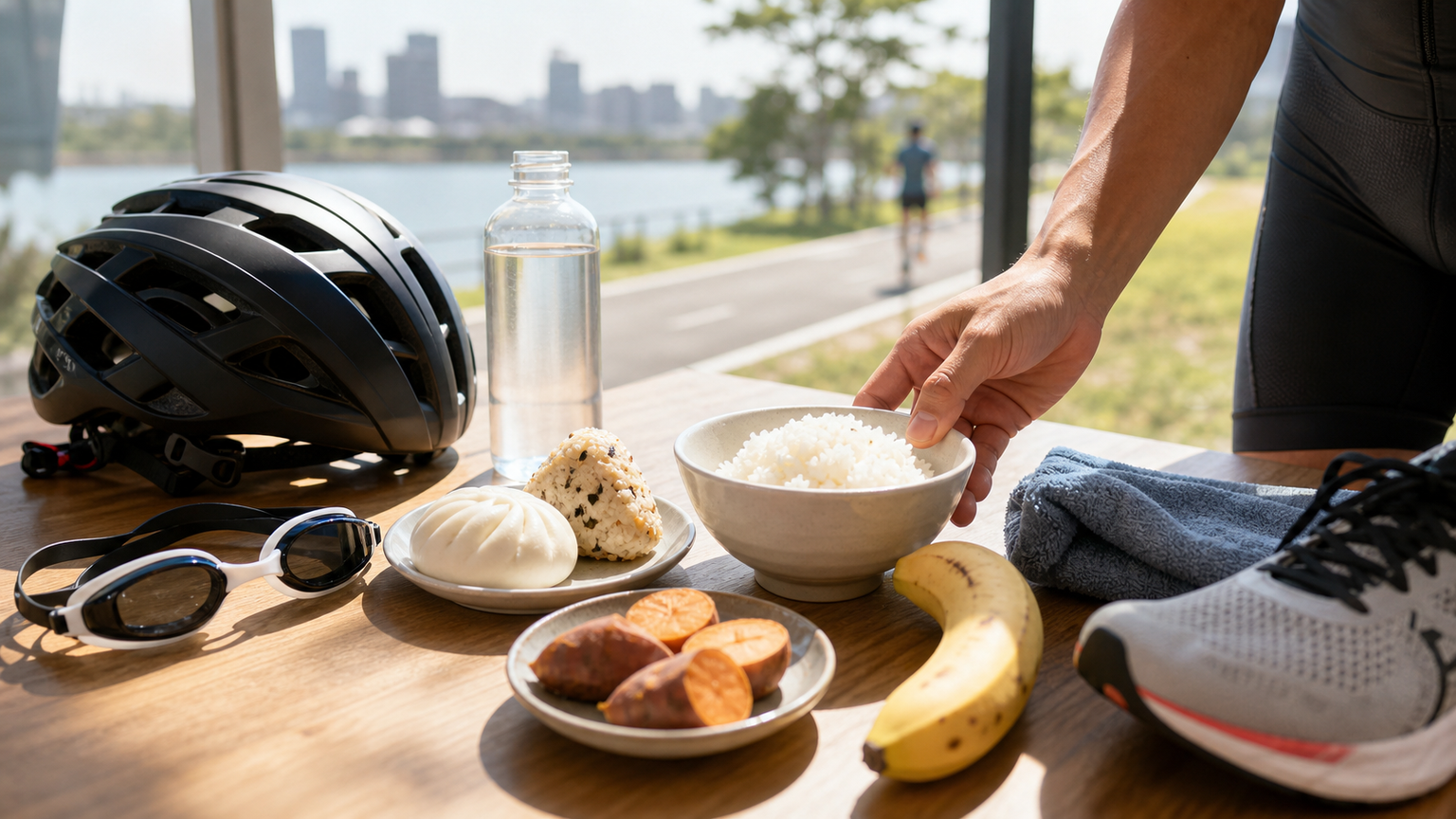
Convenience store options: 7-ELEVEN’s onigiri rice balls (approximately 40–50g carbohydrates each), FamilyMart’s baked sweet potatoes (about 30g/100g), and various rice balls and triangular onigiri are all great quick-replenishment choices.
Practical Recommendations
- Starting point for calculation: Weigh yourself first, then multiply by the corresponding coefficient to determine your daily target in grams.
- Timing allocation: Breakfast and around training sessions should account for the bulk; dinner in moderate portions maintains glycogen.
- Progress tracking: Log 3 consecutive days in a diet app (e.g., MyFitnessPal) to confirm whether carbohydrate targets are being met.
- Race-week increase: Gradually increase to 8–10 g/kg in the 72 hours before race day, combined with tapering to achieve a supercompensation effect.
- Avoid common pitfalls: Do not substitute “not feeling hungry” for calculation, especially since appetite is often suppressed after swimming.
Conclusion
Carbohydrate needs are not a fixed number but a strategy that adjusts dynamically with training load. Mastering the g/kg calculation method, combined with Taiwan’s abundant starchy foods, allows you to start every session with sufficient fuel. Remember: insufficient glycogen means compromised speed; with adequate carbohydrates, training truly accumulates.
Related Reading
- Carbohydrate Loading Before a Swim Meet: A Three-Day Pre-Race Meal Plan
- The Complete Guide to Carbohydrates: The Primary Fuel for Endurance Sports—Types, Daily Requirements, and Race-Day Fueling Strategies
- Nutrition for Recovery: A Comprehensive Practical Guide to Carbohydrate Loading for Endurance Athletes—A 72-Hour Pre-Race Meal Plan at 10g per kg Body Weight and a Full Recovery Schedule
- In-Training Fueling Strategies: How to Achieve 60–90g of Carbohydrates Per Hour
CT暗黑廚房) 車友必備 宇宙無敵鮮蚵湯 幫助訓練恢復 天然食補 好市多 超肥鮮蚵 破PR
7 年前
靠單車減肥35公斤 心得分享與整理
7 年前
單車 一日北高 ( 雙城 ) 肥宅雙人瘋狂行 紀錄片 REACTO
10 年前
半日 小台灣 極限單車路線挑戰實錄
7 年前
西進武嶺 免費訓練分析服務 Intervals | 練不夠還是練過頭?你哪一種類型選手?AI模型告訴你! | 備戰神器 | 公路車 訓練 | CT Yeh
4 年前
4K 東眼山 x 水蜜桃冰沙 百人單車約騎! 操完再吃冰 多爽快
7 年前
一日北高前的高裝檢 | 北高 360 | 挑戰11小時的裝備 | 一日雙塔 | 補給
6 年前
一日北高常見問題大集合 | 攻略 | 路線 | 訓練 | 補給 | 自行車 單車 | 一日雙城 | 雙塔 | TWB北高360 | 屁股痛
6 年前