Introduction
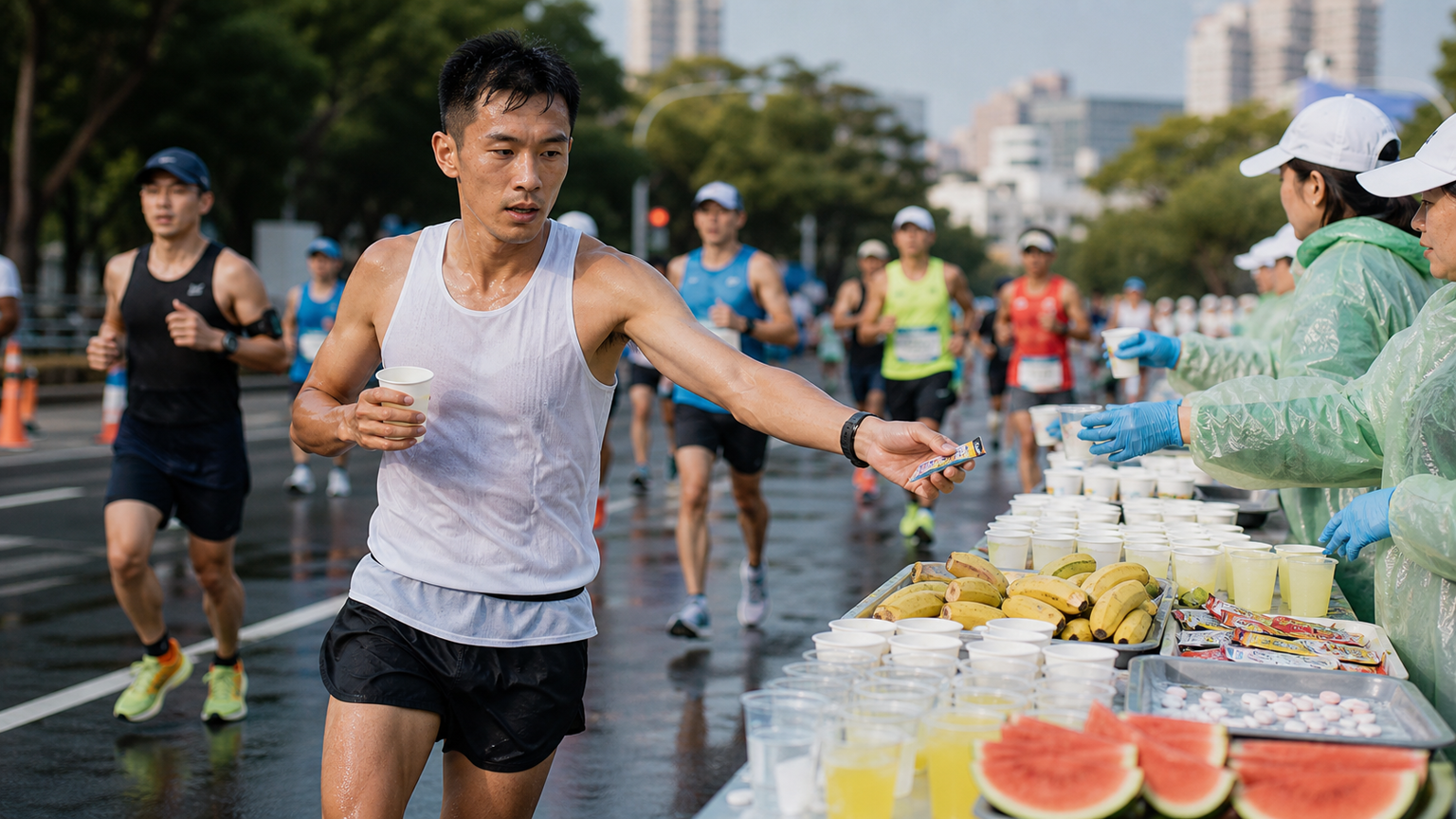
During the 42.195 km marathon course, organized aid stations are typically set up every 5 kilometers, offering water, electrolyte drinks, bananas, energy gels, and more. However, in the few seconds spent in front of the aid table, many runners often feel lost—what should I grab? How much should I drink? Should I stop or drink while running? These seemingly minor decisions add up and determine your performance in the second half of the race.
Review of Marathon Energy Demands
Take a 65 kg runner finishing in 4 hours as an example:
- Energy expenditure is approximately 60–70 kcal per kilometer (highly individual)
- Total expenditure is approximately 2,500–3,000 kcal over the race
- Stored muscle glycogen supports at most about 25–32 km (depending on intensity)
- Fueling is needed to maintain blood sugar and nervous system function in the later stages
“Hitting the Wall” occurs when glycogen is depleted, typically around 32–35 km, and pace can drop suddenly by 30–60 seconds/km. Adequate in-race fueling can delay or even prevent hitting the wall.
Nutritional Information for Common Aid Station Foods
| Aid Station Food | Serving Size | Carbs (g) | GI Tolerance | Notes |
|---|---|---|---|---|
| Sports drink (isotonic) | 200mL | 12–14 | High | Primary electrolyte source |
| Plain water | 200mL | 0 | Highest | Use with gels |
| Banana (half) | — | 13–14 | High | Rich in potassium, easy to eat |
| Energy gel (1 packet) | 30–40mL | 22–27 | Medium | Requires 150mL of water |
| Taiwanese staple: salted plum/plum juice | 50mL | 8–12 | High | Sodium + flavor change |
| Orange slices | 2–3 slices | 10 | High | Juicy and refreshing, popular in the later stages |
| Watermelon slices | 1 slice | 8–10 | High | Hydration plus carbs |
| Salt tablets | 1 tablet | 0 | High | 200–300mg sodium |
Recommended Full-Race Fueling Schedule (42 km)
| Distance | Fueling Recommendation | Cumulative Carb Intake (g) |
|---|---|---|
| 5 km | Sports drink 200mL (no need to stop) | 13 |
| 10 km | Sports drink 200mL + 1 energy gel | 50 |
| 15 km | Sports drink 200mL + half banana | 77 |
| 20 km | Sports drink 200mL + 1 energy gel | 102 |
| 25 km | Sports drink 200mL + orange/watermelon | 124 |
| 30 km | Sports drink 200mL + energy gel (with caffeine) | 149 |
| 35 km | Sports drink 200mL + salted plum/salt tablet | 163 |
| 40 km | Sports drink 200mL | 176 |
Carbohydrate intake is approximately 44–48g per hour (slightly below the ideal 60g, as stomach jostling while running limits intake).
How to Drink While Running Without Choking
This is the most common practical issue first-time marathoners face:
- Pinch the cup rim: Use your thumb and index finger to pinch the opening of the paper cup, forming a small spout-like opening to effectively control the flow.
- Slow down slightly: 20–30 meters before the aid station, ease into a jog/fast walk. After grabbing the drink, ensure you swallow steadily before resuming your pace.
- Drink in two sips: Use the first sip to moisten your mouth, and only truly swallow on the second sip, reducing the risk of choking.
- Aim your cup toss: Keep the course clean by throwing cups into nearby recycling bins or at the end of the aid station.
Unique Aid Station Highlights of Taiwanese Marathons
Common items at Taiwan road race aid stations:
- Bananas: A staple at nearly every Taiwanese marathon, the most runner-friendly solid fuel
- Salted plum soup/plum juice: The salty-sour flavor is a “taste bud wake-up” in the second half, while also providing sodium
- Electrolyte drinks (Supau/sports drinks): The mainstream choice; practice with the same brand during training
- Watermelon slices: Common at summer races, refreshing hydration plus carbs
- Local specialty foods: Some township marathons offer sweet potatoes or sweet glutinous rice balls—assess GI tolerance before consuming
Carry Your Own Strategy
If you’re concerned about aid stations being too far apart or the food not suiting your needs, carry your own supplies in a pocket or running belt:
- 2–3 energy gels (your preferred brand and flavor)
- 4–6 salt tablets
- 1 small pack of glucose gummies
- 1 caffeinated energy gel (save it for the 30–35 km mark)
Practical Tips
- Before race day, review the aid station food list published by the organizer to confirm whether your usual items are included.
- If the race beverage is an unfamiliar brand, test it at least 2–3 times before the race.
- Set a plan for each aid station (“at this one, drink + grab a banana”) rather than deciding on the spot.
Conclusion
Marathon fueling is a skill that can be practiced. Start rehearsing your fueling rhythm during long training runs, and on race day you only need to execute a plan you already know well. Those runners who still hold their pace after 35 km are often the ones with the most disciplined fueling plans.
Related Reading
- Marathon Course Aid Station Strategy: The Art of Allocating Water, Sports Drinks, and Energy Gels
- Road Race Aid Station Food Selection Strategy: Making Energy Gels Not the Only Option
- Marathon Aid Station SOP: A 4-Phase Intake Rhythm for 5K, 15K, 25K, and 35K
- Marathon Aid Station Strategy: When to Drink Water and When to Take Energy Gels
CT暗黑廚房) 車友必備 宇宙無敵鮮蚵湯 幫助訓練恢復 天然食補 好市多 超肥鮮蚵 破PR
7 年前
半日 小台灣 極限單車路線挑戰實錄
7 年前
一日北高前的高裝檢 | 北高 360 | 挑戰11小時的裝備 | 一日雙塔 | 補給
6 年前
2018 田中馬拉松 全程健跑 VR 360 環景錄影 體驗現場狂野加油氣氛! Insta 360
7 年前
靠單車減肥35公斤 心得分享與整理
7 年前
西進武嶺 免費訓練分析服務 Intervals | 練不夠還是練過頭?你哪一種類型選手?AI模型告訴你! | 備戰神器 | 公路車 訓練 | CT Yeh
4 年前
單車 一日北高 ( 雙城 ) 肥宅雙人瘋狂行 紀錄片 REACTO
10 年前
一日北高/長距離團騎 常見問題補充篇 / 組團或跟團的眉角 / 壯車友容易被瘦車友慢性拉爆 / 原來屁股痛可能是這個原因...? / 風場配速法 / 公路車 / CT Yeh
2 年前