Night Riding on the Beiyi Highway: Asphalt Glowing Under the Lights, Fear and Freedom Side by Side
Introduction
At 11 PM, I stood by Muzha MRT Station, turning my bike light to its brightest setting and setting my helmet’s tail light to flashing mode. My riding buddy, A-Kai, asked while checking his supplies: “Are you sure you want to go?”
I said I was sure.
That was my first night ride on the Beiyi Highway. Provincial Highway 9 climbs over the Erge Mountain ridge from Muzha in Taipei to Yilan, covering about 50 kilometers with nearly 1,000 meters of elevation gain—a familiar weekend route for Taipei cyclists. But the Beiyi Highway at night is an entirely different experience.
The Appeal of Night Riding: Why People Climb in the Dark
Simply put, it’s about escaping the summer heat. Taipei’s July afternoons can hit 38 degrees, and riding on asphalt feels like moving through an oven. Night riding drops the temperature to 26 degrees, and the mountaintop can even offer a refreshing chill below 20 degrees, elevating the comfort of the entire ride by a whole level.
But the appeal isn’t just the temperature. Night riding has a tranquility that daytime lacks. There are fewer cars on the road, the sounds of insects are clear, and occasionally a leopard cat darts across the roadside. Your world is compressed into the beam of your bike light—the gradient ahead, the details of the road surface, the angles of the curves—all your senses are forced into focus, and stray thoughts disappear.
The Reality of Night Riding on the Beiyi Highway
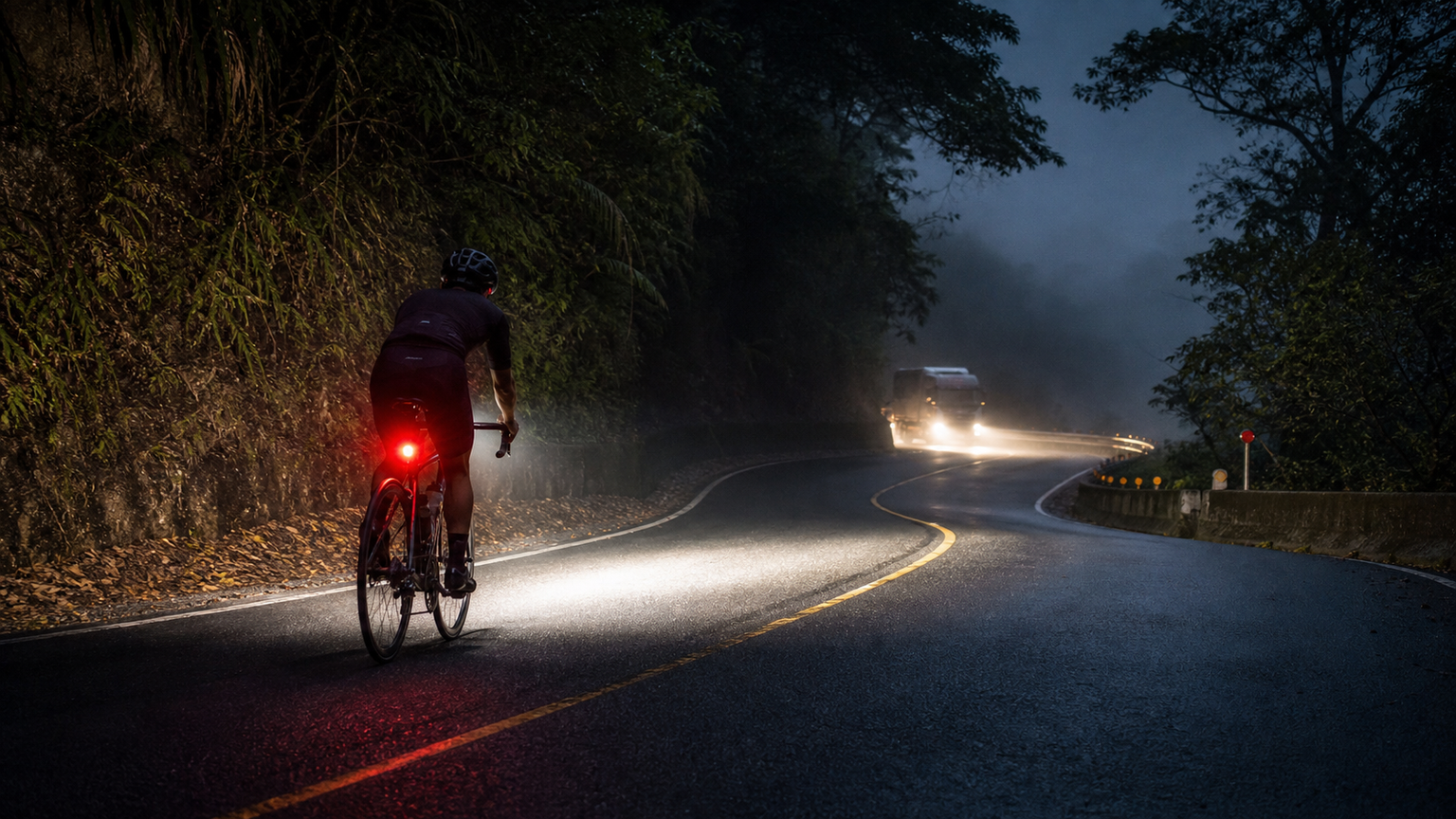
We set off from Muzha, beginning the climb along Section 3 of Zhinan Road. The initial stretch has streetlights, so it doesn’t feel oppressive, but after passing the Maokong trailhead, the streetlights vanish, replaced by dense bamboo groves on both sides, leaving only your bike light for illumination.
The gradient fluctuates between 7–9%, and I kept my speed below 12 km/h to ensure my light reached far enough ahead, giving myself reaction time. The Beiyi Highway has many sharp curves, and with limited nighttime visibility, I had to slow down before every turn, checking for oncoming traffic before proceeding.
| Section | Distance | Main Risks | How to Handle |
|---|---|---|---|
| Muzha—Shiding | Approx. 15 km | Streetlights fade, uneven road surface | Slow down early, keep all lights on |
| Shiding—Pinglin | Approx. 12 km | Trucks crossing, rockfall zones | Ride close to the edge, watch overhead |
| Pinglin—Jiaoxi descent | Approx. 23 km | Long descent, mountain fog, sudden temperature drop | Brake in intervals, bring a windbreaker |
The most dangerous section is the long descent after Pinglin. Around 1 AM, mountain fog began rising from the valley floor, and visibility dropped to less than 50 meters at one point—my bike light turned into nothing but a white glow in the mist. A-Kai and I stopped by the roadside for nearly twenty minutes, waiting for the fog to thin before continuing.
The Moment That Made My Palms Sweat
Not long after passing Pinglin, a gravel truck sped past from behind, and the air turbulence from its tires pushed me nearly half a meter toward the middle of the road. For that half-second, I almost thought I was going to fall.
I stopped, my hands trembling for a long while. A-Kai asked if I was okay, and I said I was, but I knew deep down: that was one breath away from an accident.
That moment made me rethink the essence of night riding: it’s not an act of heroism; it’s risk management. Do you have enough lights? Are you visible enough? Did you choose a time with less traffic? Every “do you” is a variable in whether you make it home safely.
Practical Advice
- Never compromise on lights: A front light of 1,000 lumens or more is recommended (e.g., Garmin Varia UT800), and a radar tail light (e.g., Garmin Varia RTL) can detect vehicles approaching from behind and warn you—the best protection for night riding.
- Timing matters: It’s best to depart between midnight and 4 AM, avoiding the 9–11 PM wave of trucks heading to unload; gravel trucks and tractor-trailers are the biggest source of danger.
- Always ride with a companion: If you get a flat tire or have an accident on a remote mountain road at night, handling it alone carries extremely high risk. Ride with at least one other person and inform family or friends of your route and expected return time.
- Prepare for cold on descents: On the long descent from Pinglin to Jiaoxi, the combination of speed and mountain fog can make the actual felt temperature 8–10 degrees lower than the reading. A lightweight down vest or windbreaker is essential.
Conclusion
When we arrived in Jiaoxi, dawn hadn’t broken yet, but a hint of pale light was already appearing along the eastern mountain ridge. A-Kai and I found an early-opening soy milk shop in downtown Jiaoxi, sat down, ordered shaobing and youtiao, and ate in silence without saying a word.
Some riding experiences don’t need words. They live in the steam rising from that bowl of soy milk, in the soreness of your leg muscles, and in the quiet gratitude of knowing, “I made it back tonight, safe and sound.”
Night riding on the Beiyi Highway is worth trying. But please put safety first.
Related Reading
- Beiyi Highway (Provincial Highway 9) Riding Guide: Gradient Analysis of the 9 Bends and 18 Turns
- The Allure and Cost of Night Riding: A Safety Guide and Real Experiences on Dark Highways
- The Appeal and Safety Rules of Night Riding: A Guide to Urban and Suburban Night Cycling
- Yilan Beiyi Highway Riding Guide: The Challenging Route from Taipei to Yilan Over the Snow Mountain Range
一日北高 知名版主影帝歡笑騎聚 | 公路車 | CT Yeh
5 年前
台北闊瀨陡坡 騎旅 / 日本單車雜誌編輯車友臨時加入!/ 髮香才是最強的 / feat. 北迴歸線小隊 / 公路車 CT Yeh
6 個月前
#北橫 + #北進武嶺 最硬的員工旅遊 EP1 | #公路車 #拉拉山 | 明池 | 武嶺 | 武陵農場 | 雲海 | Taiwan Cycling Route Wulin
6 年前
一日北高常見問題大集合 | 攻略 | 路線 | 訓練 | 補給 | 自行車 單車 | 一日雙城 | 雙塔 | TWB北高360 | 屁股痛
6 年前
北宜騎車⋯好刺激 差點被🐒尻 / 露營單車旅 / 公路車後背攜車架開箱!/ 百人大團露 / YAKIMA 設備開箱儀式感都來了 / 公路車 / CT Yeh
12 個月前
#北宜 #北進武嶺 單車員工旅遊 | 環山部落空拍大景!壯闊俯瞰視角! | 類97850|E01 | #公路車 | CT Yeh
4 年前
台北大雁西飛 約騎挑戰 feat. Doris | 公路車 | CT Yeh
3 年前
大武山20%魔王陡坡【JJSC南台灣遊騎Day2】!屁股真的要裂開了...凡士林抹滿也沒用?神秘金教堂還有超便宜夜市
3 個月前