Introduction
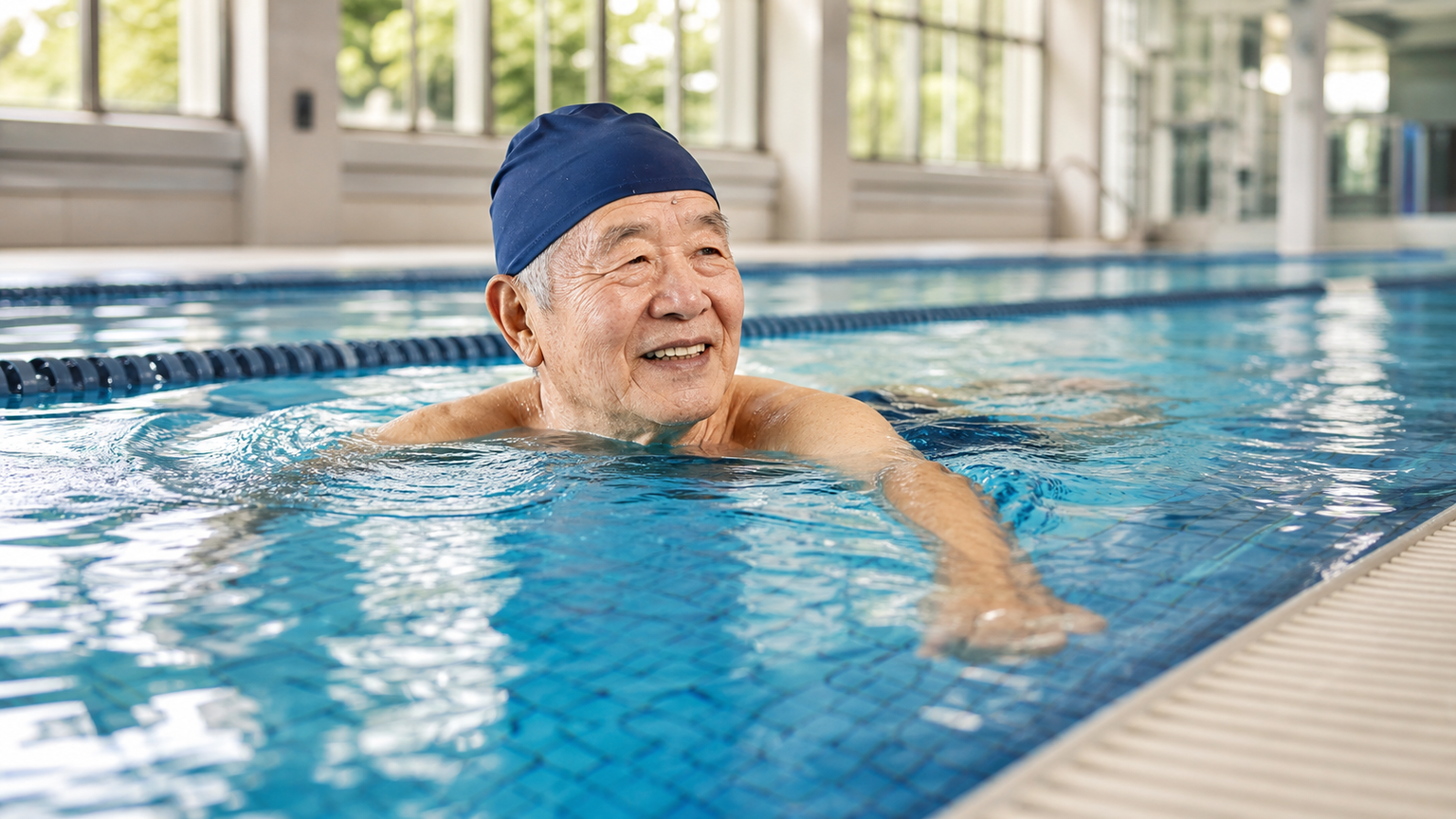
Taiwan has entered a super-aged society, with the proportion of people aged 65 and above continuing to rise. For many older adults, knee degeneration, declining heart function, or balance issues make land-based exercise challenging, and some even avoid exercise entirely for fear of falling. Swimming provides a water-supported environment that minimizes impact on the body while still delivering effective cardiovascular and strength training—even seniors over 75 can participate safely.
The Unique Physiological Benefits of Swimming for Seniors
Combating Muscle Loss (Sarcopenia)
After age 60, muscle mass decreases by approximately 3–5% every 10 years. The water resistance of swimming can effectively stimulate muscle protein synthesis and slow the progression of sarcopenia. Water resistance increases non-linearly with speed, providing a safe yet effective strength training environment.
Supporting Osteoporosis Management
Swimming is a non-weight-bearing exercise, so its direct stimulation of bone density is less than that of walking or jumping rope. However, swimming can:
- Strengthen muscles, indirectly reducing fracture risk (muscles can cushion falls)
- Improve balance and core stability
- Work even better when combined with land-based weight-bearing exercises
Maintaining Cognitive Function
Research on regular swimming (3 times per week for 3 months) shows improvements in executive function, memory, and attention in seniors, with mechanisms linked to increased cerebral blood flow and promotion of BDNF (brain-derived neurotrophic factor) secretion.
Risk Assessment for Senior Swimming
| Condition | Recommendation |
|---|---|
| Stable heart disease (no acute symptoms) | Can swim; start at low intensity after evaluation by a cardiologist |
| Hypertension (controlled) | Can swim; avoid cold water (<26°C) which may trigger sudden blood pressure spikes |
| Chronic kidney disease (non-dialysis) | Can swim; be sure to rehydrate after swimming |
| Artificial knee/hip replacement | Can swim 6–8 weeks after surgery once the wound has healed (confirm with your surgeon beforehand) |
| Parkinson’s disease (mild to moderate) | Warm-water swimming can improve stiffness; requires accompaniment in the water |
| Dementia (mild) | Can participate in water activities with a caregiver present |
| Acute illness or fever | Stop swimming temporarily |
Swimming Training Plans Suitable for Seniors
Beginner Phase (Weeks 1–4)
Goal: Get used to the water environment and build basic confidence
- Standing and walking in water (waist-deep): 20 minutes per session
- Wall-supported kicking drills: 2 minutes × 4 sets
- Freestyle kicking with a kickboard: 25m × 4 lengths
- Frequency: 2 times per week
Progressive Phase (Weeks 5–12)
Goal: Complete continuous swimming and improve cardiovascular fitness
- Continuous swimming (including backstroke or slow freestyle): 20–30 minutes per session
- Rest 30–60 seconds after each 50m length
- Frequency: 3 times per week
Maintenance Phase (After Week 13)
- Swim 3 times per week, 30–40 minutes per session
- May add aqua aerobics classes to increase social interaction
- Adjust training volume slightly every 4–6 weeks (rest week) to avoid over-fatigue
Safety Guidelines for Senior Swimming
Getting In and Out of the Pool
- Use the stairs rather than diving in: Make sure the pool has sturdy stairs and keep one hand on the handrail at all times.
- Do not run on the pool deck: The wet pool deck is the highest-risk area for falls.
- Wear non-slip slippers: Keep them on from the locker room to the pool edge, and only take them off right before entering the water.
In-Water Safety
- Start in the shallow end: Those unfamiliar with their swimming ability should practice in water shallower than 1.2m.
- Inform the lifeguard of your age and health conditions: Let the staff be prepared.
- Do not swim alone: It is recommended to swim with a friend or inform family members of your swimming plans.
Practical Tips
- Many cities and counties in Taiwan offer senior swimming classes: Numerous pools offer courses designed specifically for people over 60, with small class sizes and instructor accompaniment, often at discounted rates. Search for resources at your local aquatic center or city/county sports bureau.
- Consume protein after swimming: Seniors have lower post-exercise muscle synthesis efficiency and need more protein (aim for 25–30g per meal). Milk, eggs, or soy milk are convenient options.
- Prioritize warm-water pools: A pool at 28–30°C is most comfortable for older adults, reducing the risk of blood pressure spikes and muscle cramps upon entry.
- Water aerobics is an excellent alternative: If you lack confidence in your swimming technique, water aerobics provides equally effective cardiovascular and strength training, and since you remain standing in the water throughout, it offers a greater sense of security.
Conclusion
Age is never a reason to say no to swimming. The buoyancy of water protects your joints, the resistance of water provides strength training, and the aquatic environment reduces the risk of falls. For seniors in Taiwan, swimming is an ideal activity for maintaining vitality, slowing aging, and enjoying social interaction—start today and make the pool your best health partner.
Related Reading
一日北高/長距離團騎 常見問題補充篇 / 組團或跟團的眉角 / 壯車友容易被瘦車友慢性拉爆 / 原來屁股痛可能是這個原因...? / 風場配速法 / 公路車 / CT Yeh
2 年前
CT暗黑廚房) 車友必備 宇宙無敵鮮蚵湯 幫助訓練恢復 天然食補 好市多 超肥鮮蚵 破PR
7 年前
一日北高常見問題大集合 | 攻略 | 路線 | 訓練 | 補給 | 自行車 單車 | 一日雙城 | 雙塔 | TWB北高360 | 屁股痛
6 年前
靠單車減肥35公斤 心得分享與整理
7 年前
白沙屯媽祖進香在家走!UREVO 坡度自調走步機 / 可連接訓練遊戲APP MyWhoosh / 邊看直播邊走起來 / CT Yeh
11 個月前
滑雪新手們慘摔學習全紀錄(請開字幕),滑雪好好玩 | Snowboard + Ski | 岩原 スキー場 | 滑雪APP使用 | GoPro Max
6 年前
NEKO's Fun 高美濕地團練
8 年前
實景訓練台) 彰化經典百K 高強度喵團 90分鐘 跟著一起練功 2019 Indoor workout Changhua Classic 100 Taiwan
7 年前