Introduction
Ask a swim coach “how do you train your core?” and eight out of ten will say “the plank.” The plank is indeed a good exercise for building foundational stability, but once an athlete can easily hold it for over 90 seconds, the benefit of extending the duration drops significantly. The core strength required for swimming is multi-dimensional: anti-rotation, dynamic rotation, hip stability, and maintaining torso rigidity under respiratory control—all of these require more advanced training stimuli.
The Specific Demands of the Swimming Core
In the water, the body floats horizontally, and every stroke generates rotational torque. The core must simultaneously achieve:
- Anti-rotation: Prevent the upper and lower body from disconnecting, maintaining a streamlined body position
- Dynamic rotation: Body roll during freestyle side-breathing and backstroke strokes
- Lumbar stability: Prevent excessive lower back flexion during kicking, which increases drag
- Breathing coordination: Maintain core contraction while holding breath and breathing in the water
A static plank can only partially address the first item; the remaining three are almost impossible to train effectively with it.
Advanced Core Training Exercise Categories
1. Dynamic Rotation Series
| Exercise | Focus | Set Recommendations |
|---|---|---|
| Seated Medicine Ball Rotation Throw | Rotational power | 3×10 (each side) |
| Mountain Climber (Cross-Body) | Rotation + Cardio | 3×20 |
| Bear Crawl | Contralateral coordination + Core | 3×20 meters |
| Russian Twist | Oblique endurance | 3×15 (weighted) |
The Cross-Body Mountain Climber deserves special emphasis: bringing the knee toward the opposite elbow trains both the rotational function of the obliques and the cardiovascular system, making it more aligned with swimming demands than the original version.
2. Anti-Rotation and Anti-Extension
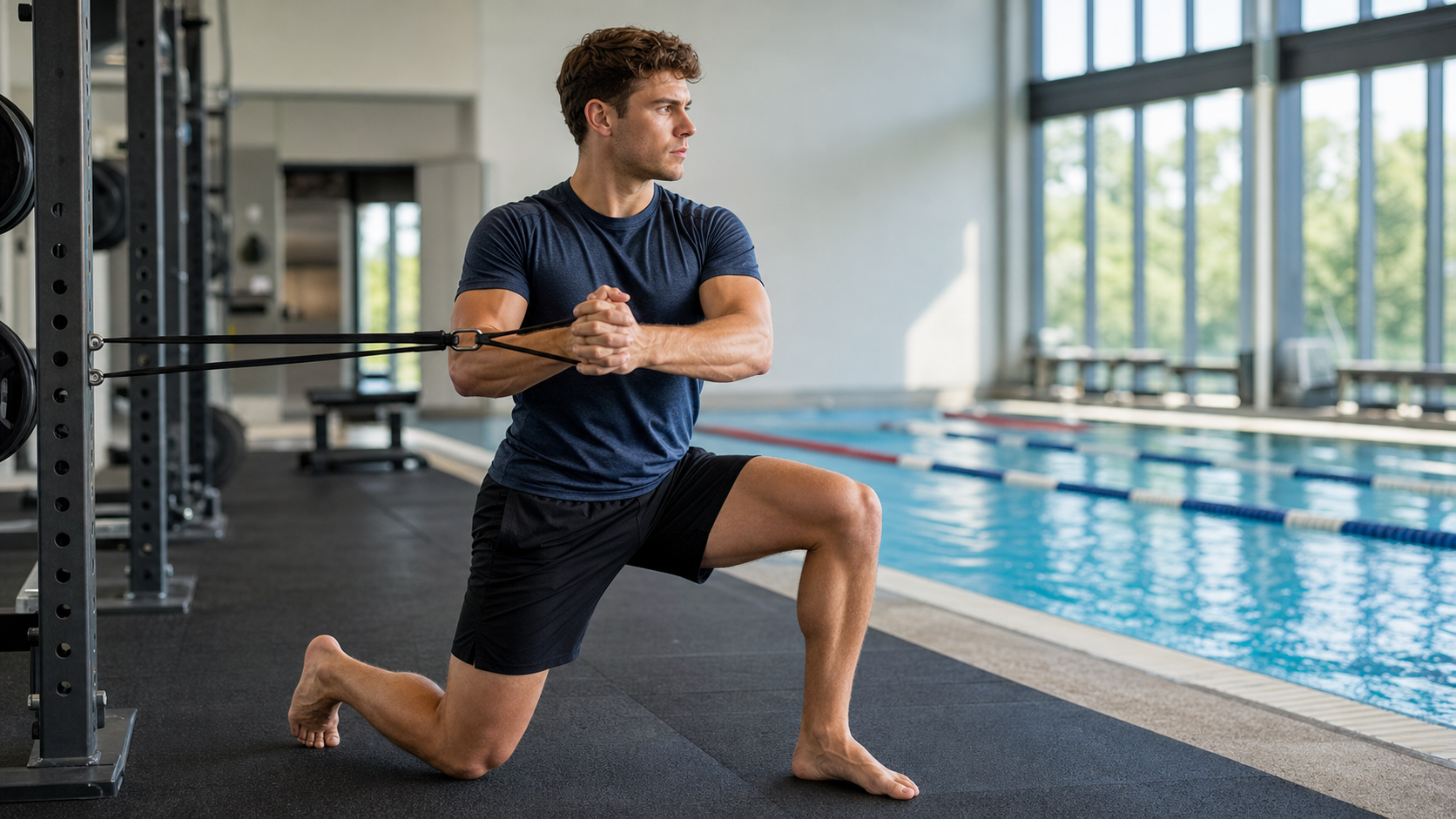
- Pallof Press (all directions): Can be performed standing, kneeling, or on a single leg; currently the most scientifically supported anti-rotation exercise
- Dumbbell Farmer’s Walk (single-sided): Unilateral loading forces lateral core stability, transferring to the unilateral stroke of backstroke and freestyle
- Cable Anti-Rotation Chop: Simulates rotational resistance during the kicking motion
3. Dynamic Movements Under Spinal Stability
- Dead Bug: Contralateral arm and leg extension with the lower back pressed to the floor throughout; the top choice for swimmers building lumbar stability
- Bird Dog: Extending the contralateral arm and leg from a quadruped position, training coordination of the multifidus and erector spinae
- Single-Leg Romanian Deadlift: Standing core control + hip stability, transferring to the single-leg stance during the start
4. Breathing Integration Training
Many athletes habitually hold their breath during core exercises, but breathing in the water follows a fixed rhythm, and the core must remain contracted even during exhalation:
- When doing Dead Bugs, deliberately complete the leg-lowering phase during exhalation to practice core maintenance during the exhale phase
- Add diaphragmatic breathing practice to the plank: on the inhale, the belly does not push downward—only the ribcage expands
Sample Workout Plan (3 times per week, 20–25 minutes each)
Day A (Rotation-focused)
- Seated Medicine Ball Rotation Throw 3×10
- Dead Bug 3×10 pairs
- Cross-Body Mountain Climber 3×20
- Standing Pallof Press 3×12
Day B (Stability-focused)
- Bird Dog 3×12 pairs
- Single-Sided Farmer’s Walk 3×30 meters
- Side Plank Hip Lift 3×15
- Cable Anti-Rotation Chop 3×12
Day C (Integration-focused)
- Bear Crawl 3×20 meters
- Russian Twist (weighted) 3×15
- Single-Leg Romanian Deadlift 3×10
- Breathing-Integrated Plank 3×30 seconds
Practical Recommendations
- Schedule core training at the beginning of your dryland session, when the nervous system is most alert for the highest quality work
- Confirm basic exercise quality before progressing to advanced movements; if you cannot keep the lower back flat during Dead Bug, do not add load yet
- Swap out some exercises every 4–6 weeks to avoid neural adaptation causing a plateau in gains
- Film a side-view video of yourself performing the movements to confirm there is no excessive lumbar lordosis
Conclusion
The goal of swimming core training is not “how long you can hold,” but maintaining torso rigidity under dynamic, rotational, and respiratory stress. From Dead Bugs and Pallof Presses to medicine ball rotations, these exercises provide stimuli far beyond the static plank and are indispensable training tools for athletes aiming to improve their efficiency in the water.
Related Reading
- Swimming Core: Why Anti-Rotation Matters More Than Flexion
- Swimming Core Training: The Dialectic Between Rotational Power and Spinal Stability
- Swimming Core Training: The Direct Impact of Land-Based Core Strengthening on Water Streamlining
- Swimming Core Muscle Training: The Scientific Basis of Propulsion in Water
[教學] Premiere 影片 手震 修正 教學 防抖 單眼 影像 GoPro 穩定 Video Stabilization
8 年前
西進武嶺 免費訓練分析服務 Intervals | 練不夠還是練過頭?你哪一種類型選手?AI模型告訴你! | 備戰神器 | 公路車 訓練 | CT Yeh
4 年前
實景訓練台) 彰化經典百K 高強度喵團 90分鐘 跟著一起練功 2019 Indoor workout Changhua Classic 100 Taiwan
7 年前
一起升級!海鷗盃LSD團練...JJSC Zone2招待 騎到手抖 / 公路車 / CT Yeh
2 天前
一日北高 實用 單車手機架!Bone蹦克磁吸單車手機綁 //環島/室內訓練 / 導航的APP推薦 / 日本島波海道取景 / 公路車 / CT Yeh
2 年前
西進武嶺 自製新版AI配速表產生器 x 賽前攻略 抱佛腳! 沒有功率計也可以產生配速表嗎?有什麼其他眉角賽前要注意的呢? | 西進武嶺 / 東進武嶺 KOM 攻略 | 公路車 | CT Yeh
4 年前
CT暗黑廚房) 車友必備 宇宙無敵鮮蚵湯 幫助訓練恢復 天然食補 好市多 超肥鮮蚵 破PR
7 年前
Garmin Edge 1040 重大韌體更新!! / 1050功能全下放!? / 坡度反應變快了嗎?/ 快速對比實測 / 公路車 / CT Yeh
1 年前