Introduction
“Swimmer’s Shoulder” is the most common overuse injury among swimmers, with an incidence rate as high as 40–70% in competitive athletes. The rotator cuff consists of four tendons—the supraspinatus, infraspinatus, subscapularis, and teres minor—which work to maintain the stable position of the humeral head during large ranges of shoulder motion. When the high-elbow position of the pull, internal rotation during the push phase, and the recovery phase after exiting the water create cumulative load, combined with weakness in the scapular stabilizer muscles, the rotator cuff tendons become prone to impingement syndrome or chronic inflammation.
Analysis of the Causes of Rotator Cuff Injuries
During the swimming stroke, the shoulder joint repeatedly moves near its maximum range of motion:
- Catch Phase: Shoulder flexion + internal rotation, with the supraspinatus bearing maximum tension
- Pull Phase: Strong internal rotation, dominated by the subscapularis; if the scapula is unstable, the humeral head shifts forward and compresses the anterior tendons
- Recovery Phase: External rotation + abduction, requiring eccentric control from the infraspinatus and teres minor
The core problem usually lies not in the rotator cuff itself, but in the fact that: the scapular stabilizer muscles (serratus anterior, lower trapezius) are too weak to maintain subacromial space during high-speed stroking.
Key Training Movements for Injury Prevention
Layer 1: Activating Scapular Stabilizers
| Exercise | Target Muscles | Sets/Reps |
|---|---|---|
| Band External Rotation (Side-Lying) | Infraspinatus, teres minor | 3×15 |
| Wall Angel | Lower trapezius, serratus anterior | 3×10 |
| Prone Y-T-W | Middle and lower trapezius | 3×10 per letter |
| Serratus Wall Slide | Serratus anterior | 3×12 |
Prone Y-T-W is the essence of scapular stability training: the athlete lies prone on a training bench and performs three positions with the arms—Y shape (overhead raise), T shape (lateral raise), and W shape (bent-elbow external rotation)—starting with body weight and gradually adding light dumbbells. This movement effectively strengthens the often-neglected lower trapezius.
Layer 2: Rotator Cuff Strength Training
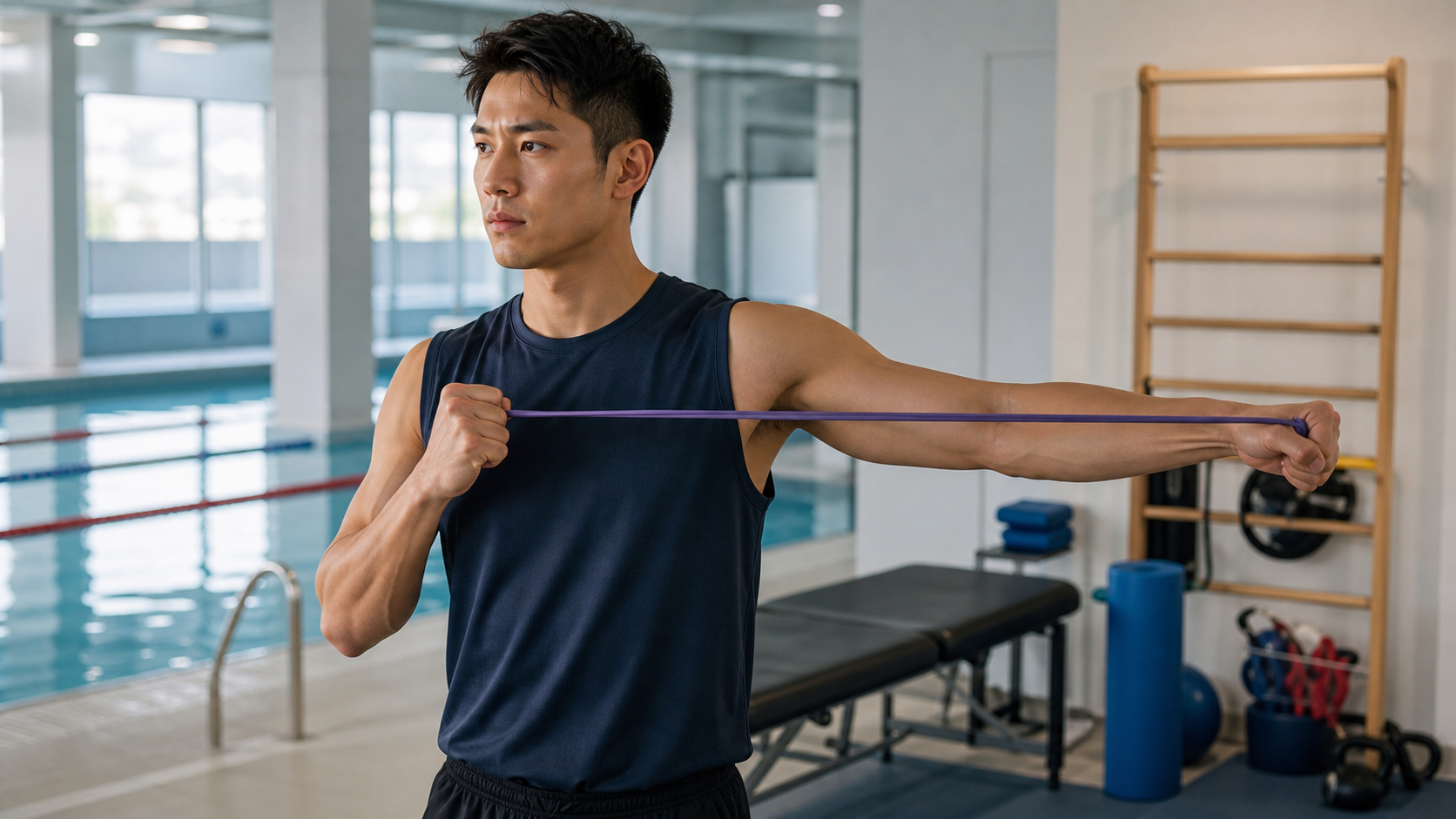
- Band External Rotation (Standing, Elbow at 90 Degrees): The most direct training for the infraspinatus and teres minor, at least 3 times per week
- Eccentric Internal Rotation Control: Slowly (5 seconds) return from external rotation to neutral position to train the eccentric capacity of the subscapularis, preventing excessive anterior translation during the pull phase
- Side-Lying External Rotation + Shoulder Flexion Compound Movement: Simulates the compound external rotation of the recovery phase of the stroke
Layer 3: Dynamic Stability Integration
Once foundational strength is established, stability needs to be integrated into dynamic contexts:
- TRX Face Pull: Stand beneath the TRX and pull the hands toward the sides of the face, training the compound movement of horizontal abduction + external rotation
- Band Side-Stepping with High-Elbow Position Hold: Simulates the high-elbow position of the stroke while maintaining scapular stability
- Prone Row (Elbow Abducted at 90 Degrees): Strengthens the back muscles used in the pulling phase of the stroke while requiring scapular retraction
Suggested Weekly Preventive Training Plan
The following plan is designed for 15 minutes per session and can be used as a warm-up before water training or as a finisher for land training:
Each Session (3–4 times per week):
- Wall Angel × 10 reps × 2 sets
- Band External Rotation × 15 reps × 2 sets (each side)
- Prone Y-T-W × 10 reps × 2 sets (each letter)
- TRX Face Pull × 12 reps × 2 sets
4 weeks before competition season: increase the number of sets while keeping reps per set the same, to avoid excessive fatigue affecting water training.
Common Mistakes and Corrections
- Band resistance too heavy: The focus of external rotation training is tendon quality, not muscle hypertrophy. The band resistance should be set so that the final rep can still be performed with proper form
- Neglecting the serratus anterior: Many athletes only train the posterior scapular muscles, but a weak serratus anterior causes winging of the scapula, which also leads to impingement issues
- Continuing to train through pain: Shoulder pain is a signal to stop training. Reduce volume immediately and seek evaluation from a physical therapist
Practical Recommendations
- Spend 5 minutes on scapular activation before each water session, especially Wall Angels and band external rotations
- When training volume increases significantly (e.g., pre-competition overload), simultaneously increase the frequency of weekly preventive training sessions
- Perform a “shoulder functional assessment” once a month: check whether side-lying external rotation range is symmetrical and whether shrugging compensation appears during prone Y-T-W
- When sleeping on your side, avoid compressing the shoulder on your dominant stroking side; use a pillow for support if necessary
Conclusion
Preventing swimmer’s shoulder is not something to address only after pain appears—it requires systematically strengthening the scapular stabilizer muscles and rotator cuff through daily training. The Y-T-W, band external rotation, and TRX Face Pull form the core of a preventive training plan. As long as they are performed consistently each week, most athletes can significantly reduce their risk of rotator cuff injuries and extend the duration of high-intensity training.
Related Reading
- Shoulder Strengthening for Swimming: Preventive Training for the Rotator Cuff
- Shoulder Injuries in Swimming: Causes and Prevention of Swimmer’s Shoulder
- Shoulder Joint Protection for Young Swimmers: Prevention and Early Intervention for Swimmer’s Shoulder
- Swimmer’s Shoulder: Identifying Rotator Cuff Syndrome and Its Causes
[教學] Premiere 影片 手震 修正 教學 防抖 單眼 影像 GoPro 穩定 Video Stabilization
8 年前
一日北高/長距離團騎 常見問題補充篇 / 組團或跟團的眉角 / 壯車友容易被瘦車友慢性拉爆 / 原來屁股痛可能是這個原因...? / 風場配速法 / 公路車 / CT Yeh
2 年前
一日北高前的西濱集訓 | 跟著11小時軍團 | 300W踩不動的大逆風 | 輪車破風差幾瓦?
6 年前
西進武嶺 免費訓練分析服務 Intervals | 練不夠還是練過頭?你哪一種類型選手?AI模型告訴你! | 備戰神器 | 公路車 訓練 | CT Yeh
4 年前
Insta 360 One 超級防手震技術實測
7 年前
一起升級!海鷗盃LSD團練...JJSC Zone2招待 騎到手抖 / 公路車 / CT Yeh
1 天前
摔車後補裝備: 好市多新款單車安全帽& Specialized Romin 北高整路屁股都不痛的坐墊 | 一千元居然有MIPS | CT Yeh | 公路車
4 年前
抖肩舞 台灣x日本交流版 (台灣 vs 前橋) 赤城山登山賽 coincidance
8 年前