Iliotibial Band Syndrome (IT Band Syndrome): The Most Common Lateral Knee Pain in Long-Distance Running
Introduction
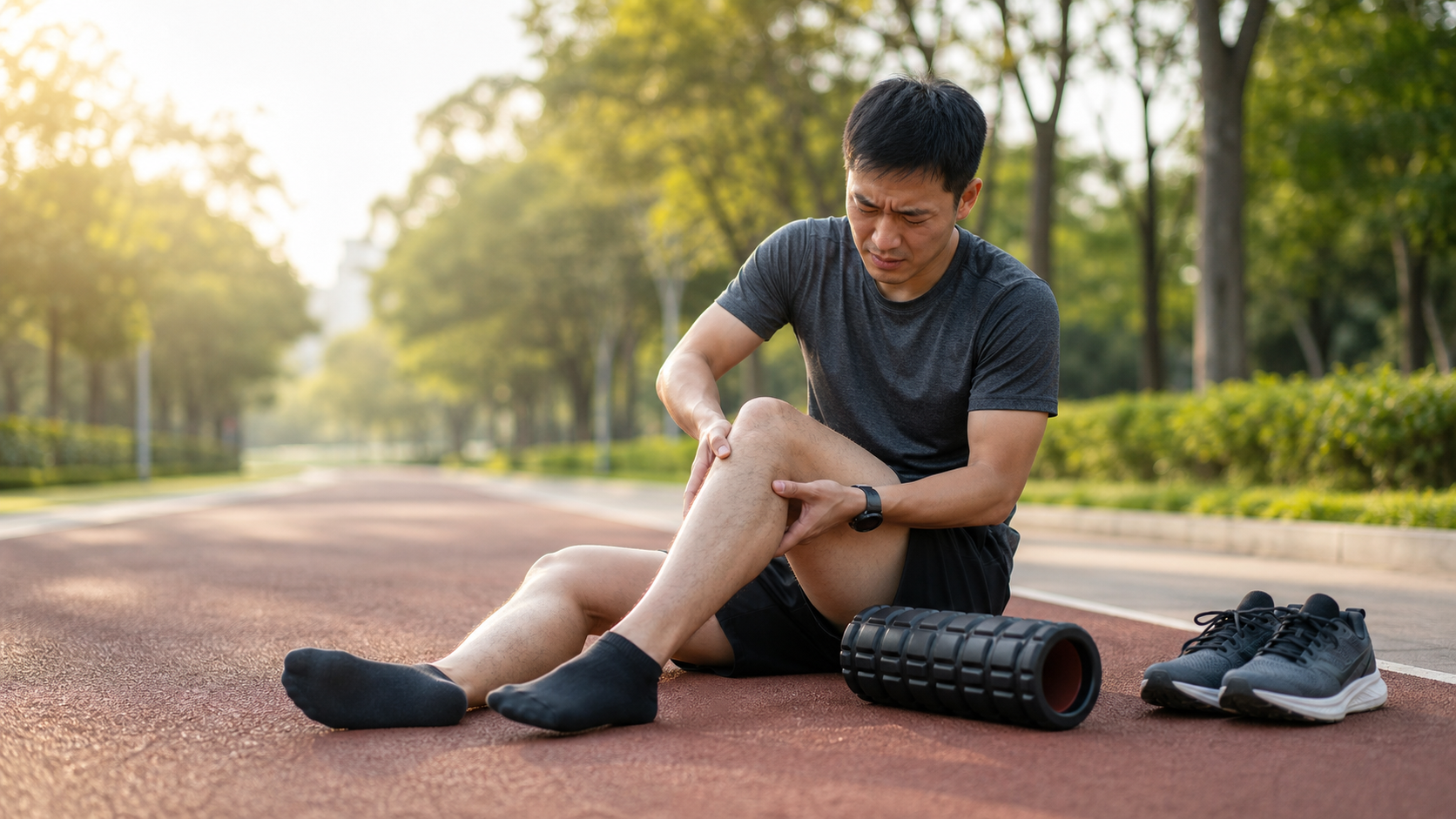
If you have ever experienced a sharp, “knife-like” or “burning” pain on the outside of your knee 30–40 minutes into a run, making it nearly impossible to continue, you may be dealing with Iliotibial Band Syndrome (ITBS). This is one of the most common overuse injuries among long-distance runners and marathoners, frequently occurring during intense training blocks or when mileage is suddenly increased.
Anatomy: What Is the Iliotibial Band?
The Iliotibial (IT) Band is a thick band of fibrous connective tissue that runs from the outside of the hip (iliac crest) down to the lateral side of the tibia. It is not a muscle and cannot actively contract; its function is to stabilize the lateral knee and transmit force from the glutes and lateral thigh.
When running, each time the knee flexes to approximately 30 degrees, the IT Band rubs against the lateral femoral epicondyle (the bony prominence on the outside of the thigh bone). When this motion is repeated thousands of times, inflammation and pain develop.
Who Is Most at Risk?
| Risk Factor | Description |
|---|---|
| Sudden increase in mileage | Weekly mileage jumping more than 10% is the most common trigger |
| Weak gluteus medius | Insufficient pelvic stability causes knee valgus, increasing IT Band tension |
| Leg length discrepancy | The longer leg’s lateral structures bear more stress |
| Downhill running | Prolonged time at 30 degrees of knee flexion leads to more friction |
| Running in the same direction on a track | The inside leg continuously bears asymmetrical stress |
| Overpronation or oversupination | Alters tibial rotation, affecting IT Band tension |
The Right Way to Release: Foam Rolling ≠ Directly Pressing the IT Band
Many runners believe that applying direct, heavy pressure to the IT Band with a foam roller is the best approach. However, the IT Band itself lacks elasticity, and direct compression can irritate surrounding nerves and cause more discomfort.
The correct approach:
- Roll the upper lateral thigh (near the IT Band origin): Gently roll over the outer hip and the upper third of the thigh, 60–90 seconds per side.
- Roll the tensor fasciae latae (TFL): Located on the front-lateral hip, use a foam roller on this small muscle while lying on your side—this is key to releasing IT Band tension.
- Stretch the piriformis: While seated, place the affected ankle on the opposite knee, lean forward, and hold for 30 seconds × 3 sets.
Treatment and Rehabilitation Protocol
Acute phase (1–2 weeks after pain onset):
- Stop running; switch to swimming or aqua jogging to maintain aerobic fitness.
- Ice the lateral knee, 15 minutes per session, 3 times daily.
- Non-steroidal anti-inflammatory drugs (e.g., Ibuprofen) may be used short-term, following your doctor’s advice.
Rehabilitation phase (2–6 weeks):
- Strengthen the gluteus medius: side-lying leg raises and lateral band walks, 2–3 sets daily.
- Strengthen the gluteus maximus: single-leg bridges, 15 reps per side × 3 sets.
- Progressively resume single-leg squats, ensuring the knee does not cave inward.
Return-to-running phase (after 6 weeks):
- Start with short distances on flat terrain (3–5 km), and only increase mileage when completely pain-free.
- Avoid running on consecutive days to allow adequate tissue recovery.
- Temporarily avoid downhill running and running in a single direction on a track.
Running Technique Adjustments
Research indicates that the following technical corrections can effectively reduce IT Band stress:
- Increase cadence: Aim for 170–180 steps per minute, shorten your stride, and reduce impact per step.
- Lean the torso slightly toward the affected side: This reduces the pelvic abduction angle and lowers IT Band tension.
- Land closer to your center of mass: Avoid overstriding to improve running mechanics.
Practical Advice
- When training on a track, reverse direction every 1–2 laps to prevent unilateral stress accumulation.
- If pain persists beyond 8 weeks despite conservative treatment, consider ultrasound-guided injection therapy.
- Pilates or yoga classes are highly beneficial for improving hip and gluteal function related to IT Band issues.
Conclusion
ITBS rarely requires surgery. The vast majority of cases fully recover with proper strength training, technique adjustments, and patience. The most common mistake is “rushing mileage as soon as symptoms improve,” which leads to recurring flare-ups. Giving your body enough time to heal is the core strategy for running long-term.
Related Reading
- Iliotibial Band Syndrome (IT Band): Complete Prevention and Rehabilitation Guide
- Iliotibial Band Syndrome (ITBS): The Complete Management Manual for Runners’ Lateral Knee Pain
- The Ultimate Guide to Iliotibial Band Syndrome: A Complete Home Rehab Record for Runners’ Lateral Knee Pain
- Runner’s Knee (Iliotibial Band Syndrome): Complete Guide to Causes, Prevention Training, and Taping Techniques
iPhone內建一秒變長腿🤣 車友必備#cycling
2 年前
一日北高/長距離團騎 常見問題補充篇 / 組團或跟團的眉角 / 壯車友容易被瘦車友慢性拉爆 / 原來屁股痛可能是這個原因...? / 風場配速法 / 公路車 / CT Yeh
2 年前
一日北高常見問題大集合 | 攻略 | 路線 | 訓練 | 補給 | 自行車 單車 | 一日雙城 | 雙塔 | TWB北高360 | 屁股痛
6 年前
西進武嶺 免費訓練分析服務 Intervals | 練不夠還是練過頭?你哪一種類型選手?AI模型告訴你! | 備戰神器 | 公路車 訓練 | CT Yeh
4 年前
Never Stop 西進武嶺 前後雙機 完整全程錄影 訓練台 實境
8 年前
白沙屯媽祖進香在家走!UREVO 坡度自調走步機 / 可連接訓練遊戲APP MyWhoosh / 邊看直播邊走起來 / CT Yeh
11 個月前
#公路車 #Fitting 靠人工智慧APP 幫你調整單車
6 年前
單車AI教練!全新 ChatGPT4o 幫你分析訓練成果!排武嶺課表,分析騎車姿勢! 太神了! / 公路車 / CT Yeh / feat. 緯緯
2 年前