Introduction
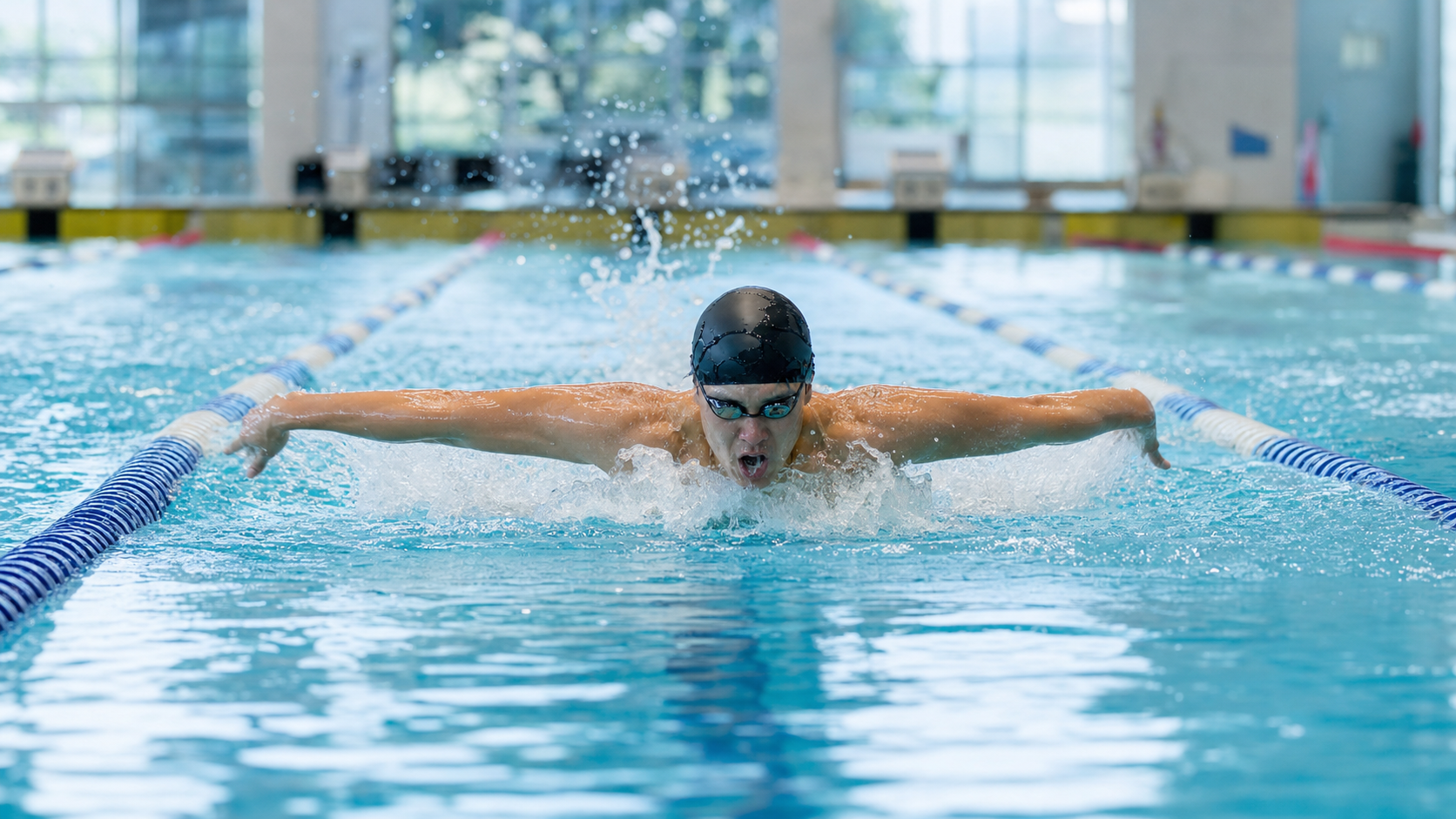
The butterfly—widely recognized as the most demanding stroke in swimming. It requires perfect synchronization of the upper body, core, and legs, with energy expenditure far exceeding that of the other three strokes, making it a stroke that many swimmers both love and fear. In Taiwan’s swimming competitions, butterfly swimmers are often all-around athletes combining both endurance and technique. This article provides a complete race preparation guide, covering the explosive sprint strategy for the 50m butterfly and the endurance pacing management for the 100m butterfly.
Biomechanical Foundations of the Butterfly
The propulsion of the butterfly comes from two sources:
- Arm Pull: Both hands enter the water simultaneously, following an S-shaped path outward, downward, and backward to push the water, providing the primary propulsion
- Dolphin Kick (Body Wave): The undulating motion of the hips and legs, assisting propulsion and maintaining a horizontal body position
The unique challenge of the butterfly lies in the precise synchronization between the dolphin kick and the arm pull—the first kick occurs as the hands enter the water (maintaining the entry position), and the second kick occurs as the arms complete the push phase (assisting propulsion). A disrupted rhythm causes a sharp decline in efficiency.
Butterfly Rhythm Types:
| Rhythm Type | Characteristics | Best Application |
|---|---|---|
| High-frequency butterfly | High stroke rate, small dolphin kick amplitude | 50m sprint |
| Medium-frequency butterfly | Balanced glide and propulsion | First half of 100m |
| Low-frequency, large-amplitude butterfly | Full extension on every stroke | 200m distance swimming |
50m Butterfly: Pure Explosiveness
The 50m butterfly (short course 25m / long course 50m) is the ultimate test of explosive power and technique, completed entirely in a highly anaerobic state.
Start Technique:
The start of the 50m butterfly places special emphasis on the efficiency of the underwater dolphin kick after entry. The rules allow fully underwater swimming before the first breath, and elite swimmers propel themselves 15 to 18 meters underwater to fully capitalize on the start’s momentum.
Underwater dolphin kick key points:
- The first three kicks use larger amplitude (for full acceleration), then reduce amplitude to conserve energy
- When speed approaches surface swimming speed, surface with a breath after one arm stroke
Mid-pool Pace:
The mid-pool segment of the 50m butterfly should maintain as high a stroke rate as possible. Regarding breathing frequency, sprint swimmers may choose to breathe every other stroke (breathing once every 2 strokes) to reduce drag from lifting the head. Be careful not to lift the body too high out of the water; maintain a low profile when breathing.
Final Sprint:
At 10 meters from the wall, increase the amplitude of the dolphin kicks to boost overall output. Ensure both hands touch the wall simultaneously on the final stroke (as required by the rules); touching slightly above the water surface can shorten the touch time.
100m Butterfly: The Most Difficult Pacing Management
The 100m butterfly has the highest “collapse rate” in the second half of any swimming event—swimmers who push too hard in the first 50m often struggle in the second 50m, with their arm pulls degrading into flat pushes and their dolphin kicks disappearing entirely.
Key Principle: The first 50m should feel “a little slower”
Many swimmers’ 100m butterfly times plateau because they “over-invest” in the first 50m—too many dolphin kicks, too frequent breathing—causing lactic acid to accumulate heavily in the first 50m. Elite swimmers actually look “more relaxed” in the first 50m precisely because they precisely control their energy output.
100m Pacing Strategy:
- First 50m: Swim at approximately 1.5 to 2 seconds slower than your target pace per 50m, preserving energy for the second half
- 15m after the turn: Use the underwater dolphin kick to actively accelerate (this segment is the fastest)
- Main body of the second 50m: Maintain stroke rate, do not reduce the dolphin kick from at least two kicks per arm stroke
- Final 25m: Full output, deliberately increase stroke rate
Breathing Strategy:
Breathing management in the 100m butterfly is the key to victory. In the first 50m, it is recommended to breathe every 2 arm strokes (breathing every other stroke). In the second 50m, if you feel oxygen-deprived, you may adjust to breathing on every stroke, but maintain a consistent rhythm.
Pre-Race Preparation
- Thorough Warm-up: The butterfly requires a longer warm-up time; it is recommended to swim at least 400m for warm-up, including butterfly leg warm-up (dolphin kick only with a kickboard), and incorporate 2 to 3 sets of 15m butterfly sprints
- Pre-Race Mental Setting: The final 25m of the 100m butterfly will be extremely painful. Acknowledge this before the race and set a mental preset of “maintain the stroke rate no matter how much it hurts”
Practical Advice
- Dolphin Kick Board Training: Perform pure dolphin kick training at least twice a week to improve core-to-leg coordination
- Breathing Timing Training: Practice breathing only at designated points to build discipline and breathing efficiency
- Video Analysis: Record from the side to observe whether your body rises and falls excessively above and below the water surface (it should stay as flat and low as possible)
- Taiwan Reference Standards: National Youth Group A men’s 100m butterfly is approximately 58 seconds to 1:03, women’s approximately 1:05 to 1:12
Conclusion
Race preparation for the butterfly ultimately comes down to one core question: Can you maintain the integrity of your technical movements while fatigued? This requires not just physical strength, but muscle memory built through extensive training. Every complete and beautiful butterfly stroke lays the foundation for success on race day.
Related Reading
- Explosive Power Management in the 100m Butterfly: Balancing Early Conservation with Late Sprinting
- 50m Freestyle Race Strategy: Reaction Time, Mid-pool Swimming, and Sprinting
- Olympic 200m Butterfly Tactics Deep Dive: How to Allocate the First and Second Halves to Win Gold?
- Coordination Training for Butterfly Dolphin Kick and Body Wave
Live) 備戰2019彰化經典百K 賽前攻略 (已完賽請看新影片
7 年前
戀戀197 血脈噴張 多視角剪輯版 最艱難的市民競賽組 M30 M35 參賽記錄 請開字幕 4K高畫質 #公路車
6 年前
西進武嶺 自製新版AI配速表產生器 x 賽前攻略 抱佛腳! 沒有功率計也可以產生配速表嗎?有什麼其他眉角賽前要注意的呢? | 西進武嶺 / 東進武嶺 KOM 攻略 | 公路車 | CT Yeh
4 年前
CT 喇低賽) 武嶺牽車 才是王道 西進牽車四小時內秘訣 攝手位置 如何判斷 防抽筋小秘訣
7 年前
戀戀197 競賽組 | 50頁投影片心得報告 | 賽後檢討 攻略 #公路車
6 年前
實景訓練台) 彰化經典百K 高強度喵團 90分鐘 跟著一起練功 2019 Indoor workout Changhua Classic 100 Taiwan
7 年前
2024 彰化經典百K 參賽直播 / 黃亭茵集團 / 公路車 / CT Yeh
2 年前
西進武嶺 免費訓練分析服務 Intervals | 練不夠還是練過頭?你哪一種類型選手?AI模型告訴你! | 備戰神器 | 公路車 訓練 | CT Yeh
4 年前