Introduction
In cycling, crashes are an unavoidable risk, but fractures are not necessarily unpreventable. According to Taiwan emergency medical data, cycling-related fractures account for 15–20% of sports fractures, with clavicle fractures being the most common single-site injury, representing approximately 35% of cycling fractures. Understanding fracture risks, choosing appropriate protective gear, and mastering proper crash techniques can significantly reduce the severity of injuries sustained in the same crash scenario.
Common Fracture Sites and Mechanisms in Cycling
Analysis of Common Fracture Sites
| Fracture Site | Incidence | Primary Mechanism | Common Scenarios |
|---|---|---|---|
| Clavicle | ~35% | Shoulder striking the ground during lateral fall, or force transmitted through an outstretched hand | Group ride contact, loss of control on descents |
| Wrist (distal radius) | ~25% | Instinctive hand brace against the ground | Low-speed falls, hard braking on descents |
| Ribs | ~15% | Side impact with the road surface or obstacles | High-speed crashes, mountain bike off-road riding |
| Acromioclavicular (AC) joint | ~10% | Direct impact to the acromion | Collision with vehicles, high-speed side falls |
| Hip (femoral neck) | ~5% | Side falls in middle-aged and older riders | Riders over 50, those at risk of osteoporosis |
Clavicle Fractures: Why Are They So Common?
The high incidence of clavicle fractures in cycling accidents stems from a human instinctive reflex: extending the arm to protect the head during a fall. The impact force travels from the palm through the radius, elbow joint, and humerus to the shoulder joint, ultimately concentrating on the midshaft of the clavicle. Additionally, direct impact of the acromion with the ground during a lateral fall is another common mechanism for clavicle fractures.
For cyclists using clipless pedal systems such as SPD or LOOK, the inability to release the foot from the pedal immediately during a fall prevents the rider from absorbing the impact with proper body positioning, further increasing the risk of fracture.
Risk Assessment Framework
Individual Bone Health Assessment:
The following groups are at high risk for fractures and should assess their bone health before riding:
- Postmenopausal women (accelerated bone loss)
- Men over 50
- Those on long-term corticosteroid therapy
- Individuals with a family history of osteoporosis
- Underweight individuals with a BMI below 18.5
Riders over 50 are advised to undergo a bone density (DEXA) scan to understand their T-score. If the T-score is below -1.0, they should discuss cycling risk management strategies with an orthopedic physician.
Riding Scenario Risk Assessment:
- Club Rides: High risk of crashes in the peloton; beginners are advised to first master group riding etiquette
- High-speed descents: For every 10 km/h increase in speed, the impact force upon crashing increases exponentially
- Mountain biking (MTB): Dense obstacles; riders should assess terrain that exceeds their technical skill level on off-road trails
- Wet road surfaces: During Taiwan’s plum rain season or on roads with morning dew, braking distance increases by 40–60%
The Science of Choosing Protective Gear
Helmets (the most important protection):
- Helmets reduce the risk of traumatic brain injury by approximately 60–70% (Cochrane Review data)
- Ensure the helmet meets CE EN 1078 or CPSC certification standards
- Replacement timing: after any impact (even if there is no visible damage, the internal EPS foam may have been compressed and compromised), or after more than 5 years of use
- Helmet fit: after putting it on, there should be no more than 5 mm of movement front-to-back or side-to-side; the strap should be adjustable for a snug fit
Wrist Guards and Knee Pads:
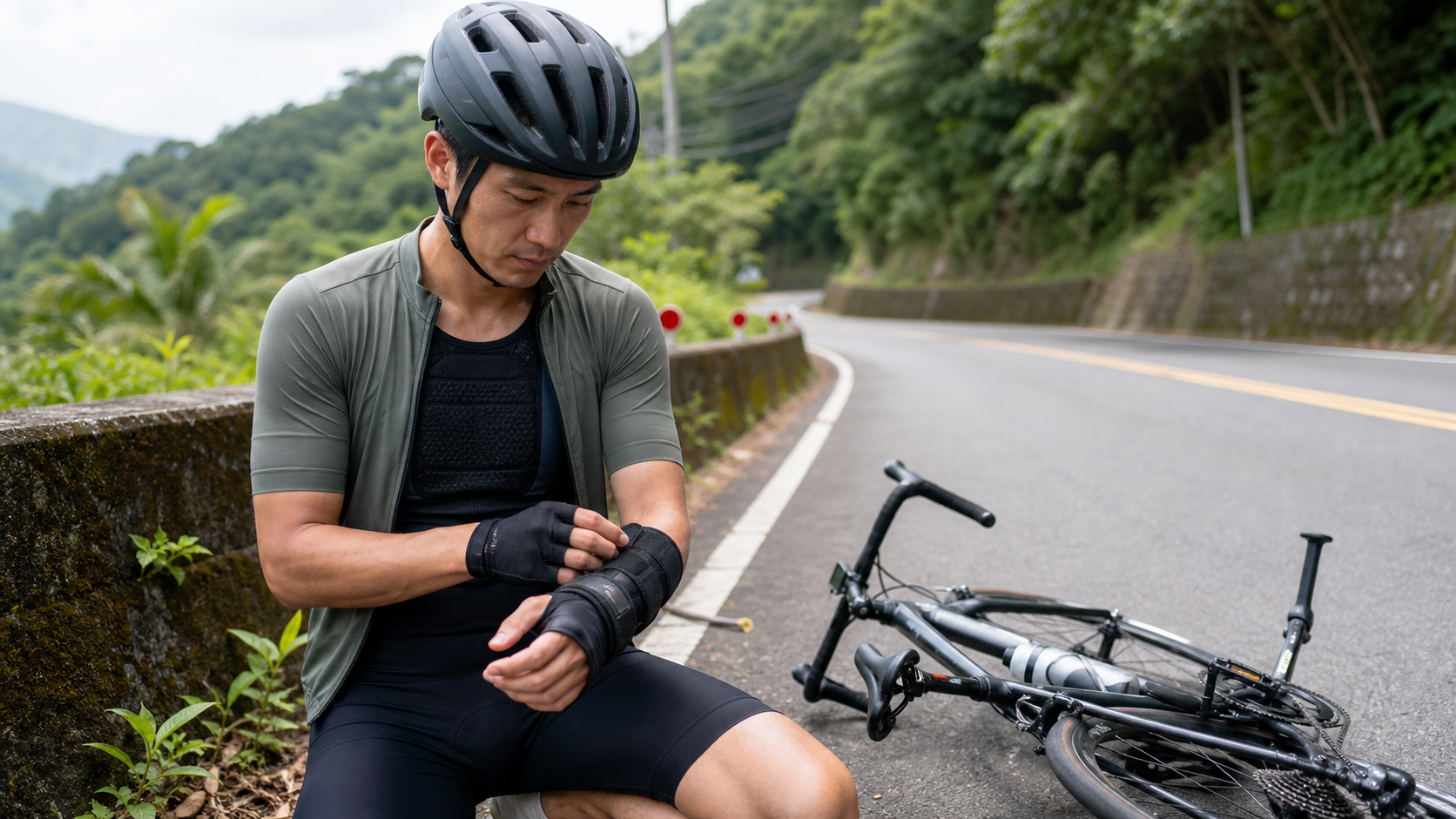
- Wrist guards significantly reduce the risk of distal radius fractures, particularly recommended for MTB riders and beginners
- Downhill MTB knee-shin guards protect the patella and tibia
- Road cyclists can opt for lightweight, low-profile knee guards during training races or group rides
Clavicle Protection:
- Airbag shoulder protectors are an emerging technology in recent years, inflating at the moment of impact to significantly reduce the risk of clavicle fractures
- Traditional EVA foam shoulder pads (integrated into protective vests) provide basic protection, suitable for mountain bikers
Impact-Absorbing Apparel:
- MTB shorts with CE-certified armor protect the hips and coccyx
- While road cyclists’ tight-fitting jerseys offer no impact protection, they do reduce the coefficient of friction between the skin and the road surface during a slide
Proper Crash Techniques
An ideal fall position can significantly reduce injuries:
- Do not brace with your hands: Although it is instinctive, landing on a rigid, outstretched arm is the leading cause of radius fractures; practice the concept of a “tuck and roll” landing
- Tuck your chin to protect your head: At the moment of impact, tuck your chin toward your chest to reduce the risk of head contact
- Roll to the side to absorb impact: If you have time to react, attempt a lateral roll rather than landing flat, distributing the impact force over a larger surface area
- Stay relaxed, don’t tense up: Muscle tension actually increases the risk of fracture; try to remain relatively relaxed
Practical Recommendations
Bone Strengthening Strategies:
- Cycling is a non-weight-bearing exercise and has limited benefits for improving bone density; it is recommended to engage in weight-bearing exercises such as weight training or running twice a week to maintain bone density
- Ensure adequate calcium intake (1000–1200 mg daily) and vitamin D (800–1000 IU daily)
- Taiwan enjoys abundant sunshine in summer, but cyclists who use comprehensive sun protection should monitor their vitamin D levels (regular blood tests are recommended)
Post-Crash Assessment Principles:
- Any altered consciousness, neck pain, or arm numbness/weakness → call an ambulance immediately; do not attempt to move the injured person
- Suspected clavicle fracture: immobilize the arm (support the injured side’s elbow with the opposite hand) and do not continue riding
- Suspected wrist fracture: apply a splint (a tire repair tool can serve as a temporary substitute) and seek medical attention; do not attempt to move the joint
Conclusion
Fracture prevention requires a multi-faceted approach: strengthening the bones themselves, selecting appropriate protective gear, assessing and appropriately avoiding high-risk scenarios, and practicing proper emergency response techniques. Cycling is thriving in Taiwan, with more riders tackling more routes at higher speeds—which underscores the importance of systematic knowledge of fracture prevention. Push your limits with courage, but also protect yourself with intelligence.
Related Reading
- First Aid for Cycling Fractures: On-Site Management of Clavicle Fractures and Return-to-Riding Timing
- Rehabilitation Plans After Cycling Fractures: Return-to-Training Timelines for Clavicle and Wrist Fractures
- Common MTB Injuries: Prevention and Rehabilitation for Wrist, Shoulder, and Knee Injuries
- Choosing Protective Gear for Cyclists: How to Protect Your Wrists and Knees
摔車後補裝備: 好市多新款單車安全帽& Specialized Romin 北高整路屁股都不痛的坐墊 | 一千元居然有MIPS | CT Yeh | 公路車
4 年前
靠單車減肥35公斤 心得分享與整理
7 年前
高雄綠園道鐵路自行車道 / 外地人能輕鬆駕馭 還是整路崩潰? / 2025 全線開通 春節實地探索一次!(附GPS連結)/ 公路車 / CT Yeh
1 年前
風櫃嘴 | 全台最多大砲的單車路線 | 尋寶網攝影師告訴你怎麼擺拍起來才好看 | 熱門攝影地點巡禮
6 年前
2026 車錶排行榜!誰是最多車友正在使用?練家子最愛哪款?🏆 (2萬名車友數據) / 公路車 / CT Yeh
5 個月前
Canyon 公路車斷把手 五年老車特規還能修嗎? 維修保養全記錄 feat. 501單車監理站 | 公路車 | CT Yeh
4 年前
超開放的自行車錶!可以玩遊戲裝APP!?/ SRAM合併的 Hammerhead Karoo深入開箱!/ 即時爬坡偵測 / 全球導航地圖 / Garmin Bryton / CT Yeh
1 年前
一日北高/長距離團騎 常見問題補充篇 / 組團或跟團的眉角 / 壯車友容易被瘦車友慢性拉爆 / 原來屁股痛可能是這個原因...? / 風場配速法 / 公路車 / CT Yeh
2 年前