Introduction
“Runner’s Knee” is one of the most common injuries among the road-running community in Taiwan, encompassing Iliotibial Band Syndrome (ITB Syndrome) and Patellofemoral Syndrome. Most people’s instinctive reaction is “too much mileage, not enough rest,” but if you simply rest and then return to running, the injury often recurs within weeks.
The root cause usually lies not in the knee itself, but further up the chain: a weakened Gluteus Maximus. The gluteus maximus is the largest muscle in the human body, controlling hip extension, external rotation, and abduction—three movements that directly determine knee alignment. When the glutes are weak, the knee collapses inward (Knee Valgus) with every foot strike, leading over time to abnormal wear on the patella and femur.
How the Gluteus Maximus Protects the Knee: A Biomechanical Breakdown
Knee problems in running can almost all be traced back to the issue of “knee valgus.” Let’s follow the kinetic chain:
- After foot strike, the gluteus medius and gluteus maximus should activate immediately to stabilize the ipsilateral pelvis
- If the glutes respond slowly or are weak, the pelvis tilts to the opposite side (Trendelenburg Gait)
- The pelvic tilt triggers compensatory internal rotation of the thigh, and the knee shifts inward accordingly
- In a knee valgus state, the patella tracks laterally against the femur, causing abnormal friction
- Simultaneously, the IT band is overstretched, triggering lateral knee pain
The gluteus maximus’s direct protective mechanisms for the knee:
| Gluteus Maximus Function | Protective Mechanism | Consequence When Lost |
|---|---|---|
| Hip extension | Sufficient push-off power, reducing knee compensation | Excessive knee flexion, increased patellar pressure |
| Hip external rotation | Prevents excessive internal rotation of the thigh | Knee valgus, overstretched IT band |
| Pelvic stability | Maintains a level pelvis during running | Pelvic tilt on every step, cumulative knee joint stress |
Common Causes of Gluteal Deactivation
Modern life puts the gluteus maximus to “sleep,” with the main causes including:
- Prolonged Sitting Inhibition (Gluteal Amnesia): Long periods of sitting suppress neural recruitment of the gluteus maximus, and even after standing up, the brain “forgets” how to activate it
- Tight Hip Flexors: Tight hip flexors inhibit the opposing gluteus maximus through Reciprocal Inhibition
- Weakened Brain-Muscle Connection: Without targeted neuromuscular training, gluteal recruitment during running is delayed
Self-Test: Are Your Glutes Working?
Perform a side-lying Clamshell: lie on your side, bend your knees 90 degrees, keep your heels together, and slowly raise the top knee. If you feel the outer thigh (TFL) working rather than the glutes, you have a gluteal deactivation issue.
Glute Strengthening Training Plan
Step 1: Activation Training (Awakening Phase, First 2 Weeks)
Before strengthening, rebuild the neural connection to the glutes:
- Clamshell: Lie on your side with a resistance band around your thighs, slowly raise the top knee, focusing on feeling the glutes engage, 3 sets × 15 reps/side
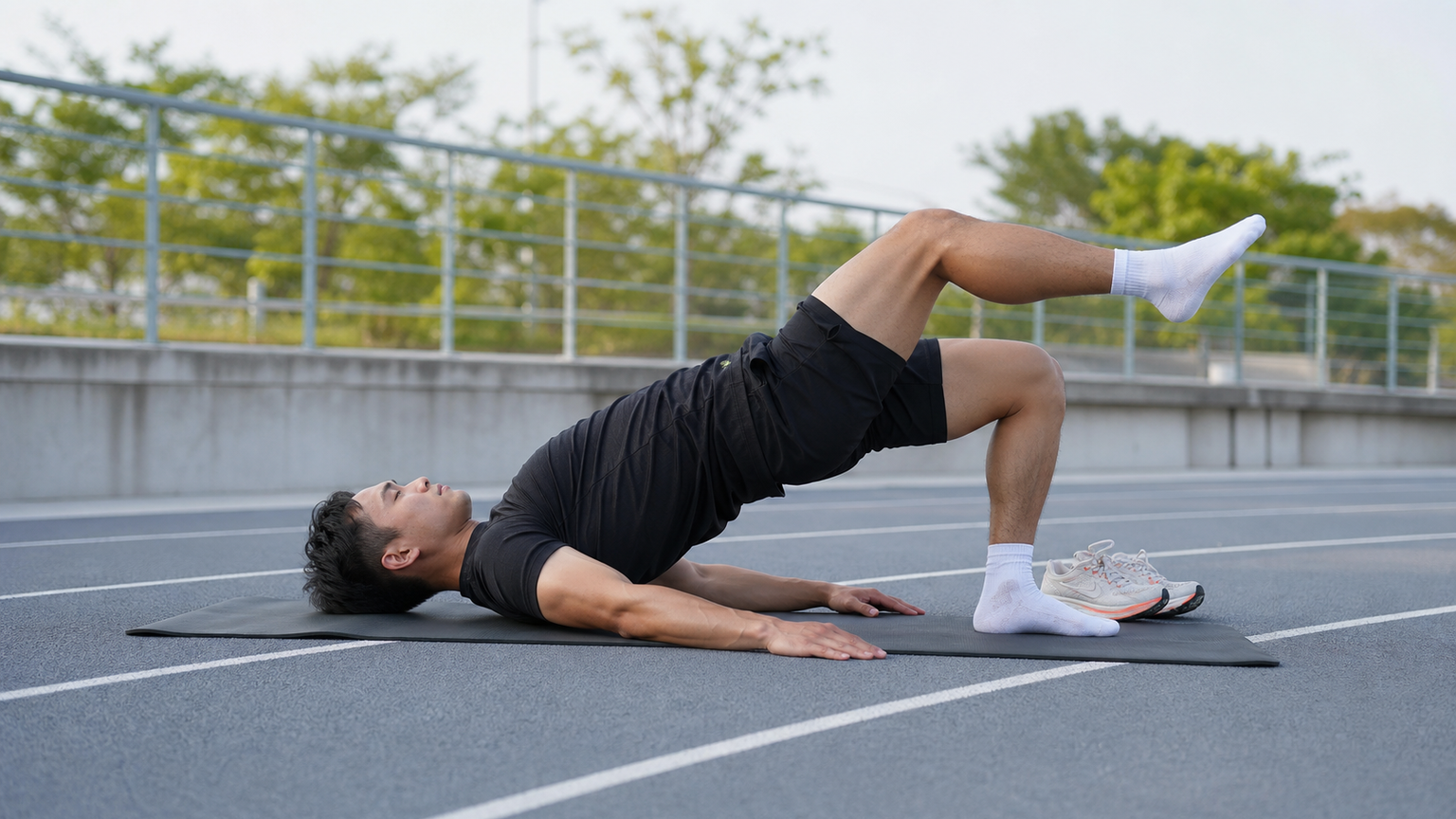
- Glute Bridge: Lie on your back with knees bent, squeeze the glutes as you lift the hips and hold for 3 seconds, 3 sets × 15 reps
- Donkey Kick: On all fours, kick one leg back until the thigh is parallel to the floor, 3 sets × 15 reps/side
Key to activation training: Move slowly and hold for 2–3 seconds at the top to ensure the brain rebuilds its connection with the glutes. If you feel the back of the thigh (hamstrings) working, you’re compensating with your hamstrings and need to adjust the movement.
Step 2: Strengthening Training (Weeks 3–8)
- Single-leg Glute Bridge: Extend one leg and perform a single-leg bridge to build unilateral gluteus maximus strength, 3 sets × 10 reps/side
- Romanian Deadlift: A posterior-chain compound movement, driving power from the hips, 3 sets × 8–10 reps
- Bulgarian Split Squat: Rear foot elevated on a bench, squat down until the thigh is parallel to the floor, emphasizing output from the front-leg glutes, 3 sets × 8 reps/side
- Clamshell with Resistance Band: Add band resistance on top of the basic clamshell, 3 sets × 15 reps/side
Step 3: Functional Integration (Weeks 9–12)
- Lunge with Rear Leg Raise: After completing a lunge, kick the rear leg backward and upward to reinforce gluteal involvement during the push-off phase
- Lateral Box Jump: Take off laterally on one leg and jump onto a box to build rapid power in the gluteus medius and gluteus maximus
- Kettlebell Swing: An explosive movement powered by the hips as the engine—the best exercise for functional integration
The Importance of Pre-Run Glute Activation
Research shows that runners with gluteal weakness who perform 10 minutes of glute activation before running significantly improve knee alignment at foot strike. Recommended pre-run routine:
- Clamshell 2 sets × 15 reps/side (awaken the gluteus medius)
- Glute Bridge 2 sets × 15 reps (activate the gluteus maximus)
- Monster Walk with resistance band, 20 steps out and back (functional activation)
Practical Advice
- Address tight hip flexors first: Before glute training, perform a runner’s lunge stretch for 30 seconds/side to release reciprocal inhibition
- Pre-run activation matters more than the training itself: Even without additional training, 10 minutes of activation before every run can improve gluteal engagement during running
- Use video to check your running form: Have someone film you running from behind and observe whether your pelvis drops or your knees cave inward
- Don’t neglect the gluteus medius: The gluteus medius’s lateral stabilization function is just as important as the gluteus maximus—both clamshells and side planks should be included in your program
- If your knee hurts, stop running and do glute training: When runner’s knee symptoms appear, take 1 week off running and focus on glute activation and strengthening—this often resolves the problem faster than rest alone
Conclusion
A weakened gluteus maximus is the true root cause of most road runners’ knee injuries—not excessive mileage. Once you understand this relationship, your training strategy should shift from “cut back and rest” to “strengthen the upstream muscles.” With glute training three times per week, combined with a pre-run activation routine, you’ll find knee problems greatly reduced within a few months, your running form more stable and powerful, and your performance improving along with it.
Related Reading
- Runner’s Glute Strengthening: The Role of Gluteus Medius and Gluteus Maximus in Running Stability
- Pelvic Stability Training for Female Runners: Gluteus Medius Strengthening to Prevent Knee Injuries
- Runner’s Glute Training: Bridge, Clamshell, and Side-Lying Leg Raises for Running
- Preventive Strength Training: Twice-Weekly Glute and Core Workouts to Reduce Injury Rates
一日北高常見問題大集合 | 攻略 | 路線 | 訓練 | 補給 | 自行車 單車 | 一日雙城 | 雙塔 | TWB北高360 | 屁股痛
6 年前
一日北高/長距離團騎 常見問題補充篇 / 組團或跟團的眉角 / 壯車友容易被瘦車友慢性拉爆 / 原來屁股痛可能是這個原因...? / 風場配速法 / 公路車 / CT Yeh
2 年前
iPhone內建一秒變長腿🤣 車友必備#cycling
2 年前
爬陡坡被爆胎的車友跑步超車 #cycling #里佳部落
9 個月前
大禹嶺 到 武嶺牌樓 全程前後實況錄影 | 北進武嶺 | 東進武嶺 | KOM | 訓練台 | 坡度分析 | Taiwan KOM Last 10 km HARD | 公路車
6 年前
Never Stop 西進武嶺 前後雙機 完整全程錄影 訓練台 實境
8 年前
單車 一日北高 ( 雙城 ) 肥宅雙人瘋狂行 紀錄片 REACTO
10 年前
CT 喇低賽) 單車 比賽總是沒照片? 攝影師的觀點大公開 姿勢就是力量! 請加速1.25倍收看
7 年前