Introduction
“Why do I run out of breath after just a few dozen meters?” This is the most common problem faced by beginner swimmers. Poor breathing technique not only affects oxygen supply but also disrupts the overall swimming rhythm and body balance. In swimming instruction in Taiwan, breathing is often the most frustrating technical hurdle for beginners.
Even for advanced swimmers, the choice of breathing strategy is an important topic: side breathing (fixed to one side) or bilateral breathing (alternating sides)? Should the strategy be the same for long-distance training as it is for racing? This article will comprehensively analyze the various aspects of freestyle breathing technique.
The Physiological Basis of Breathing
Oxygen Demand and Breathing Frequency
Swimming is a high-oxygen-consuming aerobic exercise. At moderate swimming intensity, the body requires the oxygen equivalent of 20–30 breaths per minute. However, breathing opportunities in swimming are limited by the stroke rhythm, meaning swimmers must complete a full breath within a limited time window.
Common causes of inadequate breathing:
- Only “inhaling” during the breath, without “exhaling”
- Lifting the head too high out of the water, wasting time
- Pausing the stroke rhythm during the breath, causing the body to decelerate
Correct Breathing Rhythm
Efficient swimming breathing follows this rhythm:
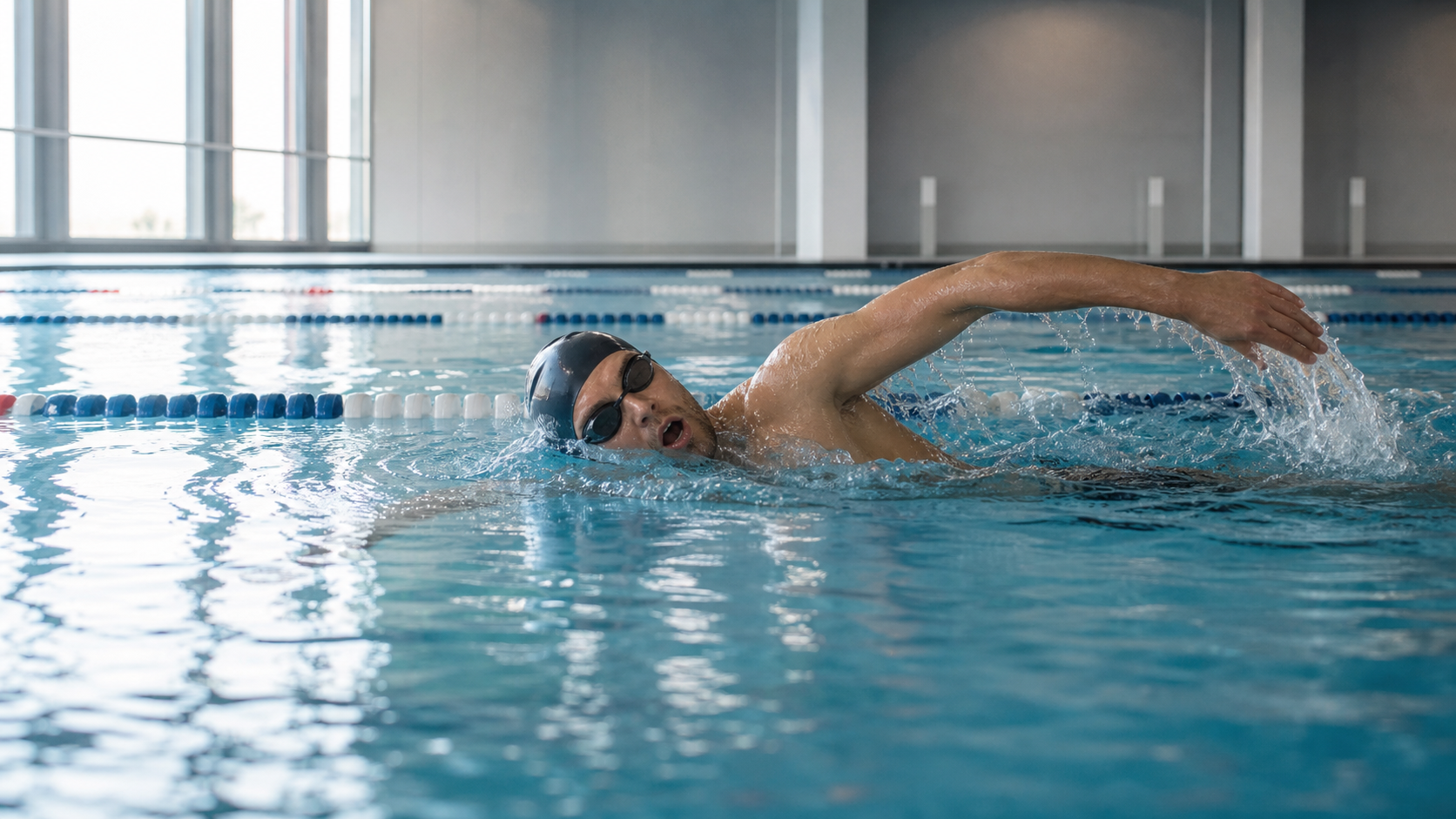
- Continuously exhale while the face is in the water (slowly exhale through the mouth and nose)
- Quickly inhale a large volume of air as the face turns to the side (open the mouth wide and rapidly take in fresh air)
- Return the face to the water and continue exhaling
“Exhaling in the water” is a key point many people overlook. If there is still air in the lungs when the face turns out of the water, you must exhale before inhaling, which significantly shortens the available inhalation time.
One-Side Breathing
Technical Characteristics
One-side breathing means consistently breathing from one side (usually the dominant side), taking a breath every 2 strokes or every stroke.
Advantages:
- Higher breathing frequency, suitable for oxygen supply needs during high-intensity or high-speed swimming
- Fixed movement pattern makes technique easier to stabilize
- Easier for beginners to master, building confidence in breathing
Disadvantages:
- Long-term fixed one-side breathing may cause left-right asymmetry in the body (uneven development of neck and shoulder muscles)
- During races, can only observe opponent positions from one side
- In open water swimming, fixed one-side breathing may not allow effective sighting of directional markers
Suitable Scenarios
One-side breathing is most suitable for: sprint races under 100 meters, high-intensity training sets, and long-distance swimming in a fatigued state
Bilateral Breathing
Technical Characteristics
Bilateral breathing typically uses a “breathe every 3 strokes” rhythm, allowing breathing to alternate between the left and right sides.
Advantages:
- Promotes body symmetry, reducing left-right imbalance issues
- Suitable for lower-intensity long-distance swimming
- Allows observation of the environment from both sides in open water
- Helps develop a more balanced stroke technique
Disadvantages:
- Lower breathing frequency (one-third fewer breaths compared to breathing every 2 strokes)
- May result in insufficient oxygen supply during high intensity
- Higher technical coordination difficulty, harder for beginners to master
- If one side’s breathing technique is weaker, bilateral breathing can expose and reinforce technical flaws
Suitable Scenarios
Bilateral breathing is most suitable for: technical training periods, distances of 400 meters and above, open water swimming, and specialized training to improve body symmetry
Breathing Strategy Comparison
| Breathing Method | Breathing Frequency | Oxygen Supply Adequacy | Body Symmetry | Learning Difficulty | Suitable Distance |
|---|---|---|---|---|---|
| One-side every 2 strokes | High | Adequate | Asymmetrical | Low | Short–medium distance |
| Bilateral every 3 strokes | Medium | Acceptable | Symmetrical | Medium | Medium–long distance |
| Bilateral every 2 strokes | High | Adequate | Symmetrical | High | All distances |
| Mixed breathing | Adjustable | Flexible | Good | Relatively high | Advanced swimmers |
Technical Details of Breathing
Head Rotation Angle
When breathing, the head only needs to rotate just enough for the mouth to clear the water surface—it’s not about “lifting the head” but “turning the head.” A common mistake many people make is lifting the head out of the water, which causes:
- The hips to sink, increasing drag
- Slowing body rotation and disrupting stroke rhythm
- Increased fatigue in the neck muscles
Bow Wave Breathing Technique
An advanced breathing technique utilizes the “bow wave”—when swimming at speed, the water surface near the face forms a depression or “trough” beside the head, allowing the swimmer to find air with a smaller head rotation angle. This technique is widely used by competitive swimmers, but a certain swimming speed is required to create a noticeable bow wave.
Coordination of Breathing and Body Rotation
Breathing in freestyle should follow the natural rotation of the body. When the arm on the breathing side pushes backward through the water, the body naturally rotates toward that side, and the head “hitches a ride,” rotating out of the water with the body’s rotation rather than rotating independently. This saves energy in the neck muscles and maintains better body posture.
Special Considerations for Open Water Breathing
Triathlon events in Taiwan (such as Sun Moon Lake and Penghu) are typically held in open water. Open water breathing has the following special requirements:
- Sighting: Periodically lift the head to check direction; this should be done in conjunction with breathing to minimize additional head lifts
- Wave Adaptation: In wavy seawater, you may need to adjust the breathing side, choosing the side with smaller waves
- Group Swimming Interference: At the start of a race, group swimming can easily cause water inhalation; be prepared and develop the ability to “quickly stabilize breathing after inhaling water”
Practical Advice
- All swimmers are advised to master bilateral breathing; even if you usually breathe on one side, you should have the ability to breathe bilaterally during races
- The fastest way to improve breathing technique: first simulate the head rotation movement on land to confirm it’s “turning the head” rather than “lifting the head”
- For high-intensity training sets, breathe every 2 strokes; for low-intensity technical training sets, use a 3-stroke breathing pattern to force more time exhaling in the water
- If you frequently inhale water, it’s usually due to an incorrect breathing angle or insufficient exhalation in the water; you need to re-practice the basic breathing movements
Conclusion
Swimming breathing is not just about “not inhaling water”—it is a core technique concerning oxygen supply, body balance, and swimming rhythm. Although bilateral breathing is more technically demanding, its value for the balanced development of swimming technique in the long run is irreplaceable. It is recommended to schedule at least one bilateral-breathing-focused technical training session per week, gradually building comprehensive breathing ability so that breathing becomes a natural extension of the swimming stroke rather than an additional technical burden.
Related Reading
- Learning Methods and Pros and Cons of Bilateral Breathing in Freestyle
- Breathing Rhythm in Swimming: Training Timing and Long-Term Benefits of Bilateral Breathing
- Breathing Rhythm in Open Water: Techniques for Maintaining Long Distances
- Improving Breathing Side Imbalance: A Progressive Plan for Bilateral Breathing Training
碟煞公路車 優缺點?換車一年半實際經驗分享 / 公路車 / CT Yeh
2 年前
詳測) 小米 電動打氣筒 公路車胎要充多久? 值得買嗎? 米家充氣寶 小心燙手!
7 年前
CT 喇低賽) 武嶺牽車 才是王道 西進牽車四小時內秘訣 攝手位置 如何判斷 防抽筋小秘訣
7 年前
一日北高/長距離團騎 常見問題補充篇 / 組團或跟團的眉角 / 壯車友容易被瘦車友慢性拉爆 / 原來屁股痛可能是這個原因...? / 風場配速法 / 公路車 / CT Yeh
2 年前
#公路車 #Vo2Max #最大攝氧量 測驗 體驗 | 心肺測試
6 年前
戰略) Zwift Race 如何咬在第一集團 如何評估自己要開多少推力 (請開1.5倍速看)
7 年前
live) 超越北高 之一日北高12小時 策略
7 年前
碟煞公路車 銑面器 !? 原來銑完差這麼多! 降低蹭碟機率! | TIME 公路車 保養小記錄 | CT Yeh
3 年前