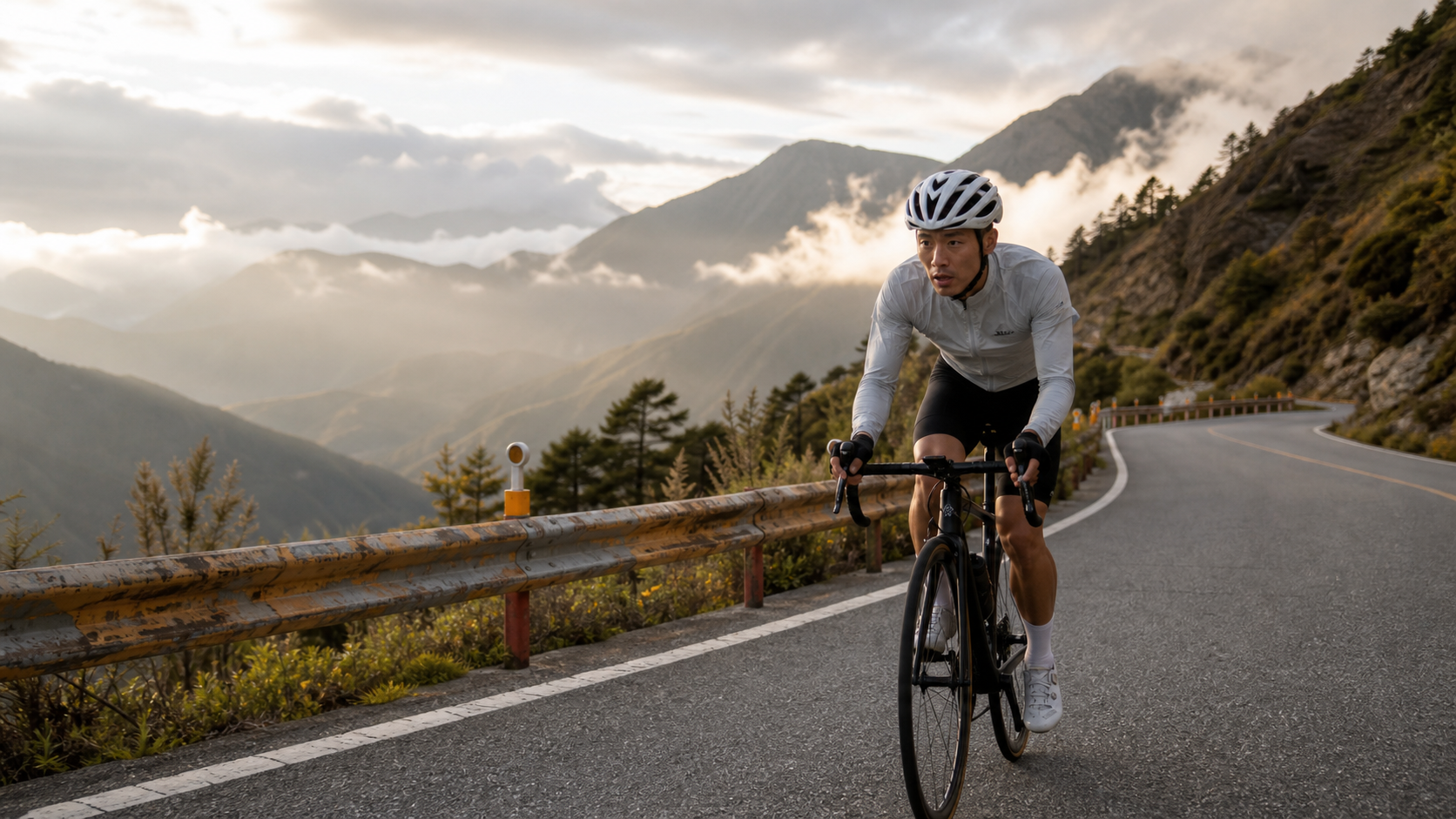
Introduction
In the final five kilometers of Wuling, the gradient approaches 7%, the altitude exceeds 3,000 meters, and every pedal stroke feels like it’s burning. At this moment, most people aren’t thinking about technique—they’re thinking, “How much longer can I hold on?” Climbing is one of the most mentally demanding aspects of cycling. In Taiwan, from the Fengjing Ancient Trail on Yangmingshan to Wuling on Hehuan Mountain, from Alishan to Taipingshan, every climb is a psychological experiment.
This article isn’t about pedaling technique or gear selection, but about what’s happening in your head when the gradient makes you want to stop, and what you can do about it.
1. What Is Your Brain Doing During a Climb?
The “Central Governor” Model of Perceived Exertion
Sports scientists have proposed the “Central Governor” theory, which suggests that the brain continuously assesses the body’s rate of energy expenditure and remaining reserves, proactively reducing exercise intensity or sending “stop” signals before it perceives risk. In other words, the pain you feel during a climb is often a protective exaggeration by the brain, not a sign that your body has truly reached its limit.
The practical implication of this theory is: most of the time, you have more in reserve than you think.
The “Peak-End Rule” of Pain
Psychological research has found that our overall memory of an experience is determined primarily by how we felt at the peak and how we felt at the end, rather than the total duration of pain. This has profound implications for climbing strategy—if you can control how you feel in the final stretch before the summit and “finish well,” the entire psychological memory of the climb becomes acceptable, even enjoyable.
2. Three Levels of Pain Management
Level 1: Cognitive Reframing
Redefine “pain” as “training effects are happening.” When the burning sensation of lactate sets in, don’t tell yourself “I can’t hold on,” but rather “this is the feeling of my muscles getting stronger.”
This isn’t self-deception; it’s a scientifically grounded cognitive strategy—research shows that under identical physiological stimuli, subjects’ tolerance times and subjective perceptions differ significantly depending on their psychological framing.
Level 2: Attention Allocation Strategies
There are two modes of attention during a climb:
| Mode | Description | When to Use |
|---|---|---|
| Internal Focus | Monitoring heart rate, breathing, pedaling cadence | Technical climbs, when you need to control intensity |
| External Distraction | Enjoying the scenery, listening to music, chatting | Long climbs, when experiencing mental fatigue |
On long climbs, switching between the two modes at appropriate times is more efficient than maintaining either one for an extended period.
Level 3: Endpoint Visualization
Clearly picture in your mind the moment you reach the summit—the view as you stop and look down, the feeling of the cool breeze, the act of taking that photo. Visualization isn’t just a motivational tool; it actually activates the brain’s reward circuitry, releasing small amounts of dopamine that help you keep pedaling through difficult sections.
3. Applying Mindfulness to Climbing
Breathing Rhythm Anchoring
What’s easiest to lose during a climb is the rhythm of your breathing. The core of mindful riding is using your breath as an anchor to return to the present moment:
- Gradient below 5%: Inhale for 3 pedal strokes, exhale for 3 pedal strokes
- Gradient 5-8%: Inhale for 2 pedal strokes, exhale for 2 pedal strokes
- Gradient above 8%: No forced counting, but maintain “conscious breathing”
The Section-by-Section “Acceptance” Strategy
What drains the most mental energy is “resistance” to pain. When you tell yourself “I shouldn’t be this tired” or “Why isn’t the top here yet,” this resistance itself is more devastating than the pain. The mindful approach is: acknowledge the current discomfort, without judgment, let it exist, and keep pedaling.
“I’m out of breath right now, that’s fine, keep pedaling.” This single sentence is one of the most powerful psychological tools during a climb.
Setting Small Milestones
Don’t view the entire climb as a single whole. Pick out utility poles, road signs, or switchbacks along the way as temporary targets: “Just get to that bend,” “Just past that tree.” This strategy, known as “segmented attention,” can significantly reduce the perceived difficulty of the task.
Practical Tips
- Before the climb: Do 3 minutes of deep breathing or brief meditation to shift your nervous system from “anxiety mode” to “preparation mode”
- When the urge to quit arises: Tell yourself “just ride for 2 more minutes, then decide after those 2 minutes”—most of the time, that urge will have passed
- “Talk” to the gradient: Japanese professional road cyclists have a practice of silently describing their current physical state during climbs (“my legs are starting to burn,” “my breathing is getting faster”), shifting the brain from being the feeler to being the observer, reducing the subjective intensity of pain
- Keep a climbing journal: After each challenge, write down your psychological journey; over time, you’ll recognize patterns in your “breaking points” and can prepare for them in advance
- Leverage the group effect: Research has found that in the presence of others (even virtual ones, like other riders on Zwift), endurance performance can improve noticeably
Conclusion
Climbing has never been just about the legs. Those riders spreading their arms wide at the summit of Wuling aren’t there because they don’t feel pain—they’re there because they’ve learned to coexist with it, learned to push a few more pedal strokes after their brain says “enough.” Every climb is a negotiation with yourself—and those who master psychological tactics will always sit on the advantageous side of the negotiating table.
Related Reading
- Psychological Strategies for Cycling Climbs: Pain Segmentation and Goal Decomposition Techniques
- Mental Strategies for Climbing: Segment Goal Setting and Psychological Splitting Techniques
- Mountain Climbing Psychology: How to Persevere and Break Through Limits in the Toughest Moments
- Climbing Mental Tactics: The Segmentation Mindset of Breaking Long Climbs into Small Goals
大武山後門26%歡樂陡坡!JJSC南台灣單車行Day2 / 被颱風追著跑 / 公路車 / CT Yeh
2 年前
大禹嶺 到 武嶺牌樓 全程前後實況錄影 | 北進武嶺 | 東進武嶺 | KOM | 訓練台 | 坡度分析 | Taiwan KOM Last 10 km HARD | 公路車
6 年前
西進武嶺 免費訓練分析服務 Intervals | 練不夠還是練過頭?你哪一種類型選手?AI模型告訴你! | 備戰神器 | 公路車 訓練 | CT Yeh
4 年前
大武山20%魔王陡坡【JJSC南台灣遊騎Day2】!屁股真的要裂開了...凡士林抹滿也沒用?神秘金教堂還有超便宜夜市
3 個月前
Never Stop 西進武嶺 前後雙機 完整全程錄影 訓練台 實境
8 年前
單車 梅山36灣 坡度介紹 路段介紹 空拍 (相關遊記影片,請參考說明或我的頻道喔,歡迎訂閱)
6 年前
風櫃嘴時間 預測西進武嶺時間?13000名車友統計數據分析告訴你 !
5 年前
如果Pogačar騎西進武嶺可以多快?會破2嗎?各種情況深度推估探討 / 公路車 / CT Yeh
2 年前