Introduction
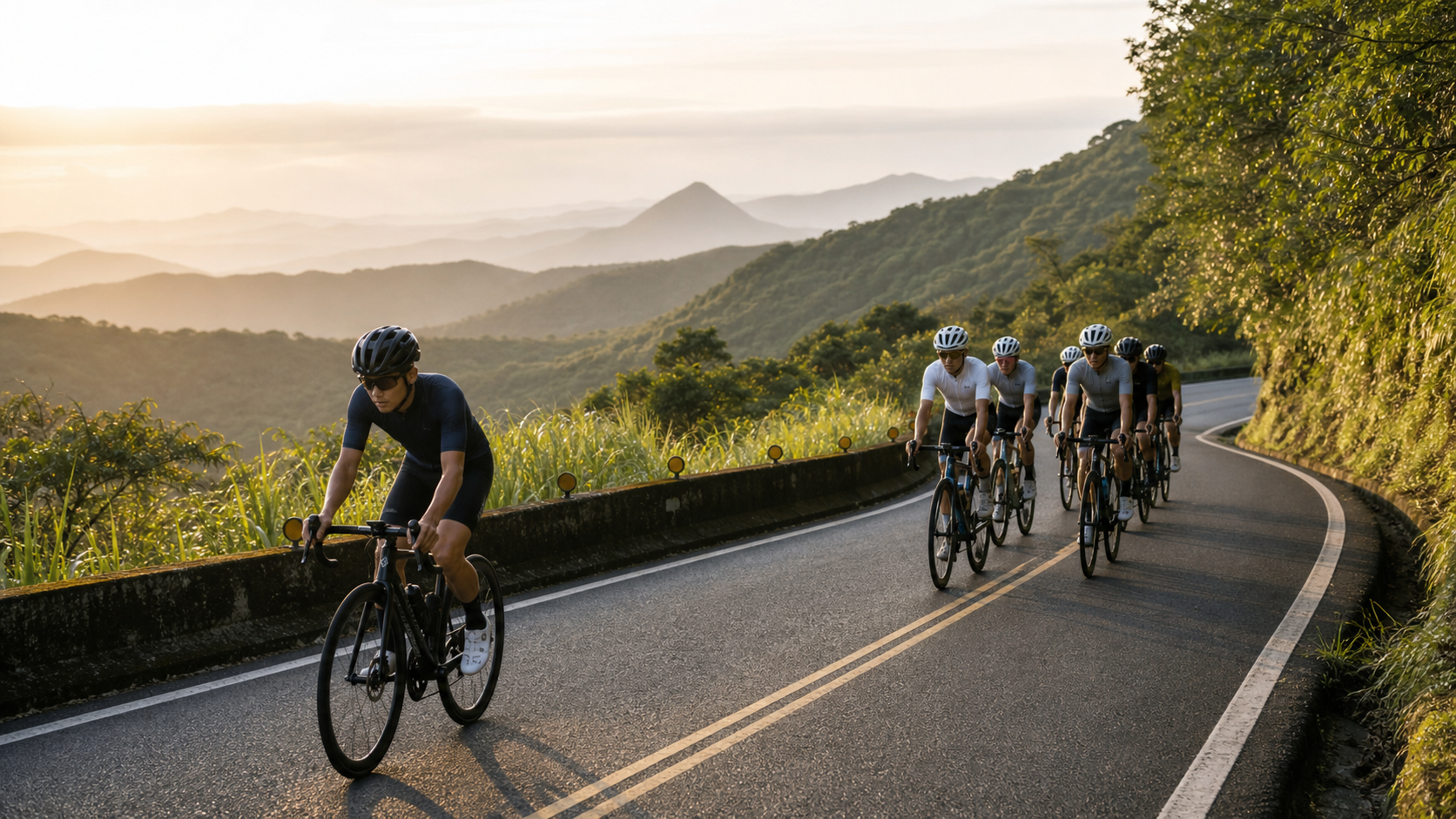
At seven o’clock on a Saturday morning, there are two versions of you: one version rides up Yangmingshan alone, immersed in your own thoughts; the other version meets up with a cycling club at Bitan in Xindian, where laughter mingles with the sound of chains. These two riding modes offer vastly different psychological experiences, and each has its own irreplaceable value.
Taiwan’s cycling culture has grown rapidly in recent years, with club culture and solo-riding culture expanding side by side. Yet few have analyzed it from a psychological perspective in depth: What do solo riding and group riding each leave in our brains and minds? Which mode suits your current needs better?
1. The Psychological World of Solo Riding
Solitude Is Not Loneliness: The Psychological Benefits of Voluntary Aloneness
Solo riding gives you something that is increasingly scarce in daily life: uninterrupted alone time. Psychological research shows that voluntarily chosen solitude (as opposed to forced isolation) aids emotional regulation, self-reflection, and creative thinking.
Many cyclists report solving work problems or clarifying life choices while riding alone—this is no coincidence. The rhythmic motion of pedaling, combined with the natural environment, creates a kind of “light meditative state” that allows the brain’s Default Mode Network to operate freely.
The Psychological Challenges of Solo Riding
However, solo riding also carries psychological costs:
- No access to social facilitation effects: The presence of others boosts performance; this bonus disappears when riding alone
- No support when you mentally break down: When facing difficult sections or unexpected situations, there is a lack of immediate emotional support
- Prone to excessive self-criticism: Without others as a reference point, solo riders tend to be overly hard on themselves when performance falls short of expectations
- Lower sense of safety: The real-world safety concerns of riding alone also translate into psychological stress
2. The Psychological Dynamics of Group Riding
Social Facilitation: The Group Makes You Faster
In 1898, psychologist Norman Triplett discovered that cyclists rode faster when accompanied by others—this was the first experiment in social psychology. More than a century later, this phenomenon remains robust. In Taiwan’s club training, this effect happens every day.
The Metronome Effect and Learning to Pace
When riding in a group, others’ rhythm becomes your external metronome. For beginner cyclists building their aerobic base, riding with more experienced riders helps you learn “proper pacing” faster—an intuitive feel that is harder to build from data tables (heart rate, power) alone.
The Psychological Challenges of Group Riding
| Challenge | Description | Coping Strategy |
|---|---|---|
| Social comparison pressure | Seeing others keep up effortlessly while you’re already gasping can trigger self-doubt | Set personal goals rather than comparing yourself to others |
| Improper pacing | To maintain the group’s rhythm, you may exceed your intended training zone | Communicate riding goals and intensity beforehand |
| Groupthink trap | Setting off despite bad weather because “everyone else is going” | Maintain independent judgment; don’t make dangerous decisions due to social pressure |
| Performative riding | Being overly concerned with image, unwilling to show fatigue in front of teammates | Foster a club culture of honest sharing |
3. How to Choose the Riding Mode That Suits You?
Different psychological needs call for different riding modes:
Choose solo riding when you need:
- To process a complex emotion or thought
- To follow a specific-intensity training plan (unaffected by group pacing)
- To rebuild your passion for cycling (over-socialized training can sometimes turn riding into an “obligation”)
- To test personal limits and practice psychological independence
Choose group riding when you need:
- To get through a period of low training motivation
- To improve your riding ability (progress requires appropriate challenge and stimulation)
- To build social connections and find long-term riding companions
- To attempt routes or intensities beyond your comfort zone
Practical Advice
- Mixed mode: Schedule 2 solo rides and 6-8 group rides per month to address both psychological needs
- Set an intention before solo rides: Before heading out, ask yourself, “What do I want to get out of this solo ride?”—this question makes solitude more meaningful
- Communicate before group rides: Confirm the goal of the ride with the club (easy recovery? intensity training?) to avoid pacing mismatches
- Build “solitude tolerance”: If you find you can’t enjoy solo riding, that may be a personal growth opportunity worth exploring
- Record how each mode feels: Use a simple journal to track which mode leaves you feeling most fulfilled
Conclusion
Solo riding and group riding are conversations in two different languages—the former is a dialogue with yourself, the latter a dialogue with others. A mature cyclist can switch freely between both languages, choosing the mode that best fits their psychological needs at any given moment. Taiwan’s riding environment offers abundant options: a solitary early-morning ride on the Beiyi Highway, or a weekend group challenge up Wuling—each has its own meaning. What you need isn’t to choose one over the other, but to learn when you need which one.
Related Reading
- The Philosophy of Riding Alone: The Freedom and Solitude Solo Riding Gives Me
- Solo vs. Group Training: A Complete Comparison of Their Psychological and Physiological Benefits
- Solo Riding Meditation: Mental Cultivation When Riding Alone
- The Solitude and Self-Discovery of Cycling Trips: The Psychological Growth of Riding Around Taiwan Alone
「悲情男車友」創作單曲 爆笑MV / 公路車 / CT Yeh / 4K劇情版
7 個月前
一日北高/長距離團騎 常見問題補充篇 / 組團或跟團的眉角 / 壯車友容易被瘦車友慢性拉爆 / 原來屁股痛可能是這個原因...? / 風場配速法 / 公路車 / CT Yeh
2 年前
車隊介紹) 台北 一年開團365天 車隊 Apollo Ride 晨騎 好選擇 ( 陽明山 風櫃嘴 冷水坑 平等里 聖人 關渡 大稻埕 ) 找人騎車
7 年前
虎豹潭!日本老師來台一日約騎 台灣車友熱情招待私房路線 / CT Yeh
21 天前
4K 東眼山 x 水蜜桃冰沙 百人單車約騎! 操完再吃冰 多爽快
7 年前
#墾丁 #單車 微蜜月旅行 | 社頂公園絕景 | 恆春 鵝鑾鼻公園
6 年前
金門 ! 我騎過最棒的離島了 / 最後可以騎車上金門大橋的機會!?/ 公路車 / CT Yeh
1 年前
元宇宙運動 ! RouvyAR 虛擬實境約騎! 台灣路段開箱 帶你日月潭環潭一圈 | 團騎競賽參加教學 | 常見小問題整理 三人共享一年不用一千 | 公路車 | 訓練台 | CTYeh
5 年前