Taiwan's Hundred Peaks Cycling Challenge: Mental Preparation for Wuling, Tataka, and Siyuan Pass
Introduction
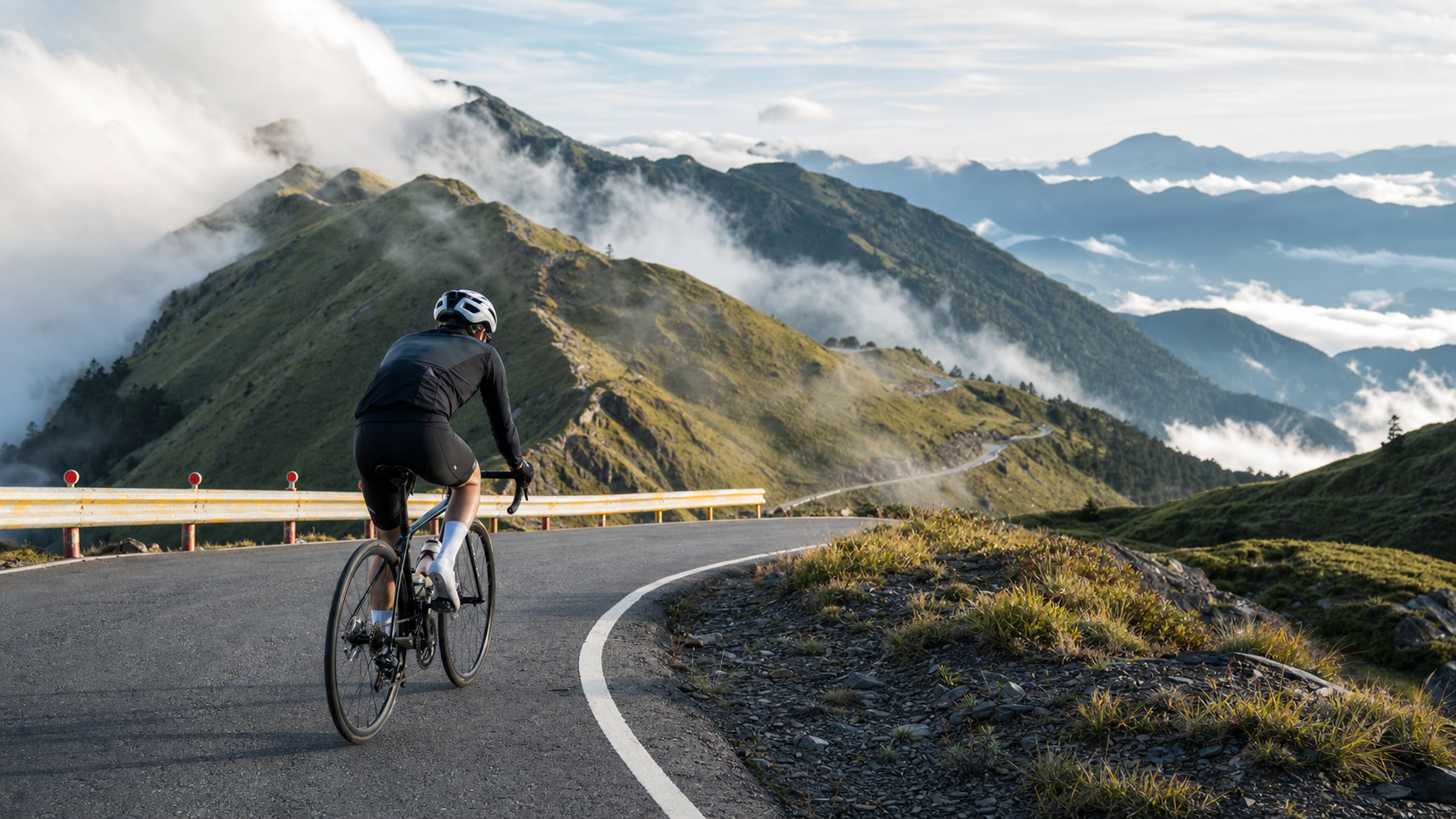
At 3,275 meters above sea level, Wuling is the highest point on Taiwan’s road network and a sacred destination for every serious cyclist. Every year, countless riders set out from Puli, Wushe, or the Lushan direction to tackle this road, with a single goal in mind: to ride to the top on their own power.
Beyond Wuling, Taiwan offers several other captivating high-altitude cycling goals: the Tataka Saddle (approximately 2,610 meters) along the Alishan Highway in Chiayi, and Siyuan Pass (approximately 1,980 meters) on the border between Yilan and Taichung. Each route has its own character and its own psychological challenges.
This article is about the mental preparation you need before reaching these high points.
1. The Unique Psychological Challenges of High-Altitude Cycling
The Impact of Thin Air on Cognition
Above 2,500 meters, the oxygen content in the air drops to about 75% of what it is at sea level. This doesn’t just affect your aerobic capacity—it also affects your brain’s cognitive function. Research shows that at moderate high altitudes, attention, decision-making ability, and emotional regulation all decline. In other words, at the very place where you need mental toughness the most, some of your psychological tools partially fail. Understanding this is the first step in coping.
Distorted Perception of Distance
The visual characteristics of mountain roads—being able to see the road still climbing far ahead—easily create a psychological “distortion of distance.” That summit that looks “almost there” could still be 10 kilometers away. This visual deception, combined with physical fatigue, is one of the main reasons people break down at high altitude.
The Uncertainty of Taiwan’s Mountain Weather
Wuling’s road closure status each year depends on snow conditions. Even in summer, afternoon thunderstorms can cause visibility to plummet. Siyuan Pass is notorious for thick fog, while Tataka experiences strong afternoon crosswinds. These unpredictable factors are a major source of psychological stress for riders without high-altitude experience.
2. Analysis of the Psychological Traits of the Three Routes
| Route | Primary Psychological Challenge | Key Psychological Strategy |
|---|---|---|
| Wuling (Hehuan Mountain Highway) | Long sustained gradients, high-altitude oxygen deficit, the psychological wall of the final 5 km | Distance segmentation, accepting hypoxia, milestone visualization |
| Tataka (Alishan Highway) | Long distance (~70 km from Chiayi), false-summit effect before the top | Ignoring distance markers, focusing on process goals |
| Siyuan Pass (Provincial Highway 7A) | Sense of disorientation while riding in thick fog, continuous long climbs on the Yilan side | Sensory shifting (using hearing to replace vision), maintaining rhythm |
3. Five Strategies for High-Altitude Mental Preparation
Strategy 1: Thorough “Mental Simulation” Training
Before setting out, take time to do a detailed mental simulation: find the route’s Strava records, study the gradient data for each section, “ride” the entire route in your mind, and anticipate how you might feel at different points (“By Kunyang my legs will already be heavy,” “The final 5 km has open views, the wind is strong, but the summit is right in front of you”). This mental rehearsal reduces the sense of unfamiliarity and shock when you’re actually there.
Strategy 2: Set “Generous Time Goals”
The biggest psychological trap in high-altitude challenges is setting unrealistic time goals, then falling apart mid-ride because you’re falling behind. For your first Wuling attempt, give yourself a time goal based on “finishing is victory” (e.g., reaching the top before sunset) rather than a speed goal like “I must finish within X hours.”
Strategy 3: Build a “Hypoxia Acceptance” Mental Framework
Tell yourself in advance: “At high altitude, my body will breathe harder and feel heavier than at sea level. This is a normal physiological response—it doesn’t mean I’m in bad shape.” Accepting the physiological limits of altitude saves a tremendous amount of mental energy compared to trying to hold yourself to sea-level standards while up there.
Strategy 4: The “Next Switchback” Focus Method
Mountain roads are dense with switchbacks, and each one is a natural psychological milestone. Don’t think about “how many kilometers are left”—just think “get past that next turn.” Once you’re past it, decide on the next target. This strategy works on all high-altitude routes, especially in the final, most fatiguing stretch.
Strategy 5: Mental Preparation for Weather Decisions
Set clear “retreat conditions” in advance: if, upon reaching a certain altitude, thunderstorms have already started, visibility drops below a certain level, or your body temperature begins to fall—then retreat decisively, without regret. Pre-establishing clear retreat conditions actually allows you to give your full effort with peace of mind during the climb, because you know your decision-making framework is sound.
Practical Advice
- Pre-ride gear testing: Confirm clothing, supplies, and emergency contact plans a week before departure to reduce anxiety triggers on the day itself
- Find a companion with high-altitude riding experience: For your first high-mountain challenge, an experienced companion is not just a safety net—they’re also psychological support
- Don’t consume all your supplies before the final kilometer: Save one special food item that’s “only for the summit” as an anchor for psychological reward
- Summit ritual: Think ahead about what you want to do when you reach the top (take a photo from a specific angle, call someone, sit quietly for a minute). A summit with a ritual creates a deeper memory than just snapping a picture
- Post-descent psychological integration: Spend 15–30 minutes (in a safe place) reviewing the entire challenge and write down three “things I learned,” so the psychological growth from this ride is explicitly recorded
Conclusion
The summit of Wuling is more than just an altitude number—it’s a psychological coordinate. It represents the way you face difficulty, the dialogue you have with yourself, and every present-moment decision you make to keep climbing. Taiwan’s mountains are waiting for you—not just as proof of your leg strength, but as a mirror reflecting the depths of your inner self. Bring your gear, and bring your mental preparation. Time to ride.
Related Reading
- High-Altitude Cycling Training: The Hypoxic Effects and Adaptation Strategies of Wuling at 3,275m
- Taiwan’s Cycling Hundred Peaks Challenge: The Complete Preparation Guide for Conquering Wuling
- Wuling Climbing Guide: Challenge Strategies and Nutrition Planning on Taiwan’s Highest Highway
- The Mental Tactics of Cycling Climbs: Pain Management and Mindful Riding Techniques
台灣登山王之路 KOM 全程參賽4K臨空錄影 PART1 穿越峽谷地形! #東進武嶺 太魯閣 / 燕子口 / 天祥 / 西寶 PART1 (公路車 / CT Yeh)
3 年前
大武山20%魔王陡坡【JJSC南台灣遊騎Day2】!屁股真的要裂開了...凡士林抹滿也沒用?神秘金教堂還有超便宜夜市
3 個月前
西進武嶺 世界紀錄挑戰!破2:30 ?!一群人推著一個夢上山 直播精華版 / ft. 張翰允 & 台視主播魏于恬 & KPLUS / #cycling 公路車 CT Yeh
2 個月前
#北橫 + #北進武嶺 最硬的員工旅遊 EP1 | #公路車 #拉拉山 | 明池 | 武嶺 | 武陵農場 | 雲海 | Taiwan Cycling Route Wulin
6 年前
台北闊瀨陡坡 騎旅 / 日本單車雜誌編輯車友臨時加入!/ 髮香才是最強的 / feat. 北迴歸線小隊 / 公路車 CT Yeh
6 個月前
阿里山塔塔加 兩倍特濃版!全新隧道開通! 進喔!公路車 | CT Yeh
3 年前
雨戰! 西進武嶺員工旅遊 加料 各路段大數據分析 | 同事端出5公斤的公路車來挑戰!? EP1
4 年前
嘉義大埔、阿婆灣挑戰賽,美到以為在日本!ft. 環騎5 Cool 西拉雅188 / 公路車 / CT Yeh
7 個月前