Introduction
When Hungarian psychologist Mihaly Csikszentmihalyi studied human well-being, he discovered a unique psychological state: when people are fully immersed in an activity with an appropriate level of challenge, the sense of time disappears, self-awareness fades, and action and consciousness merge into an effortless flow. He called it “Flow.”
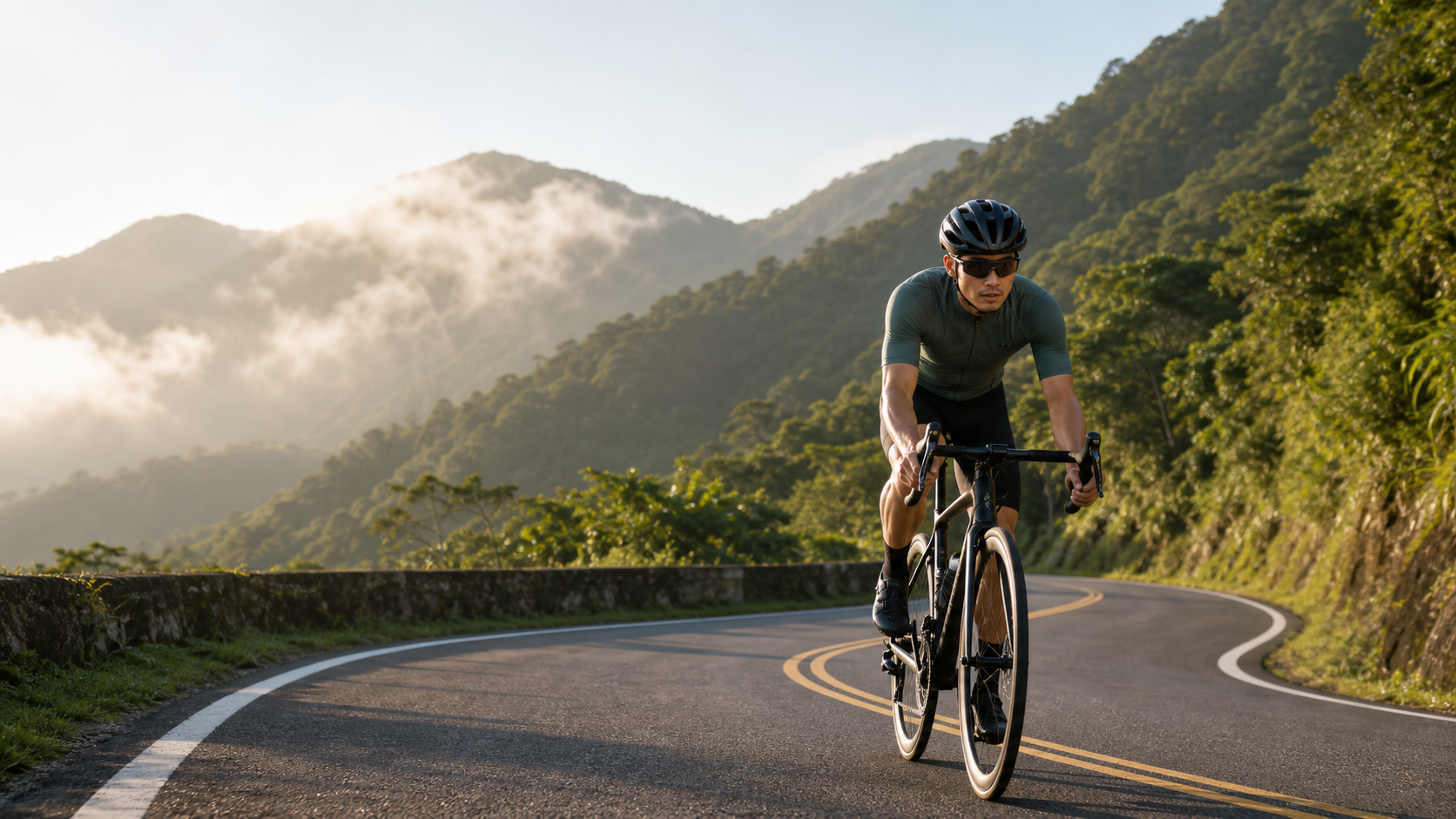
For cyclists, the flow experience is nothing unfamiliar. It’s that early morning, descending along the Beiyi Highway, when you’re not thinking about breakfast or tomorrow’s meeting—just a road, two wheels, and the sensation of your body and bike in perfect sync. In that moment, riding itself is the entire meaning.
But flow isn’t a stroke of luck—it has its psychological conditions, and those conditions can be deliberately created.
The Six Core Characteristics of Flow
According to research, the flow state has the following recognizable characteristics, all of which have corresponding manifestations in cycling:
| Flow Characteristic | How It Feels While Riding |
|---|---|
| Complete focus | Heightened awareness of the surroundings, but distracting thoughts disappear |
| Merging of action and awareness | Turning, shifting, and pedaling require no deliberate thought |
| Loss of self-consciousness | No longer worrying about how you look or whether you’re fast enough |
| Distorted sense of time | Three hours feels like thirty minutes |
| The activity is intrinsically rewarding | Riding itself is satisfying, no external reward needed |
| Sense of control | Feeling challenged by a steep climb, yet believing you can overcome it |
The Golden Condition for Flow: The Balance of Challenge and Skill
The most important prerequisite for flow is that the level of challenge is slightly above your current skill level. This balance point is called the “Flow Channel”:
- Challenge too low (route too easy) → Boredom, distraction
- Challenge too high (far beyond ability) → Anxiety, panic
- Challenge just slightly beyond ability → Flow
For cyclists in Taiwan, this means:
- Regularly choose routes slightly outside your comfort zone: If you’re used to climbing Yangmingshan, occasionally tackling the longer Lala Mountain section makes it easier to enter flow.
- Avoid overly familiar routes: After riding the same road dozens of times, your brain no longer needs to focus, and flow disappears.
- Ride with companions who are slightly stronger: The mild tension of drafting behind someone is exactly the catalyst that triggers flow.
Pre-Ride Flow Preparation Rituals
Psychological research shows that a consistent pre-ride preparation ritual helps the brain enter a focused mode, reducing the time needed to reach flow. Here are several methods:
Sensory Reset Method
For the 10 minutes before departure, avoid scrolling on your phone or engaging in high-cognitive activities. Let your brain disengage from the flood of information and shift into a mode of “being ready to receive present-moment perception.”
Breath Anchoring
For the first 3 minutes after getting on the bike, focus only on your breathing rhythm. Don’t look at speed, don’t pay attention to heart rate—just purely feel the breath moving in and out. This simple practice quickly reduces mental noise and creates space for flow.
Set a Single Riding Intention
Instead of heading out with multiple goals like “ride fast, train climbs, burn calories,” choose one core intention. For example, “Today I’ll only focus on the smoothness of my cadence” or “Today I’ll feel the weight shift through every turn.”
Music, Silence, and Their Relationship with Flow
Many cyclists enjoy listening to music while riding. In certain situations, this helps establish a sense of rhythm, but in most cases, music actually hinders flow—because it splits your attention, forcing you to switch between the “listening to music” and “riding” channels.
True flow often arrives more easily in silence. Try scheduling a few “music-free rides” each month, letting the sound of the wind, the rolling of tires, and the clicking of gears become your auditory landscape. Many cyclists describe that only after their first music-free long ride did they truly understand what it means to “converse with the road.”
Of course, this isn’t an absolute rule. Background music suited for long-distance cruising (lyric-free electronic or light jazz) can sometimes genuinely help facilitate flow—the key is that the music must not steal your awareness of the riding itself.
Practical Advice
Here are concrete practices to increase the likelihood of flow on every ride:
- Silence your phone before riding: For at least the first hour after departure, completely disconnect from notifications—no calls, no LINE messages. The lower your “sense of connection,” the easier flow is triggered.
- Choose to start in the early morning: The morning brain has the least mental noise, and Taiwan’s early-morning road conditions are relatively simple, making it the easiest time window to enter flow.
- Practice the “body scan” riding method: Every 20–30 minutes, quickly check in with your whole body—are your knees positioned correctly? Are your shoulders relaxed? Is your core stable? This active awareness doesn’t interrupt flow; it deepens the sense of connection between your body and the bike.
- Record your flow moments afterward: In your riding log, note “which section of road I entered flow today, what I was doing at the time, and what the weather was like.” After accumulating a few months of data, you’ll find your own “flow formula.”
Conclusion
Flow is not the exclusive domain of experts, nor is it an accidental miracle. It is a state that naturally emerges from the human brain under the conditions of “the right challenge + complete engagement.” Cycling is an excellent activity for triggering flow because it simultaneously satisfies both physiological stimulation (cardiopulmonary, muscular) and cognitive demands (reading the road, rhythm control).
The next time you head out for a ride, try taking one question with you: “If I only did one thing today—truly feeling the act of riding itself—what would that experience be like?” Perhaps the answer lies in that downhill turn where you forget about time.
Related Reading
- The Flow State: Finding the Optimal Experience in Cycling
- Flow State in Running: How to Enter the “Self-Forgetting” Zone of Peak Performance
- The Flow Experience in Road Running: How to Enter the Self-Forgetting State of Peak Competition
- Flow State and Endurance Sports: The Complete Guide to Entering “The Zone”
2023自行車展!與環台賽選手一同表演賽 / 全自動AI Fitting?/ TIME新車發表/神秘充電桌等 精華分享 VLOG | CT Yeh | 公路車
3 年前
西進武嶺 免費訓練分析服務 Intervals | 練不夠還是練過頭?你哪一種類型選手?AI模型告訴你! | 備戰神器 | 公路車 訓練 | CT Yeh
4 年前
[教學] Dashware 教學 如何製作有 速度 功率 心律的 騎車影片 Guages Video
8 年前
#雙崎部落 單車挑戰賽 心跳破200 #公路車 Neko's Fun
6 年前
一輪盃環湖挑戰賽 | TIME新車首航 | 一輪帶我飛 | 百萬流量都在場 | 4K畫質 | 公路車 | CT Yeh
3 年前
金門 ! 我騎過最棒的離島了 / 最後可以騎車上金門大橋的機會!?/ 公路車 / CT Yeh
1 年前
Insta360/DJI做不到的!如何製作「騎士頭頂瓦數特效」單車影片?CycleDash 完整教學 / 超強批次影片數據疊加軟體
14 天前
#公路車 #Fitting 靠人工智慧APP 幫你調整單車
6 年前