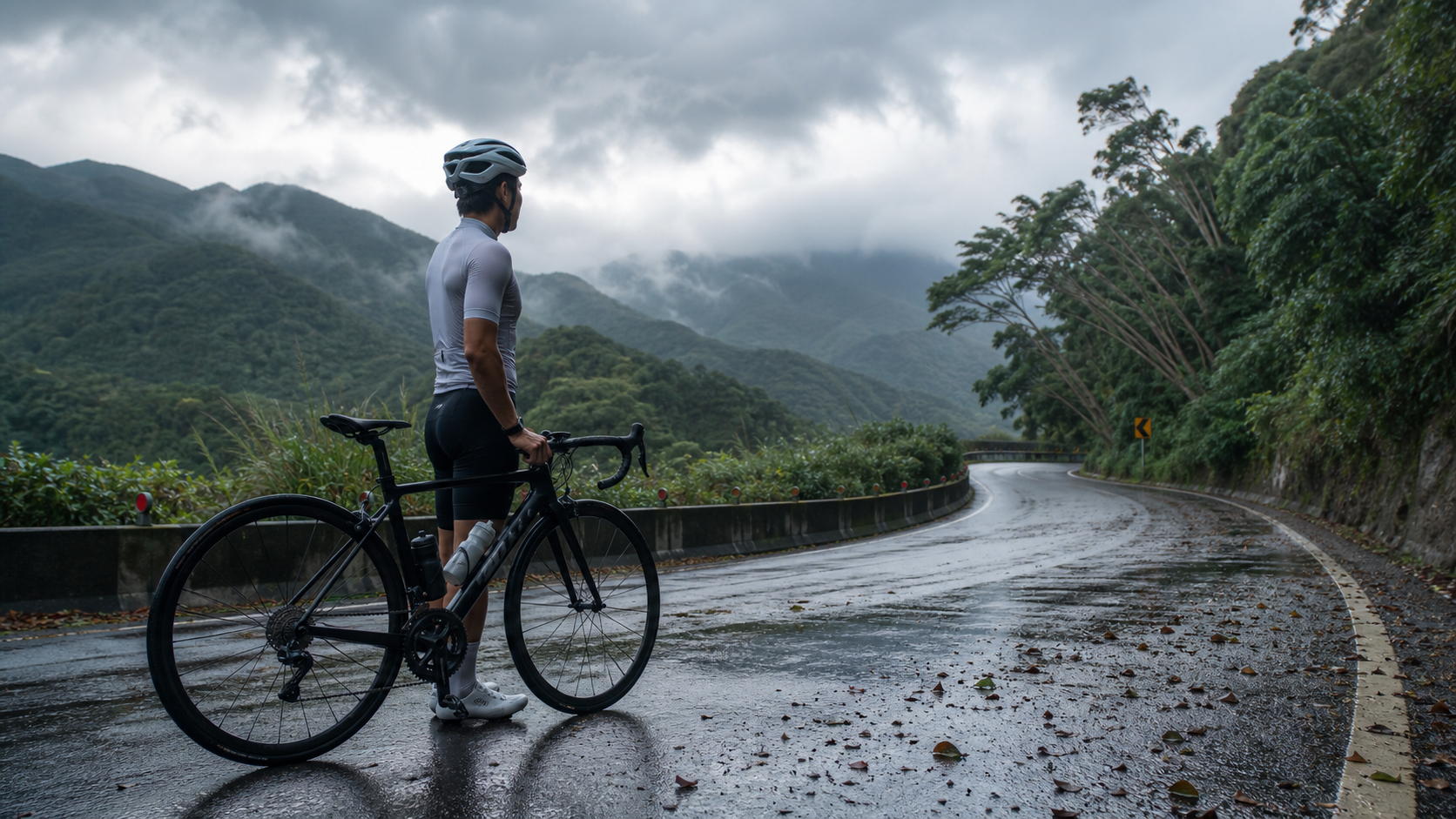
Introduction
Taiwan is one of the regions with the densest typhoon tracks in the world. Every year around the transition from summer to autumn, nearly every serious cyclist faces the same question: “Should I still go to this weekend’s challenge ride?” “It rained heavily last night—are today’s mountain roads safe?” “The storm is brewing, but I’ve already paid the start fee.”
Among outdoor-sports accidents in Taiwan caused by typhoons or torrential rain each year, cyclists account for a significant share. Many accidents don’t happen at the true center of a typhoon, but rather in the ambiguous window when “it feels okay, but risk is already present”—crosswinds before a typhoon, rockslides on mountain roads after heavy rain, and rapidly rising streams. These situations demand not just technical judgment, but a psychological test as well.
Cognitive Biases in Weather-Risk Assessment
Human decision-making under extreme weather is often distorted by several cognitive biases:
Optimism Bias
“It probably won’t be that bad” is the most common form of self-deception. Research shows that athletes’ subjective underestimation of risk is especially severe when they have already made an upfront commitment (buying a ticket, arranging to meet teammates). Sunk costs push us to keep going, even when objective conditions no longer support it.
Herd Mentality
“If everyone’s going, I’ll go too” is a common psychological pattern in group activities. When a group of riding buddies all say, “The typhoon hasn’t arrived yet, let’s finish the ride quickly,” even if you have doubts, you may follow along because you don’t want to be seen as “timid.” This social pressure can sometimes be more dangerous than the weather itself.
Overconfidence from Familiarity
The sense of familiarity—“I’ve ridden this road dozens of times, I know it well”—makes us underestimate how much the weather can change road conditions. Rockslides on mountain roads after heavy rain and gusty crosswinds before a typhoon often appear on the most familiar stretches, precisely because familiarity lowers our vigilance.
An Assessment Framework for Extreme-Weather Judgment
The following is a practical departure decision matrix, applicable to common extreme-weather scenarios in Taiwan:
| Weather Scenario | High-Risk Indicators | Recommended Action |
|---|---|---|
| 24–48 hours before a typhoon | CWA issues a land warning | Cancel. No exceptions. |
| 48–72 hours before a typhoon | Outer circulation affects the area, gusts reach Force 8 | Re-evaluate the route (avoid mountain roads), consider shortening it |
| Within 12 hours after heavy rain | Mountainous or foothill sections | Wait for road conditions to be confirmed; check the highway bureau’s live cameras |
| 24 hours after heavy rain | Urban flat routes | Usually feasible; watch for puddles and gravel |
| Afternoon-thunderstorm season | Mountain routes planned past 2 PM | Start in the morning, descend before 2 PM |
| Strong northeast monsoon | Northern and northeastern coastlines, gusty crosswinds | Adjust route direction, avoid exposed coastal sections |
Psychological Coping When Weather Turns Sudden Mid-Ride
Even if your departure decision was correct, you may still encounter unexpected weather along the way. The biggest psychological challenge then is: finding the right balance between fear and rationality.
Signs of excessive fear: The moment thunder sounds, you lose your judgment and stop urgently in a dangerous spot (a cliffside section, a bridge), which actually increases the risk.
Signs of excessive complacency: The shortsighted judgment of “the rain paused for a bit, let’s keep riding,” ignoring the possibility of rapidly rising streams from heavy rain upstream.
Three steps for a rational response:
- Immediately find a safe stopping point: Not just the roadside, but a place with real shelter and safe terrain (a temple, a gas station, a home’s arcade).
- Assess the retreat route: Don’t keep pushing forward, and don’t panic and rush back. First, clearly assess your current position and possible safe paths.
- Proactively accept help: Taiwanese people are usually very warm toward cyclists who are lost or caught in bad weather. If you run into trouble, don’t risk riding on just because you “don’t want to bother anyone.”
Typhoon Culture and the Psychology of Taiwanese Cyclists
Taiwan has a unique “typhoon-day mentality”—during that “gray period” before a typhoon day is officially announced, many people actually choose to ride outside to “make the most of the weather while it’s still okay.” The psychological roots of this behavior lie in: a sense of seizing a rare opportunity (“typhoon days are rare”) and an escape from the boredom of the recovery period.
Recognizing this psychological pattern is the first step toward making clearer decisions. True long-term riders understand: every typhoon is followed by even better weather waiting ahead; and a physical injury—or something worse—could make you miss the entire cycling season.
Practical Advice
- Subscribe to the CWA’s official LINE account: Receive real-time weather alerts; don’t wait until just before departure to check the weather.
- Set a “no-guilt cancellation” principle: Clearly tell yourself and your riding buddies: “When certain conditions are met, I will cancel, no discussion needed.” Setting your red lines in advance effectively counters the herd pressure of the moment.
- Keep a weather journal: Record every decision to ride or cancel based on weather assessment, along with the outcomes afterward. After a few months, you’ll build a more accurate personal risk-judgment model.
- Learn to read GPM/GFS and other weather forecast charts: Advanced riders can learn to interpret the upper-air weather charts published by Taiwan’s Central Weather Administration, gaining 48–72 hours of advance insight into possible typhoon path changes.
Conclusion
Respecting Taiwan’s weather is not cowardice—it’s wisdom. The bravest riding decision is sometimes not setting out into the wind and rain, but looking at the dark clouds outside the window and saying: “Today isn’t a good day to ride. I’ll wait for a better moment.” On this ever-changing island of Taiwan, learning to wait is itself one of the most important riding skills.
Related Reading
- Weather Response for Long-Distance Riding: Real-Time Adjustments for Sudden Rain, Strong Wind, and High Heat
- Cycling Weather Strategies: A Safe-Riding Guide for Rain, Strong Wind, and High Heat
- Riding Safety During Taiwan’s Typhoon and Plum-Rain Seasons: When Not to Ride
- Trail-Running Climate Response: Safety Judgment for Mountain Trails After Taiwan’s Rainy Season and Typhoons
單車 一日北高 ( 雙城 ) 肥宅雙人瘋狂行 紀錄片 REACTO
10 年前
大武山後門26%歡樂陡坡!JJSC南台灣單車行Day2 / 被颱風追著跑 / 公路車 / CT Yeh
2 年前
下雨天就是要改車 #ceramicspeed #bike
1 年前
JJSC南台灣單車走春三日行 DAY 1 / 強度 x 美食 x 節慶體驗 / 公路車 CT Yeh
5 個月前
一日北高/長距離團騎 常見問題補充篇 / 組團或跟團的眉角 / 壯車友容易被瘦車友慢性拉爆 / 原來屁股痛可能是這個原因...? / 風場配速法 / 公路車 / CT Yeh
2 年前
一日北高前的西濱集訓 | 跟著11小時軍團 | 300W踩不動的大逆風 | 輪車破風差幾瓦?
6 年前
單車賞雪 裝備準備及注意事項分享 | 公路車
5 年前
微雨戰! 2022桃園市長盃錦標賽 無敵交管 沒來玩太可惜了! 羅馬公路太可怕 差點成佛! 公路車 | CT Yeh
4 年前