Introduction
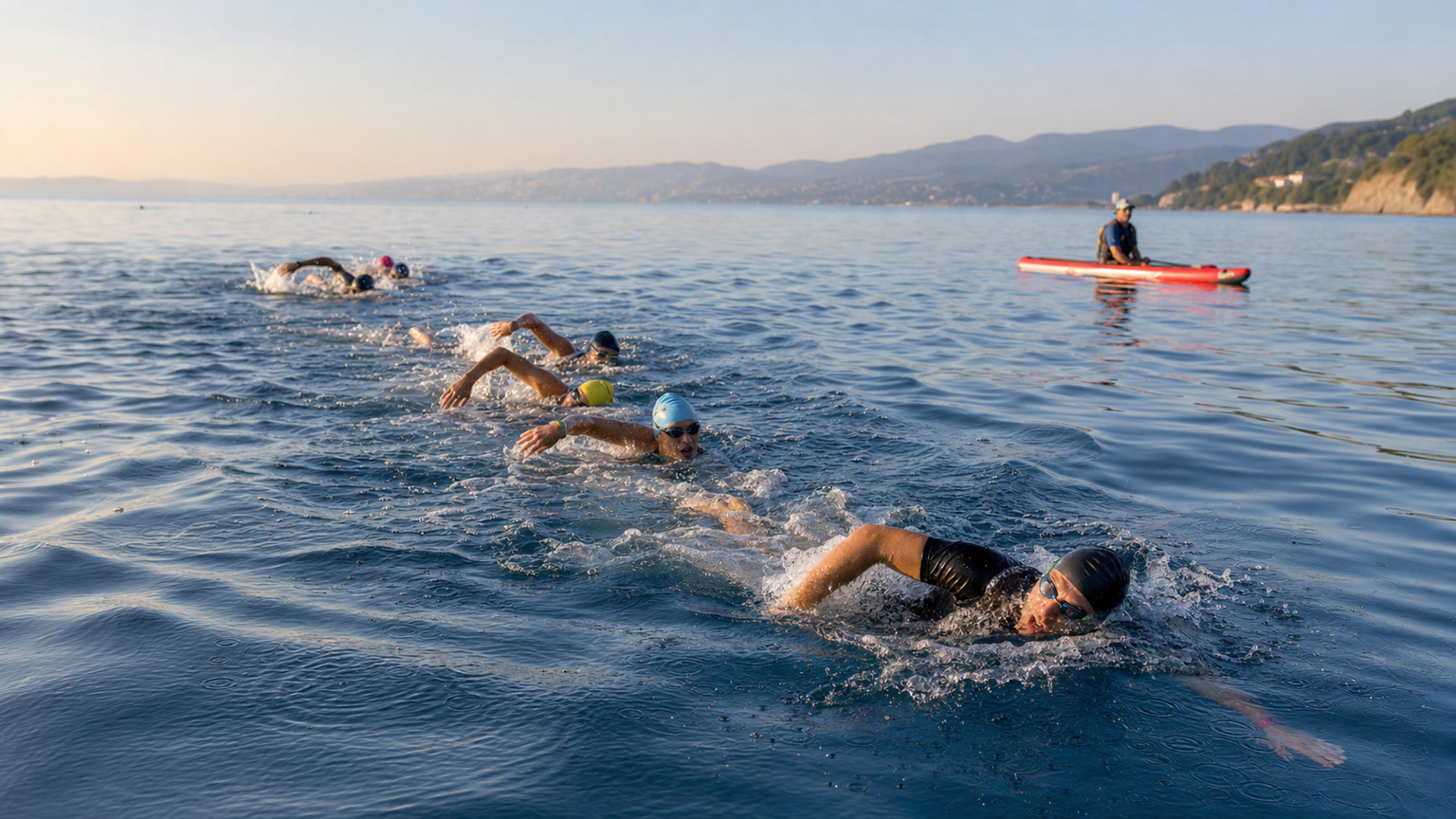
Many people consider swimming a solitary individual sport, but in open-water training and racing, teamwork can yield unexpected benefits. In the cycling world, the energy-saving effect of riding in a peloton is common knowledge; similarly, the “drafting” technique in swimming can conserve significant energy. Moreover, in a safe open-water training environment, organized team training not only improves efficiency but also greatly enhances safety. This article introduces team training strategies for open-water swimming, including the formation of pace groups, optimizing drafting, and practical methods for mutual protection.
Why Open Water Requires Team Training
| Reason | Explanation |
|---|---|
| Safety | With multiple people present, accidents can be responded to quickly |
| Drafting energy savings | Following behind a lead swimmer can save 5–15% of energy |
| Pace guidance | Partners of similar ability push each other through competition to improve |
| Navigation efficiency | Since the lead swimmer has already sighted, followers can reduce sighting frequency |
| Psychological support | The sense of isolation in open water is greatly reduced |
Principles for Forming a Pace Group
How to Divide into Groups
An ideal pace group consists of swimmers with similar swimming speeds. When the speed gap is too large:
- Faster swimmers must constantly wait, disrupting training rhythm
- Slower swimmers must sprint to catch up, straying from their target training intensity
Speed Grouping Reference:
| Group | Time per 100m | Suitable Swimmers |
|---|---|---|
| Elite Group | <1:40 | Competitive athletes, elite triathletes |
| Advanced Group | 1:40–2:00 | Swimmers with open-water race experience |
| Intermediate Group | 2:00–2:30 | General open-water swimming enthusiasts |
| Beginner Group | >2:30 | Open-water beginners |
Ideal Size of a Pace Group
- 2–3 people: The most basic safety configuration, suitable for private training
- 4–6 people: Can form a true “pace train,” maximizing drafting benefits
- >8 people: Requires more coordination and is prone to splitting due to individual speed differences
Drafting Techniques in Open Water
Choosing Your Drafting Position
As mentioned earlier, positioning yourself diagonally behind (at a 45-degree angle, about 0.5 meters away) is the optimal balance between efficiency and safety. However, in open-water races, you also need to consider:
Drafting with the current vs. against the current:
- In flowing water, the lead swimmer can “cut through the water” for you, making drafting even more beneficial
- If the current comes from the side, the best drafting position is on the “upstream side” of the lead swimmer
Forming a “Swim Train”
When multiple swimmers form a longitudinal drafting chain (similar to a cycling “train”), energy savings are maximized. Recommendations:
- The strongest swimmer leads (Break Swimmer): Bears the greatest resistance
- Rotate the lead: Every 500–1000 meters, the lead swimmer slows down to let the next swimmer take over, then drops to the back to recover
- Communication signals: Agree on hand gestures or verbal signals for “rotation” to make the exchange smooth
Sighting Techniques in Group Swimming
Drafters can reduce their sighting frequency (because the lead swimmer is already navigating), but they need to:
- Maintain awareness of the lead swimmer’s feet (don’t lose track)
- Still do an independent check every 15–20 strokes (to avoid following if the lead swimmer veers off course)
Safety and Protection Strategies
Safety Systems in Training
Standard Buddy System:
- Both swimmers always stay within visible distance of each other
- Regularly confirm each other’s status (using hand signals: thumbs up = OK, flat hand waving side to side = need assistance)
- If either person has a problem, stop immediately and address it together
Safety Configuration for a Training Team:
| Role | Responsibility | Equipment |
|---|---|---|
| Leader (strongest swimmer) | Sets the route, controls overall pace | GPS watch, safety buoy |
| Sweeper (second strongest) | Ensures the slowest member doesn’t fall behind | Safety buoy, whistle |
| Shore support (optional) | Observes the entire session from shore or a support boat | Rescue buoy, mobile phone |
Emergency Mutual Rescue Techniques
Support procedure for a fatigued/cramping swimmer:
- Notice a partner raising a hand or giving a distress signal
- Swim over quickly, but don’t let them grab you (a panicked person may pull you underwater too)
- Have them grab your safety buoy (not your body)
- Help them float on their back, and once stabilized, slowly swim together toward the nearest safe point
- Notify shore support (if the situation requires it)
Structured Team Training Plan
Weekly Training Example (4-person Pace Group)
| Training Day | Content | Distance | Focus |
|---|---|---|---|
| Tuesday (Pool) | Drafting technique practice | 2500m | Diagonal rear drafting positioning training |
| Thursday (Pool) | Speed rotation training | 3000m | Simulating “swim train” exchange rhythm |
| Saturday (Open Water) | Pace group long-distance training | 2000–3000m | Drafting and navigation in actual sea conditions |
| Sunday (Rest/Easy Swim) | Technique check | 1000m | Correcting drafting posture errors |
Practical Advice
- Arrange a pace partner before the race: Finding a swimmer of similar speed to draft behind during a race can save considerable energy compared to swimming alone
- Practice “light contact without panic” in training: Deliberately make slight contact with your partner during training to build composure around physical touch
- Pre-training safety briefing: Before each open-water session, spend 3 minutes confirming everyone’s condition, the day’s route, and emergency procedures
- Don’t overdo it: If you’re not feeling well on a given day, inform your teammates promptly and adjust your training volume; don’t hold back the whole group out of embarrassment
Conclusion
Team training in open-water swimming turns a solitary journey in the water into a shared adventure. The presence of partners is both a safety net and a driving force for continuous improvement. Find like-minded training partners, build an organized and well-coordinated pace group, and you’ll discover that swimming is not just physical training, but also a human connection built on trust and rapport. Swimming side by side with good partners in Taiwan’s beautiful waters is one of the most precious gifts this sport has to offer.
Related Reading
- Open-Water Pacing Strategies: How to Wisely Allocate Every Kilocalorie of Energy
- Energy Management in Open-Water Swimming: Pacing and Intensity Control for Long-Distance Swims
- The Benefits and Techniques of Drafting in Open Water: Swim Smart and Save 30% of Your Energy
- Pool Training Grouping Strategies: Designing Different Workouts for Fast, Medium, and Slow Lanes
一日北高/長距離團騎 常見問題補充篇 / 組團或跟團的眉角 / 壯車友容易被瘦車友慢性拉爆 / 原來屁股痛可能是這個原因...? / 風場配速法 / 公路車 / CT Yeh
2 年前
西進武嶺 免費訓練分析服務 Intervals | 練不夠還是練過頭?你哪一種類型選手?AI模型告訴你! | 備戰神器 | 公路車 訓練 | CT Yeh
4 年前
備戰 戀戀197 賽前關門點分析 西濱團練 #公路車 4K高畫質
6 年前
新屋團體繞圈賽 | 眾多菁英好手賽道奔馳 | 千瓦女子軍團 | 無敵交管狂獲好評 明年你一定不能錯過 | #公路車
5 年前
西進武嶺 自製新版AI配速表產生器 x 賽前攻略 抱佛腳! 沒有功率計也可以產生配速表嗎?有什麼其他眉角賽前要注意的呢? | 西進武嶺 / 東進武嶺 KOM 攻略 | 公路車 | CT Yeh
4 年前
FTL 與 SYB 車隊專訪 西進武嶺 實用攻略分享! 2小時 如何練?!你不知道的眉角!新手準備武嶺必看 EP1 | 實力派女車友 | 精華版 | 公路車 | CTYeh
4 年前
Live) 備戰2019彰化經典百K 賽前攻略 (已完賽請看新影片
7 年前
西進武嶺配速器 3.0更新 / NEW 免功率FTP估算! / 大數據xAI體能模型 / 如何模擬人止關前集團效應 / 配速儲存功能 / AI全台自行車賽事行事曆 / 公路車 / CT Yeh
1 年前