Introduction
After finishing an open-water swim, most people’s first instinct is to drink water, eat something, and head home. But your body’s recovery doesn’t stop the moment you leave the water—the effects of saltwater, UV rays, and muscle fatigue are still ongoing. A proper post-race care routine can significantly shorten recovery time, protect your skin and hair, and prepare you for your next training session. This article provides a complete body care guide for after open-water swimming, covering cleansing, replenishment, muscle recovery, and special area care.
Challenges Your Body Faces After Swimming
| Challenge | Impact | Urgency |
|---|---|---|
| Residual sea salt | Dry, itchy skin; corrosion of metal gear | High (rinse as soon as possible) |
| Water trapped in ear canal | Risk of otitis externa (swimmer’s ear) | High |
| Muscle fatigue | Lactic acid buildup, delayed-onset muscle soreness (DOMS) | Medium |
| Glycogen depletion | Persistent fatigue, decreased focus | Medium (high after long distances) |
| Dehydration | Headache, muscle cramps | Medium to high |
| Skin UV damage | Sunburn repair | Medium (treat immediately) |
| Salt damage to hair | Dryness, breakage, loss of shine | Low to medium |
Cleansing Process After Leaving the Water
Step 1: Quick Rinse with Fresh Water (Within 5 Minutes)
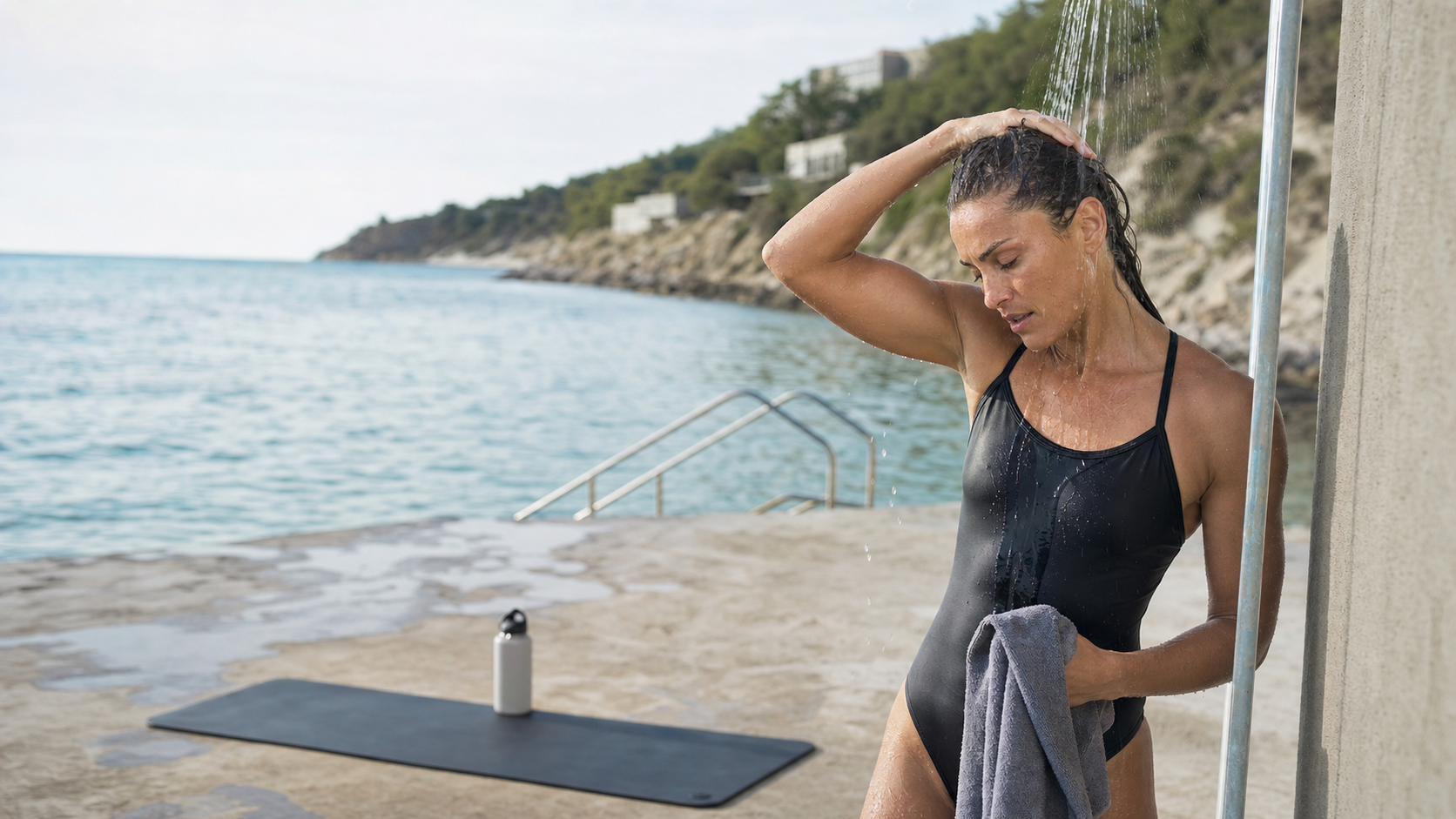
The Sooner, the Better Principle: The longer salt remains on your skin, the worse the dryness and irritation. Ideally, rinse your entire body with fresh water before changing clothes (even without soap).
Key areas to rinse:
- Ears: Press your finger over the ear flap to let water enter the ear canal, then tilt your head back to let it drain out
- Hair and scalp: Salt absorbs moisture from hair, making it difficult to manage
- Underarms and groin: Friction areas from wetsuits; residual salt can easily cause discomfort
- Around the eyes: Saltwater irritates the conjunctiva; rinse gently with lukewarm water
Step 2: Shower with Fresh Water and a Gentle Body Wash
- Use a low-irritation, fragrance-free body wash (the skin’s protective barrier is already compromised after sea swimming)
- Choose lukewarm water (not too hot—hot water further dries out the skin)
- Do not use exfoliating scrubs (the stratum corneum is already damaged after sea swimming)
Step 3: Hair Care
The damage sea water does to hair includes:
- Salt dehydrates hair, causing loss of shine
- Minerals in sea water cause mineral buildup
- UV exposure triggers protein breakdown
Care Steps:
- Soak hair with fresh water before showering (to dissolve and remove salt)
- Use a chelating shampoo after every sea swim
- Leave a deep conditioner on for 3–5 minutes to replenish oils and proteins
- If you swim in the sea regularly, use a hair mask treatment once a week
Ear Canal Care: Preventing Swimmer’s Ear
“Swimmer’s ear” (otitis externa) is one of the most common health issues in open-water swimming, caused by bacteria or fungi multiplying in a waterlogged outer ear canal.
Symptoms: Itching in the ear canal, pain, discharge, and slight hearing loss.
Prevention Methods:
| Method | Description |
|---|---|
| Tilt head and shake out water after exiting | Tilt your head to one side and hop on one foot to create vibration and let trapped water drain out |
| Ear-drying solution | DIY: mix white vinegar + rubbing alcohol 1:1, pour into ear and immediately tilt out (kills bacteria + promotes evaporation) |
| Hairdryer on low heat for ears | Hold 20 cm away, low heat setting, to help moisture evaporate |
| Swim earplugs | Waterproof earplugs prevent water from entering the ear canal |
If symptoms appear: Stop swimming and see an ENT specialist to determine whether antibiotic treatment is needed.
Muscle Recovery Strategies
Immediate Phase (0–2 Hours After Swimming)
Replenish Carbohydrates and Protein:
| Time Point | Recommended Intake | Food Examples |
|---|---|---|
| Within 30 minutes after swim | Carbs + protein (3:1 ratio) | Banana + milk, rice ball + tea egg |
| 1–2 hours after swim | Full meal | Rice + chicken + vegetables |
| Throughout the day | Adequate fluids (body weight × 35ml) | Water, low-sugar sports drinks |
Active Recovery: Do 5–10 minutes of easy kicking with a kickboard or a slow walk after swimming to help metabolize lactic acid—this is better than resting completely still.
Delayed Phase (6–48 Hours After Swimming)
Stretching and Relaxation (Key Areas):
- Shoulder rotator cuff: Doorway stretch, 20 seconds × 3 sets
- Pectorals: Wall stretch to counteract the forward-rounded posture caused by long-term swimming
- Quadriceps/Glutes: Symmetrical kicking uses these muscles relatively less, but they still need stretching
Foam Rolling:
- Key areas: latissimus dorsi, rear shoulders, glutes
- 30–45 seconds per area, rolling slowly
Special Recovery Scenarios
After a Triathlon Swim (immediately followed by cycling and running):
- Don’t aim for “immediate recovery”—focus on replenishing energy and electrolytes to support the next two legs
- During the T1 transition, quickly consume a sports drink (not plain water)
- The full recovery routine begins only after the race ends
After a Long-Distance Sea Swim (>2 km):
- Add one extra light snack compared to usual (an additional 200–300 kcal)
- Ensure 7–9 hours of sleep that night (sleep is the most important recovery tool)
- The next day, do low-intensity activities (walking, easy swimming) rather than staying completely sedentary
Post-Race Gear Maintenance
| Gear | Maintenance Method |
|---|---|
| Goggles | Rinse with fresh water, air-dry before storing (do not wipe the inside of the lenses—this damages the anti-fog coating) |
| Wetsuit | Hand-wash with fresh water, turn inside out to dry, keep away from direct sunlight |
| Safety buoy | Rinse with fresh water, deflate and store dry |
| Swim cap | Rinse with fresh water, lay flat to dry |
Practical Tips
- Bring a large bottle of fresh water to the beach: If there are no shower facilities on site, rinse your body and hair with your own fresh water immediately after exiting the water
- Change into dry clothes before eating: Eating while wet and in cold wind hinders digestion and makes you prone to catching a chill
- Log your body’s responses: After each swim, note any unusual physical sensations (muscle pain, skin reactions, ear condition) to help identify potential issues
- Assess your condition after 24 hours: If you still feel noticeably fatigued or unwell the next day, consider shortening your next training session or taking a rest day
Conclusion
Open-water swimming is a sport that demands a great deal from your body—your skin, hair, muscles, and ear canals all need attentive post-swim care. Establish your own post-race care routine and make it as natural a habit after every swim as checking your gear before heading out. This isn’t just a practical way to protect your body; it’s also a sign of respect for the effort you’ve put in—you’ve given your best out in the ocean, so when you return to land, take good care of the body that carried you through every stretch of water.
Related Reading
- Sun Protection and Skin Care for Open-Water Swimming: Strategies for Prolonged Sun Exposure
- Recovery After a Swim Race: A 48-Hour Post-Race Body Care Plan
- Swimming as Marathon Recovery: Easy In-Water Training During the First Week After a Race
- Open-Water Sun Protection and In-Water Skin Care: Don’t Let Your Skin Be the Weakest Gear
CT暗黑廚房) 車友必備 宇宙無敵鮮蚵湯 幫助訓練恢復 天然食補 好市多 超肥鮮蚵 破PR
7 年前
洗單車神器 吹水機! 實際洗車用用看 暴力洗鍊條大法 | 公路車 | CT Yeh
4 年前
洗完單車整隻手黑的解決妙招🤣 #bike
1 年前
自助洗車場 洗單車 50元有找 清鍊條大法 居然還有小小兵
7 年前
FTL 與 SYB 車隊專訪 西進武嶺 實用攻略分享! 2小時 如何練?!你不知道的眉角!新手準備武嶺必看 EP1 | 實力派女車友 | 精華版 | 公路車 | CTYeh
4 年前
碟煞公路車 銑面器 !? 原來銑完差這麼多! 降低蹭碟機率! | TIME 公路車 保養小記錄 | CT Yeh
3 年前
西進武嶺 免費訓練分析服務 Intervals | 練不夠還是練過頭?你哪一種類型選手?AI模型告訴你! | 備戰神器 | 公路車 訓練 | CT Yeh
4 年前
[教學] Premiere 影片 手震 修正 教學 防抖 單眼 影像 GoPro 穩定 Video Stabilization
8 年前