Introduction
Ultramarathon runners often say, “Every gram in your backpack will torment you in the second half of the race.” This isn’t an exaggeration—it’s the crystallized wisdom of hard-earned lessons. On 50K or even 100K trail races, the weight and contents of your backpack directly affect your running efficiency, nutrition strategy, and ultimately whether you can finish.
Taiwan’s ultramarathon events, especially the UTMB Asia Series (such as UTMB Tarawera, TNF100, etc.), typically have strict mandatory gear checklists. Not carrying the full gear could mean disqualification at best, or life-threatening risks in emergencies at worst. This article helps you figure out the two core questions: “What must you bring” and “How to pack light.”
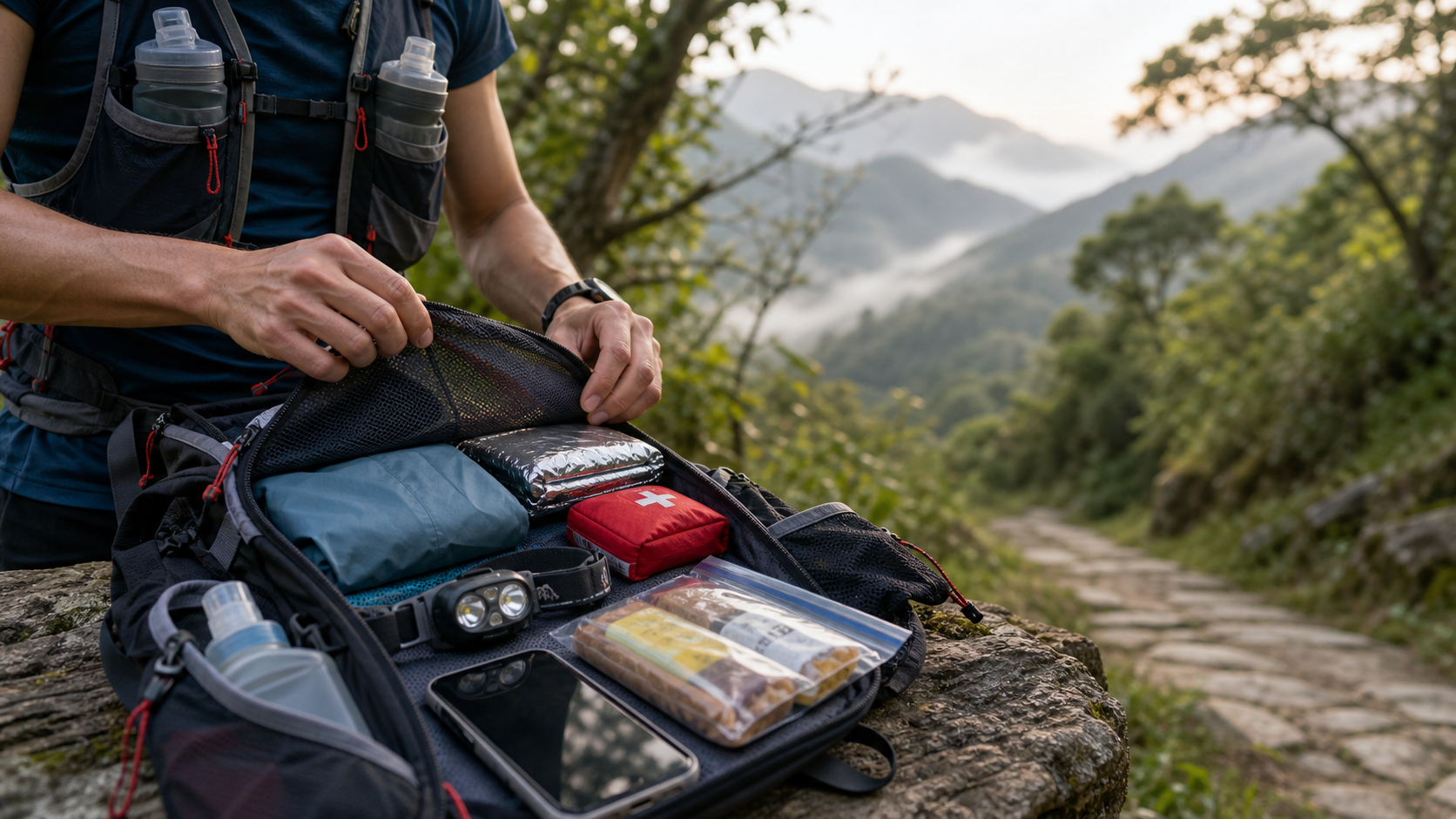
Breaking Down the Ultramarathon Mandatory Gear Checklist
Mandatory gear checklists vary slightly by event, but here are the common requirements across most Taiwanese and Asian trail ultramarathons:
| Gear Category | Typical Requirement | Weight Reference |
|---|---|---|
| Hydration Bladder/Bottles | Minimum 1.5–2L water capacity | 150–300g (empty) |
| First Aid Kit | Elastic bandage, gauze, antiseptic wipes | 50–100g |
| Emergency Blanket | Minimum 140×200cm | 20–40g |
| Rain Jacket/Waterproof Shell | Sealable waterproof design | 150–300g |
| Headlamp | Spare batteries must be carried separately | 80–150g |
| Reserve Food | Typically 200–400 kcal of emergency rations | 100–200g |
| Phone/Communication Device | Must be able to call emergency numbers | 150–200g |
| Personal Medication | Based on individual needs | Varies |
Total mandatory gear weight: approximately 750g–1.5kg (excluding water)
Add water, and your backpack typically weighs 2–3kg at the start. If the pack is poorly designed or the weight distribution is off, the impact on your shoulders and back after 6–10 hours is nothing to scoff at.
Three Key Criteria for Choosing a Backpack
Capacity: Just Enough Is Enough
Ultramarathon backpack capacities typically range from 5–12 liters. Choosing too small a pack means you can’t fit the mandatory gear; choosing too large a pack makes it easy to stuff in unnecessary items, adding weight. Recommended capacity ranges:
- Races under 50K: 5–8 liters
- 100K races: 8–12 liters
- 100-mile (160K) races: 10–15 liters
Fit: No Bouncing While Running
A backpack bouncing while you run is a major no-no—it chafes your skin and wastes extra energy. When purchasing, be sure to test-run with it on and confirm the pack has:
- A sternum strap to prevent shoulder straps from sliding outward
- A hip belt to transfer some weight to your hips
- Front bottle pockets (for easy hydration on the move without removing the pack)
- Elastic cords to secure external gear (trekking poles, etc.)
Weight: The Lighter the Pack Itself, the Better
Quality ultramarathon backpacks on the market weigh around 150–300g themselves. If a pack exceeds 500g, it’s already a relatively heavy choice. Popular brands among Taiwanese runners include Salomon, Ultimate Direction, Osprey, and others, all of which offer lightweight models designed for trail running.
Precision Nutrition Strategy
Estimating Caloric Needs
During an ultramarathon, hourly caloric expenditure is approximately 400–600 kcal (varying by body weight and pace). However, your gut’s absorption efficiency drops during prolonged exercise, so aiming for 200–300 kcal per hour is recommended to avoid overloading your digestive system.
Caloric density comparison of nutrition items:
- Energy gels: ~100 kcal per packet, 25–30g, excellent caloric density
- Bananas: ~90 kcal each, ~100g, real food, easy to digest
- Salted peanuts: ~180 kcal per 30g, high caloric density, but requires chewing
- Rice balls (popular among Taiwanese runners): ~200 kcal each, ~100g, highly satiating
- Energy bars: ~200 kcal each, 50–60g
Making the Most of Aid Stations
Most ultramarathons have aid stations every 10–20K offering food, water, and medical assistance. Using aid stations wisely can significantly reduce your backpack load:
- Refill bottles at aid stations to reduce the amount of water you carry
- Take food provided by the race to reduce what you bring yourself
- Change soaked socks (if you brought spares)
Note: Aid station food varies from person to person; test your tolerance for different foods during training, and never eat something on race day that you haven’t tried before.
Advanced Weight Management Techniques
The Habit of “Gear Audits”
After every training session, make it a habit to review the contents of your backpack. Ask yourself: “During this training run, which items did I never use?” Remove unnecessary items from your list. Common surplus items include:
- Extra reserve food
- Overweight first aid supplies (can be swapped for lighter versions)
- Unnecessary electronic devices
Prioritize Dual-Purpose Items
Choose gear that serves multiple functions, such as:
- Rain jacket doubling as an insulating layer (wear it directly when it’s cold)
- Phone doubling as GPS navigation (reducing the need to carry a separate GPS watch)
- Lightweight buff doubling as a hat and emergency headband
Practical Advice
Train with your race backpack: Don’t wait until race day to use a new pack. Wear your full race-day gear on every long training run to let your body adapt to the load, and to spot potential chafing points early—treat them in advance with sports tape or anti-chafe balm.
Pre-pack your nutrition: Pre-portion each hour’s nutrition into small ziplock bags and place them in your pack in order. This way, you won’t need to rummage around when grabbing food mid-run, saving time and preventing lost items.
Hydration plan: Based on the distance between aid stations on the course, calculate how much water you need to carry for each segment. The average adult needs 500–800ml of water per hour on trail runs (depending on weather). If two aid stations are 15K apart, at a pace of 6–8K per hour, you’ll need roughly 1–2L of water.
Conclusion
Ultramarathon backpack and nutrition management is, at its core, a discipline of “precise calculation” and “field testing.” Mandatory gear is the baseline for safety—don’t skimp on it. Beyond that, every gram added or removed deserves careful thought. We recommend doing a full “loaded long run” before race day to thoroughly test your nutrition strategy with race-day configuration, so your backpack truly becomes an asset rather than a burden.
Related Reading
- Ultramarathon Gear Checklist: The Weight Trade-off Between Mandatory Gear and Personal Choices
- Choosing a Trail Running Hydration Pack: Mandatory Gear and Weight Minimization Strategies
- Trail Running Gear Requirements: Mandatory Gear Checklist and Backpack Selection
- Road Running Vests and Hydration Packs: Gear Selection Strategies for Ultramarathons and Long-Distance Road Races
一日北高前的高裝檢 | 北高 360 | 挑戰11小時的裝備 | 一日雙塔 | 補給
6 年前
單車 一日北高 ( 雙城 ) 肥宅雙人瘋狂行 紀錄片 REACTO
10 年前
一日北高/長距離團騎 常見問題補充篇 / 組團或跟團的眉角 / 壯車友容易被瘦車友慢性拉爆 / 原來屁股痛可能是這個原因...? / 風場配速法 / 公路車 / CT Yeh
2 年前
Live) 備戰2019彰化經典百K 賽前攻略 (已完賽請看新影片
7 年前
摔車後補裝備: 好市多新款單車安全帽& Specialized Romin 北高整路屁股都不痛的坐墊 | 一千元居然有MIPS | CT Yeh | 公路車
4 年前
多到選擇障礙... 換個單車把帶想一個小時 / BTP / 編織&軟木特有材質超吸睛! / 公路車 / CT Yeh
1 年前
CT暗黑廚房) 車友必備 宇宙無敵鮮蚵湯 幫助訓練恢復 天然食補 好市多 超肥鮮蚵 破PR
7 年前
CT 喇低賽) 武嶺牽車 才是王道 西進牽車四小時內秘訣 攝手位置 如何判斷 防抽筋小秘訣
7 年前