Ultramarathon Night Running Strategy: Headlamp Selection and Mental Preparation for Night Running
Introduction
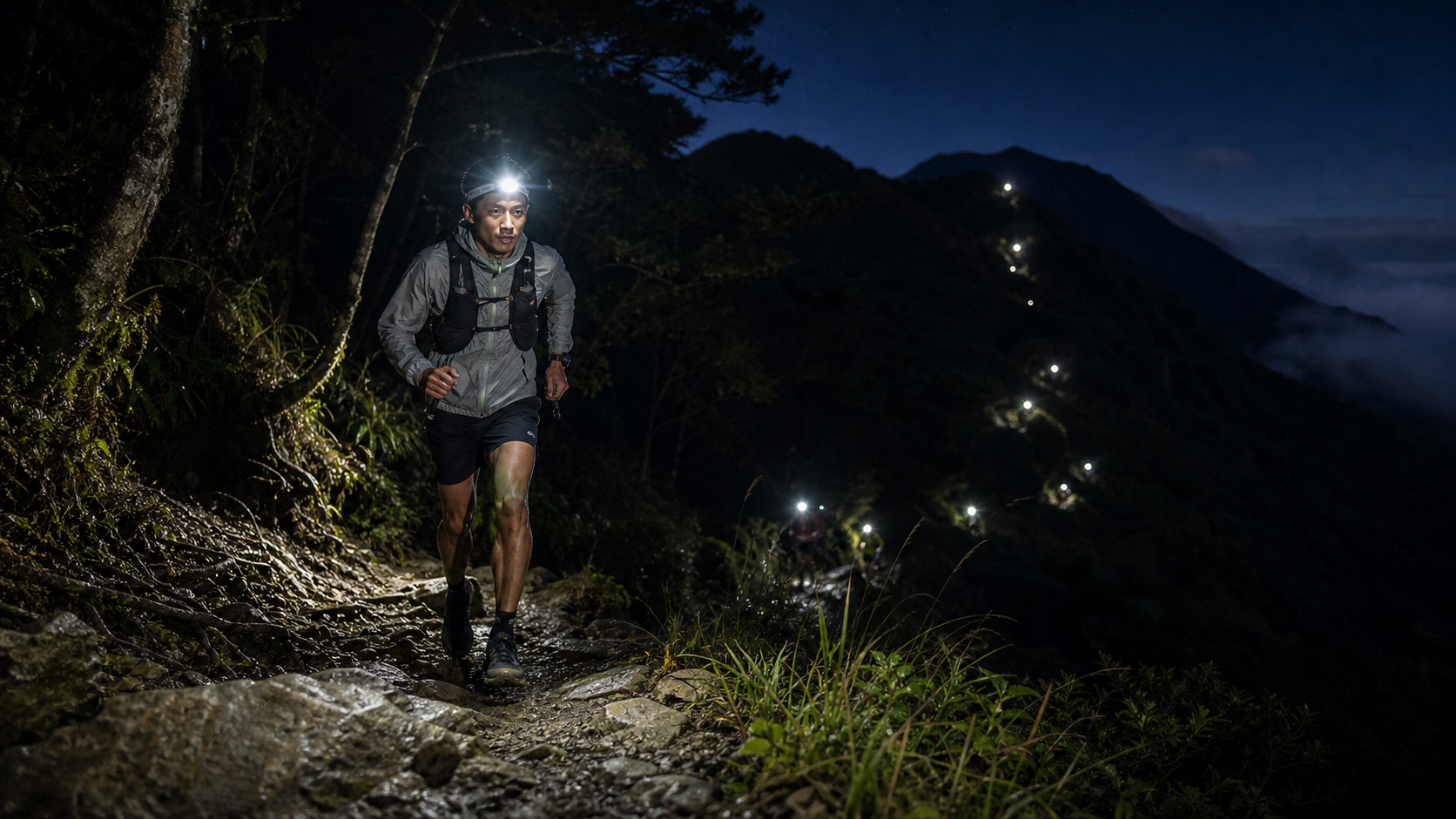
When you stand on the ultramarathon course and watch the strings of headlamp lights slowly moving along the mountain ridgeline in the distance, you’ll understand: half of the soul of ultramarathon lives in the night. For runners challenging distances of 100K or more, night running is almost an unavoidable experience. On Taiwan’s trail ultramarathons, runners who start in the early morning typically finish between the afternoon and late night, while those running slower or tackling longer distances may need to push through the entire night.
The challenges of night running come from two levels: the technical level (limited vision, difficulty reading terrain) and the psychological level (loneliness, sleepiness, and the instinctive fear of darkness). This article will help you prepare for both levels.
Key Considerations for Headlamp Selection
Brightness: Bright Enough to Be Safe
Headlamp brightness is measured in lumens. The recommended brightness for trail night running is as follows:
| Scenario | Recommended Minimum Brightness | Notes |
|---|---|---|
| Gentle trails | 200–300 lumens | Basic terrain recognition |
| Technical trails | 400–600 lumens | Rocky ground and steep descents require stronger depth perception |
| Primary race light | 600–1000 lumens | Provides ample reaction time |
| Backup light | 100–200 lumens | Emergency use if the primary light fails |
Many ultramarathon runners carry one primary and one backup headlamp. The primary light provides high-brightness main illumination, while the backup can be a small clip-on headlamp weighing just a few dozen grams.
Battery Life: Match Your Nighttime Moving Time
- Rechargeable headlamps: Eco-friendly and convenient, but you need to confirm charging opportunities at aid stations. If the race aid stations provide charging, these can be a priority
- Battery-powered headlamps: Carrying spare batteries extends usage time, making them more reliable in remote mountain areas without charging facilities
- Hybrid: Some high-end headlamps support both power methods
Practical estimate: If you expect 5–8 hours of nighttime movement, choose a headlamp that can sustain 6–10 hours in medium brightness mode, and carry one set of spare batteries.
Beam Type: Spot vs. Flood
- Spot beam: Long throw distance, suitable for seeing distant terrain on open ground or descents
- Flood beam: Wide illumination area, suitable for identifying nearby roots and rocks on dense forest trails
- Hybrid: Most race-grade headlamps offer adjustable spot-flood hybrid modes, making them the ideal choice for trail night running
Common Recommended Models in the Taiwan Market
- Petzl Nao+: Reactive lighting technology (automatically adjusts brightness based on the environment), 750 lumens, suitable for advanced needs
- Black Diamond Spot 400-R: Rechargeable, 400 lumens, great value for money, suitable for beginner runners
- Ledlenser NEO10R: 1000 lumens, running-optimized design, lightweight
Technical Adjustments for Night Running
Shorten Stride, Maintain Cadence
When vision is limited, the natural instinct is to step carefully with each stride. During night running, it’s recommended to actively shorten your stride by 20–30% to avoid over-striding onto unstable rocks. At the same time, maintain or slightly increase your cadence to preserve forward efficiency.
Tips for Headlamp Positioning
A headlamp worn simply on top of the head casts light parallel to your line of sight, which can make the terrain appear “flat” and make it difficult to judge undulations. You can:
- Tilt the headlamp slightly forward so the light shines obliquely onto the ground, increasing shadow contrast and making bumps and dips easier to identify
- If you have a chest light (clipped to your pack’s sternum strap), use it in combination with the headlamp to illuminate the terrain from different angles
Protecting Your Eyes
When in a headlamp-lit environment for extended periods, suddenly looking up at another runner’s headlamp or a vehicle’s lights requires time for your eyes to adapt. You can practice these habits during training:
- When facing an oncoming light source, close one eye to preserve your night vision
- After moving away from the light source, close your eyes for a few seconds to let them readjust
Mental Preparation for Night Running
Managing Loneliness
On nighttime trails, the gaps between runners often widen. Running alone through dark mountain forests amplifies the feeling of loneliness. Here are effective mental management strategies:
Set small goals: Don’t think “there are still 30K to the finish line.” Instead, tell yourself “just get to the next trail marker.” Break the nighttime section into small segments, and give yourself a small reward at each milestone (a pack of nutrition, a sip of water).
Using music or podcasts: Some runners listen to music through wireless earphones at night, which can genuinely help lift their spirits. However, note the following:
- Keep one ear canal open to hear environmental sounds (other runners calling out, water flow, wildlife)
- Wild boars occasionally appear in Taiwan’s mountain areas, so being able to hear your surroundings is a safety consideration
Fighting Sleepiness
Between 2–4 AM is the lowest point of the human circadian rhythm, when sleepiness is strongest. The following methods can help combat drowsiness:
- Caffeine intake: Energy gels often come in caffeinated versions; you can start using them when entering the nighttime period
- Splash cold water on your face: Wash your face with cold water at aid stations for a brief wakefulness boost
- Find a conversation partner: If you encounter a runner with a similar pace, try running together and chatting with each other
- Increase cadence: Slight muscular stimulation helps maintain alertness
Note on caffeine timing: If you expect to finish around 6–7 AM, your last caffeine intake should be before 3–4 AM to avoid affecting post-race sleep.
Practical Advice
Night running training is essential: Don’t wait until race day to experience night running. It’s recommended to schedule at least 2–3 nighttime training runs during your preparation period to familiarize yourself with the feel of trails under headlamp light, as well as the physiological and psychological states of night running.
Tell others about your plans: For nighttime training runs, be sure to inform family or friends of your route and expected return time, and carry a charged phone.
Check your nighttime gear before the race: The night before the race, be sure to confirm your headlamp has sufficient battery and that spare batteries work properly. Don’t trust “it should still have charge”—replacing with fresh batteries directly is the safest approach.
Conclusion
Night running is the most challenging and most unforgettable part of ultramarathon. When you see the first light of dawn from a mountaintop before sunrise, that feeling of emerging from the darkness is one of the most precious gifts ultramarathon gives you. Be technically prepared, be mentally prepared—the night is not your enemy, but a companion that walks with you through the challenge.
Related Reading
- Night Sections in Ultramarathons: Mental Coping in the Dark and Headlamp Selection
- Ultramarathon Night Running Techniques: Headlamp Brightness, Nighttime Heart Rate, and Nighttime Nutrition Rhythm
- Night Training for Trail Running: Headlamp Selection and Safety Rules for Nighttime Trails
- Night Running Safety Lighting Systems: A Complete Buying Guide from Headlamp Lumens to Reflective Gear
雷達尾燈 雷不雷? 邁金L508 智慧雷達尾燈 情境考驗實測 | 同場加映 2千元等級的專業車錶 C406 Pro | 公路車 | CT Yeh
3 年前
沉浸室內單車練功房開箱! 100吋大畫面,最便宜的花費? 居然還能K歌!? | 公路車 | CT Yeh
3 年前
一日北高前的高裝檢 | 北高 360 | 挑戰11小時的裝備 | 一日雙塔 | 補給
6 年前
iPhone 12 Pro 夜間騎車動態錄影 效果屌打 GoPro Hero 9 | 公路車 團練
5 年前
趣味單車配件:多功能智慧尾燈 / 有方向燈 可app編輯圖案!? / GRC x Lumii 聯名款 / 公路車 CT Yeh
9 個月前
CT 喇低賽) 單車 比賽總是沒照片? 攝影師的觀點大公開 姿勢就是力量! 請加速1.25倍收看
7 年前
CT 喇低賽) 武嶺牽車 才是王道 西進牽車四小時內秘訣 攝手位置 如何判斷 防抽筋小秘訣
7 年前
備戰 戀戀197 賽前關門點分析 西濱團練 #公路車 4K高畫質
6 年前