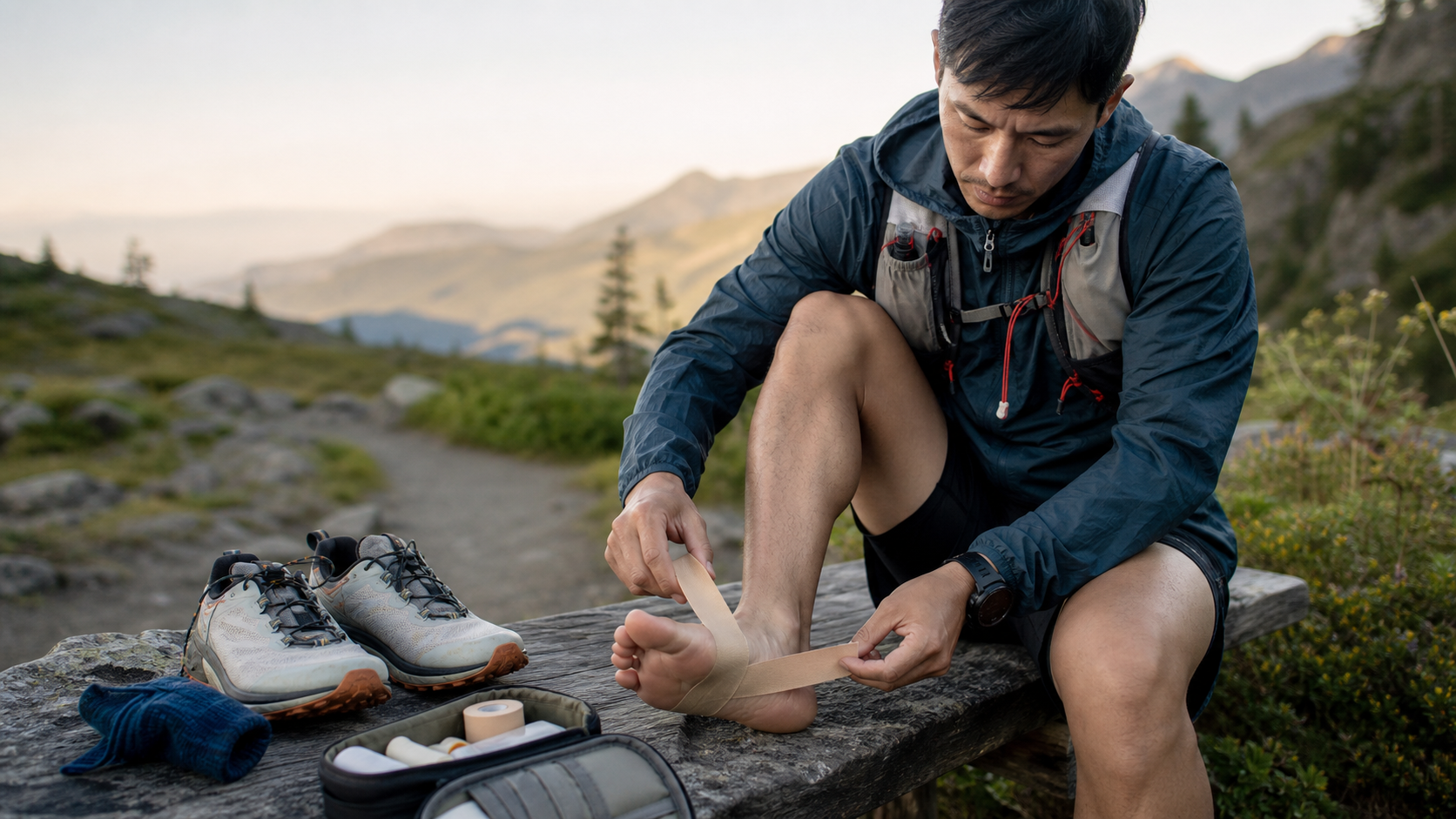
Introduction
In an ultramarathon, your feet are your most precious piece of gear. Yet the seemingly minor problem of “blisters” is the cause of countless athletes falling short of the finish. A blister in the wrong spot can turn every step into agony, eventually forcing a runner to drop out just kilometers from the end.
The cause of blisters is simple: repeated friction between skin and shoe or sock, combined with prolonged hot, humid conditions (sweat, rain, river crossings), causes fluid to build up between the epidermis and dermis, forming a fluid-filled sac. Over an 8-30 hour ultramarathon, a runner’s feet take tens of thousands of steps, and any tiny friction point can be amplified into a painful blister.
This article covers everything from shoe selection and sock choice to preventive taping and on-course first aid — a complete guide to protecting your feet during an ultramarathon.
Shoe Selection: The Special Demands of Ultras
Sizing: Half to a Full Size Larger Than Usual
This is the most commonly overlooked principle of ultra shoe fitting. After hours of running, feet swell from increased blood flow and fluid retention, and combined with thicker anti-blister socks, your usual shoe size can become too tight, causing toe-box impact and side friction.
Recommendation: Try on shoes wearing the socks you’ll race in, and fit them in the evening (when feet are naturally at their largest). Leave at least 1 cm of space between your big toe and the toe box.
Choosing the Right Shoe Type
| Shoe Characteristic | Best Suited For | Ultra Considerations |
|---|---|---|
| Low drop (0-4mm) | Technical mountain trails, off-road running | Good foot-ground feel, but requires long-term adaptation |
| Mid drop (4-8mm) | Mixed terrain | A balanced choice for most runners |
| High drop (8-12mm) | Long-distance paved routes | Strong heel cushioning, easier on the knees |
| Wide-toe-box design | Runners with wider feet | Taiwanese runners tend to have wider feet on average, so this should be a priority |
| Gore-Tex waterproof | Rainy races / river crossings | Waterproof but poor breathability; in non-river-crossing races it can trap sweat and cause blisters more easily |
Top priorities for ultras: an aggressive outsole tread pattern, adequate underfoot protection (a rock plate), and a wide toe box or a design that maximizes room for your foot shape.
“Break-In Mileage” for Shoes
Never wear brand-new shoes on race day. The upper material of a new shoe hasn’t yet molded to your foot shape, making it a high risk factor for blisters. Race-day shoes should have at least 100-150K of training mileage on them before the race to reach a proper “broken-in” state.
At the same time, don’t wear shoes that are past their usable life. Most trail shoes have a cushioning lifespan of around 400-600K; if the outsole tread is clearly worn smooth, it’s time to replace them.
Socks: The Underrated Layer of Blister Protection
Choosing the Right Material
- Merino wool: moisture-wicking, antibacterial, and odor-resistant; it retains a degree of cushioning even in wet conditions, making it a widely recommended material in the ultra community
- Double-layer design: the two layers rub against each other instead of skin rubbing against the outer layer, significantly reducing blister risk
- Coolmax/synthetic fibers: dry quickly, ideal for races with frequent river crossings or runners who sweat heavily
- Cotton: not recommended for ultras — once wet, it stays wet, making it a breeding ground for blisters
Testing Your Socks in Training
Just like shoes, race-day socks should be thoroughly tested in training. Use the exact model you plan to race in during your longest training runs to confirm there are no friction points.
Preventive Taping Techniques
Know Your “High-Risk Zones”
Everyone has their own personal pattern of where blisters form. The most common high-risk zones for ultrarunners include:
- The side and underside of the big toe (most common)
- The outer side of the little toe
- The heel (especially where the Achilles tendon rubs against the shoe collar)
- The gaps between toes
- The ball of the foot (an area of concentrated pressure over long durations)
After training runs, observe which areas show redness or mild soreness — these are your personal high-risk zones and should be taped first before race day.
How to Use Leukotape
Leukotape is the most commonly used anti-blister tape among ultrarunners. It has extremely strong adhesion and stays in place for long periods even in wet conditions.
Basic taping steps:
- Make sure the skin is clean and dry (wipe with alcohol and let it air-dry)
- If your skin is sensitive, apply a base layer of Hypafix or kinesiology tape first
- Cut the Leukotape to the appropriate shape and round off the edges (sharp right angles tend to peel up)
- Press it down slowly, working from the center outward to remove any air bubbles
- Once applied, warm it briefly with your palm to increase adhesion
Taping techniques for specific areas:
- Toes: use a toe sleeve or a wrap-around taping method, making sure joint movement isn’t restricted
- Heel: a “U”-shaped taping pattern that wraps the heel while leaving the Achilles tendon area free
- Ball of the foot: a semicircular taping pattern that covers the area beneath the metatarsal heads
On-Course First Aid: What to Do If a Blister Has Already Formed
If you discover a blister during the race, treat it at an aid station:
- Assess the severity: small blisters (under 5mm in diameter) can usually be run through; large blisters or ones that affect your gait need to be treated
- Disinfect and drain: disinfect with alcohol, then puncture the edge of the blister with a needle (leaving the overlying skin intact) to drain the fluid
- Cover and protect: cover the area with Leukotape or a dedicated blister pad (such as Compeed) to protect the exposed tissue
- If medical support is available: many large ultramarathons have medical staff stationed at major aid stations who can provide professional assistance
Warning: If the blister fluid is cloudy (a possible sign of infection) or you experience severe pain, stop racing and seek medical attention.
Practical Tips
Using anti-chafing balm: Before long-distance training, apply anti-chafing balm (such as Vaseline or BodyGlide) to your high-risk zones. Anti-chafing balm forms a protective film on the skin’s surface that reduces direct friction. It’s especially useful between the toes, on the heels, and on soft-tissue areas like the inner thighs.
Pre-race foot care: Keep your toenails trimmed short (but not too short) to avoid nail impact against the toe box causing subungual blood blisters. If you have calluses on the soles of your feet, keep a moderate amount (a thin layer of callus actually provides natural protection), but overly thick calluses are more prone to cracking during long-distance runs.
Conclusion
An ultramarathon is a long journey for your feet, and taking good care of them is the basic condition for completing that journey. Blister prevention isn’t a matter of luck — it’s a skill that can be learned and prepared for. From choosing the right shoes and socks to mastering preventive taping, turn this knowledge into concrete preparation before race day. When you cross the finish line, your feet may not be in perfect condition, but they got you there — and that alone is something to be proud of.
Related Reading
- Trail Running Foot Blisters and Chafing: From Prevention to Emergency Care
- The Complete Runner’s Guide to Blister Prevention and Treatment
- Runner’s Foot Care: A Complete Guide to Blister Prevention, Toenail Trimming, and Shoe Fit
- Black Toenails and Blisters in Runners: Prevention and Treatment Guide
洗單車神器 吹水機! 實際洗車用用看 暴力洗鍊條大法 | 公路車 | CT Yeh
4 年前
CT 喇低賽) 武嶺牽車 才是王道 西進牽車四小時內秘訣 攝手位置 如何判斷 防抽筋小秘訣
7 年前
Never Stop 西進武嶺 前後雙機 完整全程錄影 訓練台 實境
8 年前
自助洗車場 洗單車 50元有找 清鍊條大法 居然還有小小兵
7 年前
單車 一日北高 ( 雙城 ) 肥宅雙人瘋狂行 紀錄片 REACTO
10 年前
一日北高/長距離團騎 常見問題補充篇 / 組團或跟團的眉角 / 壯車友容易被瘦車友慢性拉爆 / 原來屁股痛可能是這個原因...? / 風場配速法 / 公路車 / CT Yeh
2 年前
西進武嶺 自製新版AI配速表產生器 x 賽前攻略 抱佛腳! 沒有功率計也可以產生配速表嗎?有什麼其他眉角賽前要注意的呢? | 西進武嶺 / 東進武嶺 KOM 攻略 | 公路車 | CT Yeh
4 年前
一日北高常見問題大集合 | 攻略 | 路線 | 訓練 | 補給 | 自行車 單車 | 一日雙城 | 雙塔 | TWB北高360 | 屁股痛
6 年前