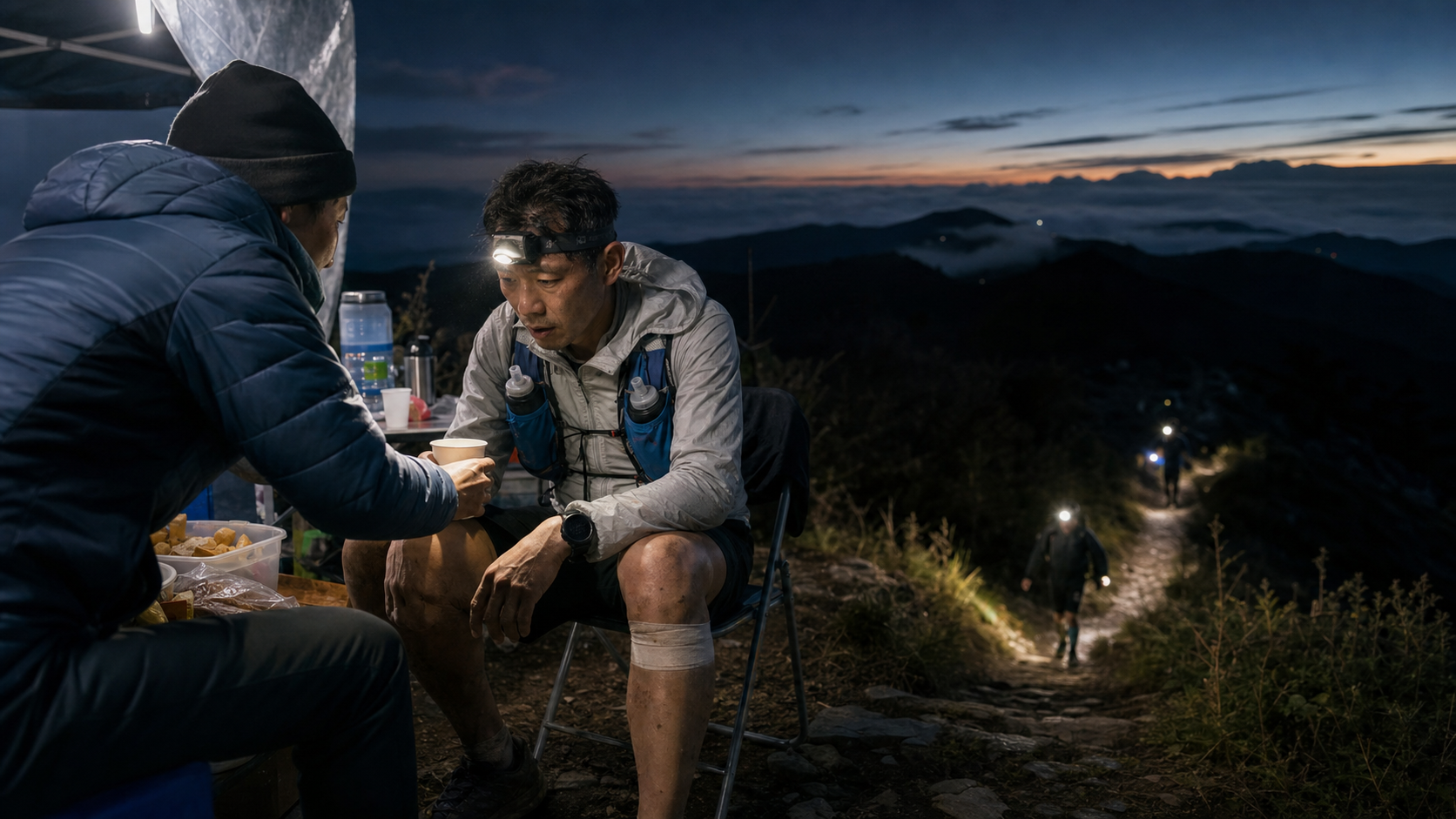
Introduction
The ultramarathon world has a poetic saying: “At 3 a.m. on a mountaintop, you meet your truest self.” This is not just poetry—it is a brutally honest description of reality. When tackling 24-hour races, 100-mile (160K) events, or multi-day relays, sleep deprivation is the ultimate challenge nearly every athlete must face.
The body’s circadian rhythm peaks in sleepiness between 2–5 a.m. No matter how much coffee you drink during the day or how hard you try to stay alert, drowsiness during this window surges with overwhelming force. Understanding the physiological mechanisms of sleep deprivation and preparing coping strategies in advance is one of the key skills for successfully completing ultra-distance events.
The Physiological Effects of Sleep Deprivation
Cognitive Decline
Research shows that after 24 hours of continuous wakefulness, cognitive decline is equivalent to a blood alcohol concentration of 0.1% (Taiwan’s drunk-driving limit is 0.05%). This means your judgment, reaction speed, and spatial awareness all deteriorate significantly, greatly increasing the risk of running on technical trails.
The Declining Curve of Athletic Performance
| Hours Awake | Primary Effects | Risk Level |
|---|---|---|
| 18 hours | Mild cognitive fog, mood swings | Low |
| 20–22 hours | Noticeably slower reaction time, impaired judgment | Medium |
| 24 hours | Possible hallucinations, impaired coordination | High |
| 30+ hours | Uncontrollable microsleep | Extreme |
Microsleep is the most dangerous symptom: your brain briefly enters a sleep state (from a few seconds to a few minutes) without you being conscious of it at all, which can cause sudden loss of balance or sense of direction while running, leading to serious falls on rugged trails.
Emotional and Motivational Collapse
Sleep deprivation severely impairs emotional regulation. Many athletes in the deep night hours of a 24-hour race suddenly plunge into intense despair, tears, or even thoughts of dropping out. Understanding that this is a temporary state caused by physiological factors—not a true emotional assessment—is crucial for maintaining psychological stability.
The Multi-Layered Defense System of Staying Awake
First Line of Defense: The Pre-Race Sleep Bank
The “sleep bank” concept involves deliberately extending sleep time in the days before a race to accumulate extra sleep reserves. Research shows that sleeping 1–2 extra hours each night for a week before a race can significantly delay the effects of in-race sleep deprivation.
Practical application:
- 7–10 days before the race: aim for 8–9 hours of sleep each night
- 2–3 days before the race: if the race starts early in the morning, try adjusting your circadian rhythm by going to bed earlier
- The day before the race: even if excitement keeps you from sleeping, make sure you lie down and rest for 8 hours
Second Line of Defense: Strategic Caffeine Use
Caffeine is the most commonly used and most effective wakefulness aid among ultramarathon runners. But casually consuming caffeine is far less effective than using it strategically.
Best strategies for caffeine use:
- Timing: Take it 30 minutes before your alertness begins to decline (i.e., before you feel sleepy, not after you are already drowsy)
- Dosage: 100–200mg per dose (equivalent to 1–2 shots of espresso or 1–2 caffeinated energy gels)
- Frequency: Once every 3–5 hours; avoid continuous heavy intake to prevent gastrointestinal discomfort
- Cutoff time: If the race is expected to end at 7–8 a.m., your last caffeine dose should be before 3 a.m. to avoid affecting post-race sleep
Note: Caffeine affects individuals very differently; test your tolerance and reaction time during training.
Third Line of Defense: Physical Stimulation Methods
When drowsiness is particularly intense, the following physical stimulation methods can provide short-term alertness:
- Cold water on the face: At aid stations, splash cold (or ice) water on your face to stimulate the trigeminal nerve and quickly wake up the brain
- Smelling salts: Some athletes carry smelling salts and take a brief sniff when needed—the effect is strong but short-lived
- Brisk walking or light jogging: If you start nodding off while walking, switch to brisk walking or light jogging; active muscle contraction helps maintain alertness
- Conversation: Find a companion and strike up a conversation—it is one of the most effective ways to stay awake
Fourth Line of Defense: Strategic Power Naps
For events lasting beyond 24 hours, strategic power naps are often more beneficial to overall performance than forcing yourself to stay awake. Research shows that a 10–20 minute nap significantly restores cognitive function, with effects lasting 1–3 hours.
Key points for ultramarathon napping:
- Choose an aid station with facilities (a tent or indoor space)
- Set an alarm and strictly control the nap to 15–20 minutes (going over 30 minutes leads to deep sleep, and you will wake up even groggier)
- Drink a cup of coffee before napping (caffeine takes effect in about 15–20 minutes, right around when you wake up—this technique is called a “Caffeine Nap”)
- Inform aid station volunteers and ask them to wake you when the time is up
Psychological Strategy: Accept the Drowsiness Rather Than Fight It
Many athletes, when hit with strong drowsiness, waste enormous mental energy on anxiety and resistance. A more effective psychological strategy is: accept that the drowsiness exists, while using the methods above to manage it.
Tell yourself: “I am very sleepy right now—this is a normal physiological response. My body is functioning, my strategy is being executed. I just need to reach the next aid station.” Focus your attention on small, controllable goals rather than resisting an uncontrollable physiological state.
Practical Advice
Training night runs is essential preparation: During your race preparation, schedule at least 1–2 late-night training runs (11 p.m. to 2 a.m.) so your body and mind can experience nighttime exercise in advance. For many people, the first late-night training run is a shocking experience—it is best to go through it during training rather than encountering it for the first time in a race.
Discuss checkpoints with your training partner: If you have a pacer, agree in advance on a response plan: “When I show these symptoms, take these measures.” Let your pacer serve as your external supervisor, helping you make sound decisions when your judgment is impaired.
Conclusion
Sleep deprivation management is the ultramarathon skill that is hardest to fully simulate in training, yet it is no less important than physical conditioning. When you stand on a mountaintop at 4 a.m. and see the first pale light of dawn on the eastern horizon, that feeling of breaking free from the depths of sleep deprivation is one of the most precious gifts ultrarunning has to offer. Be prepared, and let the night become your training ground.
Related Reading
- Sleep Deprivation in Ultramarathons: Staying Awake Strategies for Races Over 24 Hours
- Sleep Deprivation Management in Extreme Endurance Sports
- Ultramarathon Nighttime Aid: Caffeine Use Strategies and Timing Control for Night Sections
- Ultramarathon and Long-Distance Race Strategies: Full Analysis of Energy Management, Run-Walk Intervals, Nighttime Sleep Deprivation, and Mental Segmentation
CT 喇低賽) 武嶺牽車 才是王道 西進牽車四小時內秘訣 攝手位置 如何判斷 防抽筋小秘訣
7 年前
西進武嶺 免費訓練分析服務 Intervals | 練不夠還是練過頭?你哪一種類型選手?AI模型告訴你! | 備戰神器 | 公路車 訓練 | CT Yeh
4 年前
live) 超越北高 之一日北高12小時 策略
7 年前
2019 夏季KOM 5小 完賽心得 準備攻略 東進武嶺 夏季登山王之路 Taiwan KOM Challenge
7 年前
西進武嶺 世界紀錄挑戰!破2:30 ?!一群人推著一個夢上山 直播精華版 / ft. 張翰允 & 台視主播魏于恬 & KPLUS / #cycling 公路車 CT Yeh
2 個月前
CT暗黑廚房) 車友必備 宇宙無敵鮮蚵湯 幫助訓練恢復 天然食補 好市多 超肥鮮蚵 破PR
7 年前
一日北高 11小時 賽後心得分享篇 | TWB北高360 | 一日雙城 | 單車 | 公路車
6 年前
Live) 備戰2019彰化經典百K 賽前攻略 (已完賽請看新影片
7 年前