Introduction
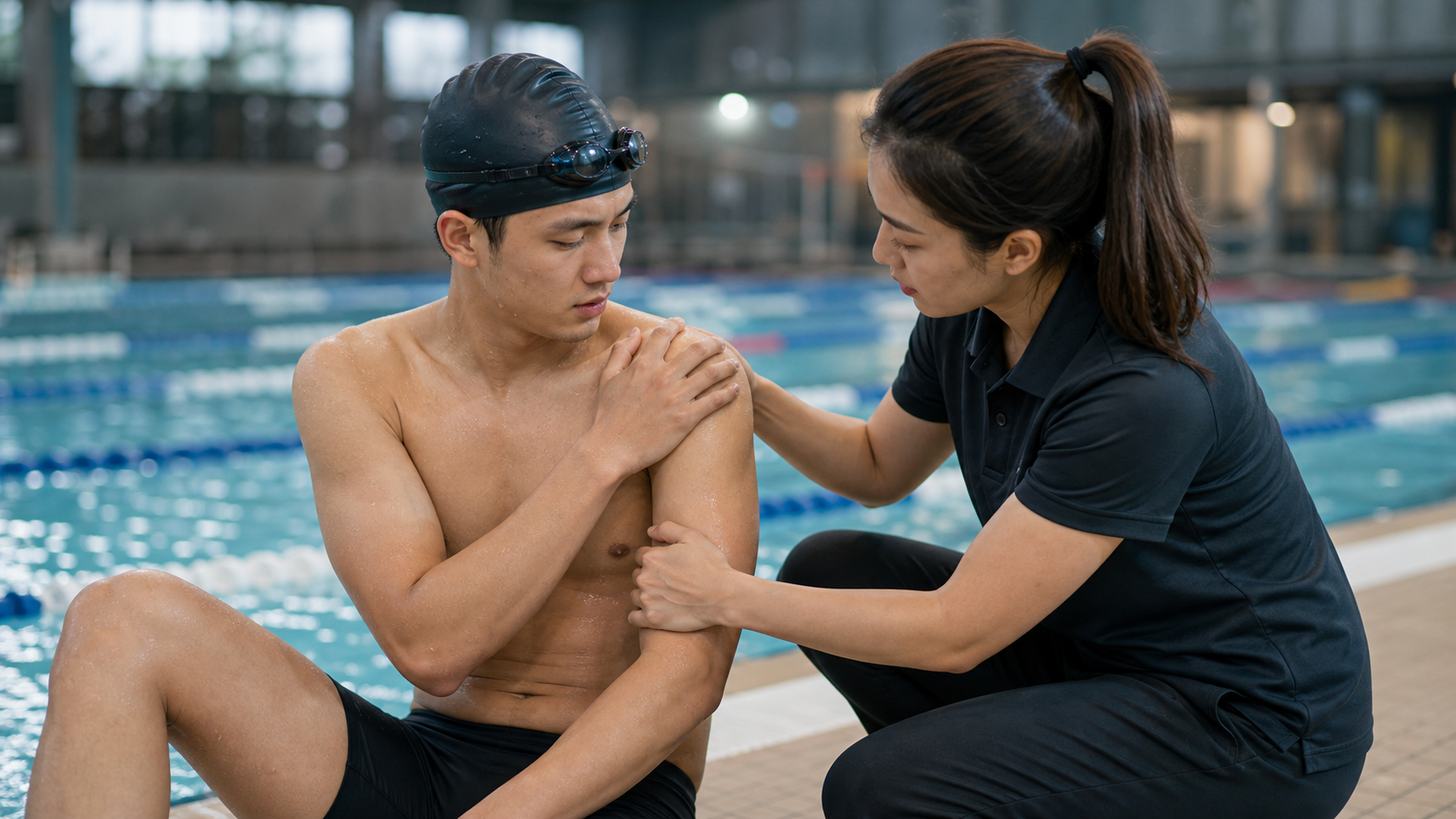
Swimmer’s Shoulder is the most prevalent overuse injury in swimming, with an estimated 40–70% of competitive swimmers experiencing shoulder pain of varying severity at some point in their training careers. The shoulder joint is the most mobile joint in the human body, and precisely because of this flexibility, it is also the most susceptible to wear and tear from repeated high-load movements. Every stroke in freestyle and butterfly requires the shoulder to perform a full circular motion, and a dedicated athlete may accumulate over 100,000 stroke cycles in a single week. This cumulative stress is the fundamental cause of swimmer’s shoulder.
Pathological Mechanisms and Commonly Affected Tissues
Swimmer’s shoulder is not a single diagnosis but an umbrella term for a group of shoulder pathologies resulting from repetitive overhead movements, primarily involving the following structures:
- Rotator Cuff: The supraspinatus is the most commonly affected muscle, bearing the greatest tension during hand entry and the pulling phase of the stroke.
- Subacromial Bursa: Provides cushioning between the acromion and the rotator cuff; chronic irritation can lead to bursitis.
- Biceps Long Head Tendon: The long head of the biceps tendon experiences continuous friction during head rotation for breathing in freestyle.
- Anterior Capsule: Excessive external rotation on the breathing side can lead to anterior capsule laxity, which in turn triggers “shoulder impingement syndrome.”
Shoulder impingement syndrome is the core pathology of swimmer’s shoulder: when the hand enters the water at too low an angle (the so-called “crossing the midline” stroke), or when weak core muscles result in poor scapular control, the greater tuberosity of the humerus repeatedly impacts the anterior edge of the acromion, impinging soft tissues.
Diagnostic Methods
Clinical Assessment
Physicians or physical therapists typically employ the following standardized assessment tools:
| Test Name | Target Tissue | Positive Finding |
|---|---|---|
| Neer Impingement Test | Subacromial bursa / Supraspinatus | Anterior shoulder pain with arm elevation |
| Hawkins-Kennedy Test | Subacromial impingement | Pain provoked with forward elevation in internal rotation |
| Empty Can Test | Supraspinatus strength | Weakness or pain |
| O’Brien Test | Labrum / Acromioclavicular joint | Pain more pronounced with downward pressure while palm facing down |
| Speed’s Test | Biceps long head tendon | Pain in the bicipital groove with resisted forward elevation |
Regarding imaging, ultrasound allows real-time dynamic observation of impingement and can detect rotator cuff tears; MRI offers the highest resolution for soft tissue pathology and is recommended if there is no improvement after 6–8 weeks of conservative treatment.
Pain Localization
Pain from swimmer’s shoulder typically presents at: the anterolateral acromion, the anterior upper arm, and as nocturnal resting pain several hours after training. If pain radiates to the neck or is accompanied by finger numbness, cervical nerve root compression should be ruled out.
Treatment Strategies
Conservative Treatment (Acute Phase: 0–6 Weeks)
- Relative Rest: Reduce swimming training volume by 30–50%, suspend butterfly and freestyle, and switch to kickboard drills to maintain aerobic fitness.
- Physical Therapy: Includes ultrasound, electrotherapy, ice therapy (acute phase), heat therapy (subacute phase), and manual therapy to release myofascial tension.
- Strengthening Exercises: Eccentric training targeting the rotator cuff (especially the infraspinatus and teres minor) and the serratus anterior is central to preventing recurrence.
- Anti-inflammatory Medication: Short-term use of NSAIDs can help control inflammatory symptoms; long-term reliance is not recommended.
- Subacromial Injection: When inflammation is severe and physical therapy yields limited results, corticosteroid injections may serve as a bridging treatment, but should not exceed 3 injections within a year.
Technique Correction (The Most Fundamental Prevention)
- Hand Entry Point: Fingers should enter the water outside shoulder width, avoiding crossing the body’s midline to reduce internal rotation impingement.
- Stroke Path: Maintain a “high elbow catch” with the elbow higher than the wrist during the pulling phase to reduce rotator cuff load.
- Breathing Frequency: Bilateral breathing balances shoulder stress; breathing every 3 strokes is recommended instead of a fixed unilateral pattern.
- Core Activation: Gently brace the abdomen before hand entry to stabilize the spine and reduce scapular compensation.
Surgical Treatment
If conservative treatment fails after 3–6 months and imaging confirms definitive structural damage (full-thickness rotator cuff tear, labral tear), arthroscopic surgery should be considered. Postoperative recovery takes approximately 3–6 months, with progressive aquatic rehabilitation as the primary approach during this period.
Practical Recommendations
- Do not increase training volume by more than 10% per week: Swimmer’s shoulder most often occurs 4–6 weeks after rapid volume increases; following the “10% rule” significantly reduces risk.
- Stretch the pectoralis major and anterior shoulder after every training session: Tight pectoral muscles cause forward shoulder posture, exacerbating impingement.
- Undergo regular stroke analysis: Have a coach review your stroke technique with underwater cameras each season, paying particular attention to hand entry angle and elbow height.
- Do not skip dry-land strengthening: Resistance band training for the rotator cuff (internal/external rotation) and prone Y/T/W exercises, 2–3 times per week, are the best investment in shoulder protection.
- Pain is not a sign of “training effectiveness”: If shoulder pain persists for more than 3 days or continues at rest, consult a sports medicine physician or physical therapist immediately.
Conclusion
Although swimmer’s shoulder is common, it is by no means an “inevitable price of swimming.” Through proper stroke technique, scientific training volume management, and a targeted shoulder strengthening program, the vast majority of swimming enthusiasts and athletes can minimize the risk of swimmer’s shoulder. Once symptoms appear, seizing the golden 6-week window for conservative treatment, combined with technique correction, typically allows for complete recovery without surgery. The shoulder is a swimmer’s most precious asset and deserves the most comprehensive protection and care.
Related Reading
- Complete Analysis of Swimmer’s Shoulder: Causes, Diagnosis, and Prevention
- Shoulder Injuries in Swimming: Causes and Prevention of Swimmer’s Shoulder
- Swimmer’s Shoulder: Identification and Causes of Rotator Cuff Syndrome
- Pediatric Swimming Shoulder Overuse Injuries: A Complete Guide to Identification, Prevention, and Rehabilitation
抖肩舞 台灣x日本交流版 (台灣 vs 前橋) 赤城山登山賽 coincidance
8 年前
一日北高/長距離團騎 常見問題補充篇 / 組團或跟團的眉角 / 壯車友容易被瘦車友慢性拉爆 / 原來屁股痛可能是這個原因...? / 風場配速法 / 公路車 / CT Yeh
2 年前
[教學] Premiere 影片 手震 修正 教學 防抖 單眼 影像 GoPro 穩定 Video Stabilization
8 年前
2026 輪霸西濱200K 挑戰VLOG / 第一集團 / 首次參加..經驗不足、膀胱不足 /死守6H內 / AI戰鬥力顯示系統 / 公路車 / CT Yeh
4 個月前
一日北高常見問題大集合 | 攻略 | 路線 | 訓練 | 補給 | 自行車 單車 | 一日雙城 | 雙塔 | TWB北高360 | 屁股痛
6 年前
如何把 GoPro 影片 翻轉 批次 轉正?
6 年前
松運深水池拍攝 作品 防寒衣品牌
8 年前
Insta 360 One 超級防手震技術實測
7 年前