Introduction
Although swimming is often regarded as a “safe, low-impact sport,” acute muscle strains still occur from time to time, especially under conditions of inadequate warm-up, fatigued training, or sudden all-out sprinting. Swimming-related acute strains most commonly affect the latissimus dorsi (during the pull phase of freestyle), the adductor muscles (during the leg closure phase of the breaststroke kick), the gastrocnemius (during kicking or pushing off the wall), and the rotator cuff muscles. Correct first-aid management determines the speed of recovery, and the PRICE principle (Protection, Rest, Ice, Compression, Elevation) is the most widely adopted initial management guideline for acute soft-tissue injuries in sports medicine worldwide.
Grading of Muscle Strains
Three-Grade Classification System
Correctly assessing the severity of a strain is key to determining subsequent management:
| Grade | Degree of Muscle Fiber Damage | Symptom Characteristics | Estimated Recovery Time |
|---|---|---|---|
| Grade 1 (Mild) | Micro-tears in less than 5% of muscle fibers | Mild pain, normal muscle strength, no effect on walking | 1–2 weeks |
| Grade 2 (Moderate) | Partial muscle fiber tearing (5–50%) | Notable pain, swelling, bruising, decreased muscle strength | 3–6 weeks |
| Grade 3 (Severe) | Complete rupture of the muscle or tendon | Severe pain, immediate loss of function, palpable gap | 3–6 months (including surgical evaluation) |
Grade 3 strains (complete rupture) require immediate medical attention and usually need surgical repair; for any injury suspected to be Grade 3, self-treatment followed by continued training is strictly prohibited.
Detailed Explanation of the PRICE Principle
P — Protection
During the first 24–72 hours after a strain, the most important thing is to “not make the injury worse”:
- Immediately stop the movement that causes pain and get out of the water
- Use protective gear (e.g., an elastic bandage lightly wrapped for support in the case of a thigh strain) to temporarily protect the injured area
- Avoid any movement that might stretch the injured muscle—forcefully stretching immediately after a strain is a mistake
- If you need to get back into the water after finishing a swim (e.g., if the injury occurs in the middle of a pool), swim to the edge using movements with the least tension
R — Rest
“Relative rest” rather than “absolute immobilization” is the principle recommended by modern sports medicine:
- Stop swimming training, but low-load activity of the contralateral limb is permitted (e.g., light activity of the non-affected limb for a Grade 1 strain)
- For Grade 1 strains, light active range-of-motion (ROM) exercises can usually begin after 48 hours
- Grade 2 strains require a longer protection period; light rehabilitation can typically begin only after 5–7 days
I — Ice
The main purpose of ice application is to control secondary injury—reducing the swelling and tissue hypoxia caused by excessive local blood flow after injury:
- Begin immediately after the injury; the first 48 hours are the most critical
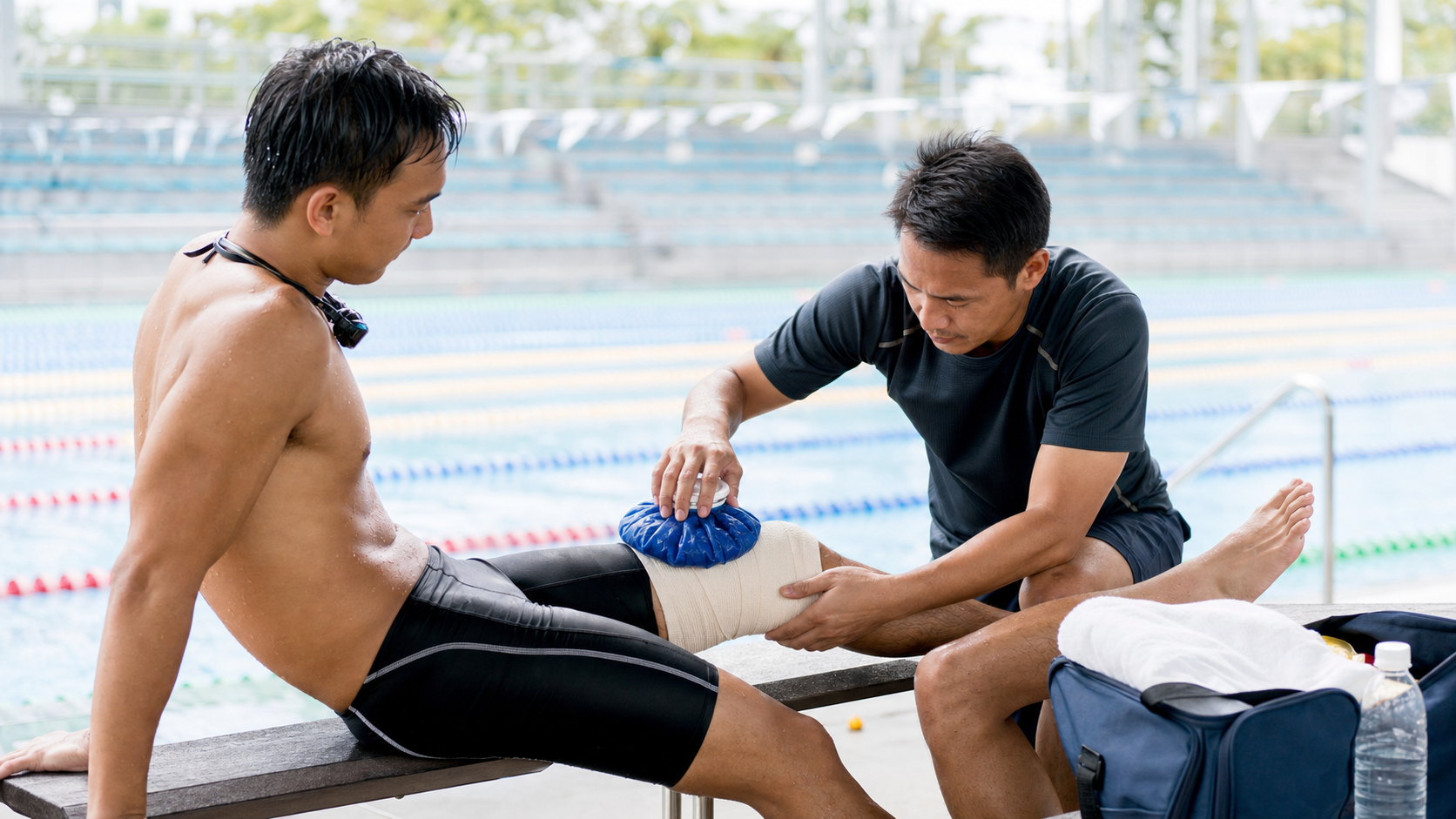
- Correct method: wrap an ice pack in a towel and apply it to the affected area for 15–20 minutes per session, once every 2–3 hours
- Avoid: direct skin contact with the ice pack (risk of frostbite); continuous icing for more than 20 minutes
- If the skin turns reddish-purple or becomes numb, remove the ice immediately and assess for frostbite
- Icing is not “the more, the better”; after 48 hours, it is recommended to switch to heat application or contrast baths (alternating cold and hot) to promote tissue repair
C — Compression
Compression reduces fluid accumulation in the tissue spaces and accelerates the removal of metabolic waste:
- Wrap an elastic bandage from the distal end of the injury toward the proximal end (e.g., for a calf strain, wrap upward from the ankle), with the direction going from the extremities toward the heart
- Appropriate tightness: a finger should be able to slip easily under the bandage; too tight will impede circulation
- If the extremities become pale, cold, or tingly, the wrap is too tight—loosen it immediately
- It is recommended to remove the compression bandage during sleep to avoid affecting nighttime circulation
E — Elevation
Elevating the affected area above the level of the heart uses gravity to assist the return of lymphatic fluid and accumulated fluid:
- Lower-limb strains (adductors, gastrocnemius): when resting supine, prop the leg up with a pillow or a rolled towel
- Upper-limb strains (rotator cuff, latissimus dorsi): support or sling the forearm while sitting or reclining to reduce congestion from hanging down
- The effect of elevation is most significant within 24–48 hours after the injury
Special Management for Common Swimming Strain Sites
Latissimus Dorsi Strain
Commonly occurs during high-intensity freestyle sprinting or the butterfly recovery phase. Symptoms include a sharp pain below the armpit and along the lateral back, worsening with deep breathing. In addition to PRICE, it is recommended to avoid shoulder elevation movements and to sleep in a side-lying position with the affected side facing up, which can reduce tension on the latissimus dorsi.
Adductor Strain
Most likely to occur during the leg closure phase of the breaststroke kick, with groin pain being the main symptom. Abduction and breaststroke kicking should be avoided; freestyle or backstroke can be used instead to maintain aerobic training.
Gastrocnemius Strain (Tear Following a Swimming Cramp)
If, after a leg cramp during swimming, the ankle is forcefully dorsiflexed to relieve the spasm, an immediate strain of the gastrocnemius may result. Management is based on the PRICE principle, along with replenishing fluids and electrolytes (potassium, magnesium) to prevent recurrent cramping.
Practical Recommendations
- Carry a small first-aid kit: keep an elastic bandage and instant cold packs (chemical ice packs) in your swim bag so that immediate management can begin the moment an acute strain occurs.
- Understand the nature of pain: the sharp, acute pain of a strain must be distinguished from post-training muscle soreness (DOMS); if it is uniform whole-body muscle soreness, icing is usually unnecessary—light activity and massage are sufficient.
- Don’t rush back to the pool: the most common cause of recurrence is “feeling fine and immediately swimming at full speed.” It is recommended to first swim twice at 50% intensity to confirm there is no discomfort, then gradually return to normal training.
- If swelling or bruising continues to expand after 48 hours, or if there is no improvement in pain at all, be sure to seek medical attention to rule out fracture or complete rupture.
Conclusion
The PRICE principle is first-aid knowledge that every swimmer should memorize. It may seem simple, but each step has a physiological basis. Correct and timely initial management can significantly shorten recovery time and reduce the risk of an injury progressing from the acute phase to a chronic problem. Incorporating the PRICE principle into the safety knowledge base of swimming training is a fundamental responsibility every serious swimmer has toward their own musculoskeletal health.
Related Reading
- Acute Management of Swimming Injuries: Applying the RICE Principle at Poolside
- The 3-Grade Classification of Muscle Strains and the RICE Evolution—POLICE Management: A 4-Week Rehabilitation Plan for Endurance Athletes
- Return-to-Run Timeline After a Muscle Strain: A Scientific 4-Week Phased Schedule for Resuming Mileage
- Muscle Strains: Don’t Rush to Rest, Don’t Rush to Train—A Complete Coach’s Manual from Grading and Acute Management to Progressive Return
[教學] Premiere 影片 手震 修正 教學 防抖 單眼 影像 GoPro 穩定 Video Stabilization
8 年前
滑雪新手們慘摔學習全紀錄(請開字幕),滑雪好好玩 | Snowboard + Ski | 岩原 スキー場 | 滑雪APP使用 | GoPro Max
6 年前
西進武嶺 免費訓練分析服務 Intervals | 練不夠還是練過頭?你哪一種類型選手?AI模型告訴你! | 備戰神器 | 公路車 訓練 | CT Yeh
4 年前
戰略) Zwift Race 如何咬在第一集團 如何評估自己要開多少推力 (請開1.5倍速看)
7 年前
自助洗車場 洗單車 50元有找 清鍊條大法 居然還有小小兵
7 年前
一起升級!海鷗盃LSD團練...JJSC Zone2招待 騎到手抖 / 公路車 / CT Yeh
1 天前
摔車後補裝備: 好市多新款單車安全帽& Specialized Romin 北高整路屁股都不痛的坐墊 | 一千元居然有MIPS | CT Yeh | 公路車
4 年前
CT 喇低賽) 武嶺牽車 才是王道 西進牽車四小時內秘訣 攝手位置 如何判斷 防抽筋小秘訣
7 年前