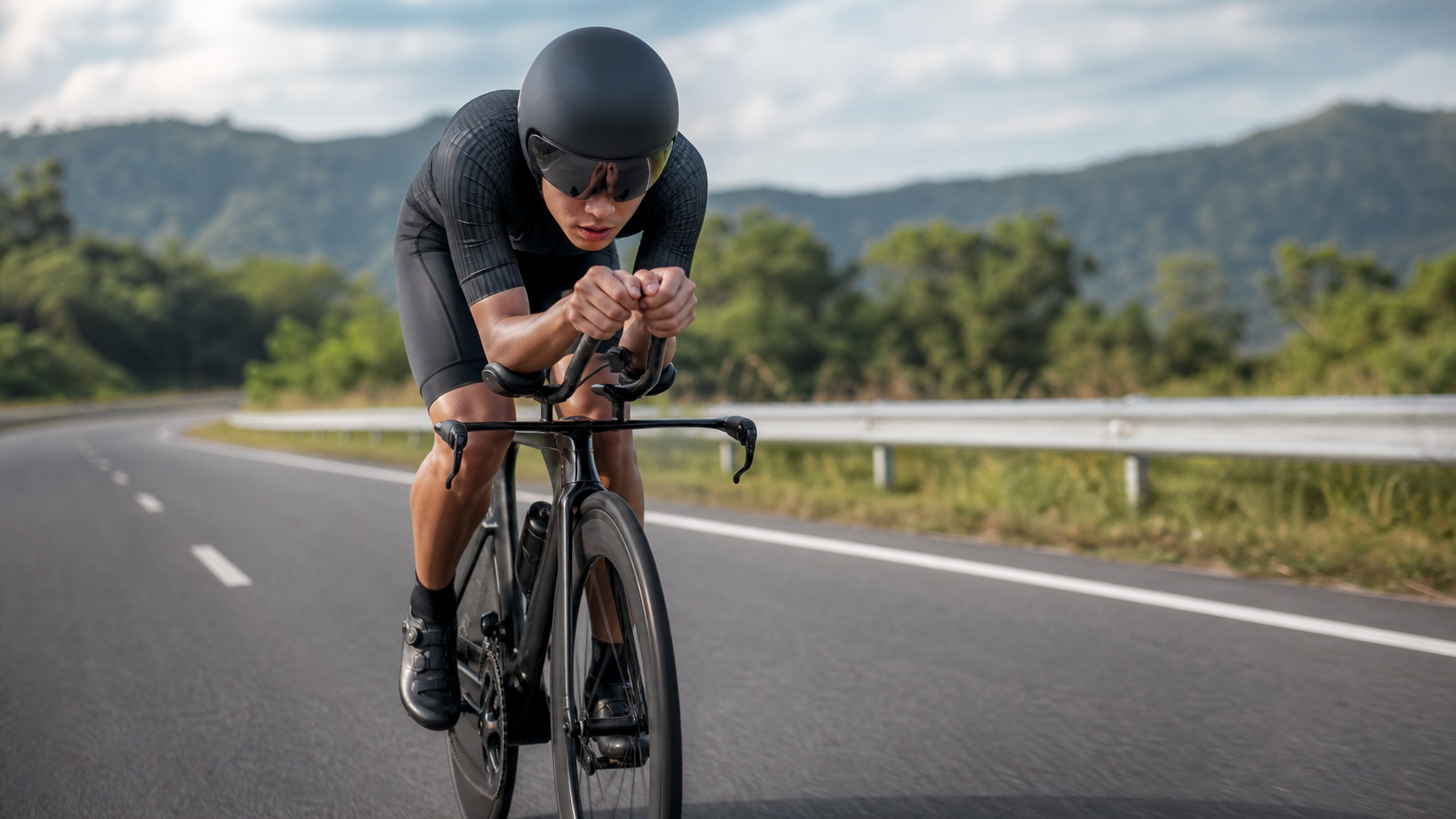
Introduction
The time trial (TT) is the most “brutal” event in cycling—no one to draft behind, no peloton to set the rhythm, just you, your power meter, and a course that must be covered in the most efficient way possible. Most amateur riders’ time trial failures aren’t due to “lack of strength” but poor pacing: going out too hard and burning through too much W’ early on, then fading in the second half and barely finishing on willpower alone. The Critical Power (CP) model provides a scientific framework that lets you plan ahead and execute an optimal pacing strategy during the race.
Fundamentals of Applying the CP Model to Time Trials
The Relationship Between CP and FTP
Critical Power (CP) ≈ 95–105% of FTP, the two concepts are similar but not identical. CP is a theoretical threshold derived from physiological models, while FTP is an estimated value measured as 20-minute all-out power × 0.95. For most riders, the difference between the two is within 5%, so they can be used interchangeably when planning a time trial.
CP is the power you can theoretically sustain for an “unlimited time” (assuming ideal conditions).
Every watt above CP depletes W’, and once W’ is exhausted, your power will collapse to a level far below CP—this is the physiological explanation for “blowing up.”
Optimal Pacing: Even Pacing Strategy
Based on the CP+W’ model, even pacing (maintaining the same power throughout) is the theoretically optimal strategy for a flat time trial. The reasons are as follows:
- Every extra watt above CP depletes W’ at a linear rate
- Air resistance is proportional to the cube of speed—the faster you go, the exponentially more power is needed for each additional 1 km/h
- The “time saved” by going out too fast cannot compensate for the “time lost” when you blow up later
Experimental data supports this: in a flat 40 km TT, even pacing is on average 2–3% faster than a positive split strategy, and 0.5–1% faster than a negative split.
Power Target Settings for Different TT Distances
| TT Distance | Recommended Intensity (%CP) | Estimated Duration (assuming 4.0 W/kg) | Strategic Focus |
|---|---|---|---|
| 10 km | 108–115% | 15–18 minutes | Depletes W’ almost the entire way, near all-out effort |
| 20 km | 103–108% | 30–35 minutes | Sustained above CP, precisely controlling when W’ runs out |
| 40 km | 98–105% | 55–65 minutes | Roughly around CP, with a limited sprint to the finish |
| 50 km+ | 93–100% | 75 minutes+ | Slightly below CP to conserve, gradually building in the latter half |
Key Principle: Make W’ Hit Zero Exactly at the Finish Line
The ideal time trial is one where W’ is used up exactly at the finish—if you still have plenty of W’ left before the line, you rode too conservatively; if you blow up several kilometers before the finish, you overspent early on. The goal is to “spend it all” with precision.
Adjusting Pacing Strategy for Terrain
Power Allocation on Rolling Courses
Many TT courses in Taiwan (such as those used for the National Time Trial Championships) feature rolling terrain, so a pure even-pacing strategy needs adjustment:
Principles:
- On climbs, allow power to be 10–15% higher than the target power (because the duration is short, W’ expenditure is limited)
- On descents, allow power to drop below the target (no need to grind against air resistance)
- Brake early before technical corners, then accelerate explosively after the corner—this is better than entering a corner too fast, slamming the brakes, and having to re-accelerate
Quantified example (40 km TT, target 270 W, CP = 260 W):
- Flat sections: 260–275 W
- Climbs (3–5% grade): 285–300 W
- Descents: 220–240 W (let speed build naturally, don’t waste energy)
- Acceleration after corners: brief 300–320 W (no more than 10 seconds)
Dealing with Strong Wind Conditions
In strong headwind sections, drag increases dramatically, and the benefit of raising power drops significantly (speed gains are limited but W’ expenditure increases). In strong headwind sections, you should moderately lower your power expectations, while in tailwind sections you can push slightly higher—reducing overall power variance is more effective than grinding into the wind.
Pre-Race Preparation and Warm-Up for Time Trials
Standard TT Warm-Up Protocol
Unlike a road race where the peloton’s rhythm provides a buffer at the start, insufficient warm-up will leave you underpowered in the first 5 minutes while your body hasn’t fully activated, wasting precious time.
Standard warm-up (starting 45–60 minutes before the start):
- 20 minutes of progressive aerobic riding (Z2→Z3)
- 3 minutes at target power (CP range) as a simulation segment
- 2–3 × 20-second sprints above threshold (activating the lactate system)
- 10 minutes of easy spinning
- Stand and wait 5 minutes before the start
Pre-Race Nutrition Strategy
- 3–4 hours before the race: a proper meal (rice/noodles as the base, reduced fiber)
- 60 minutes before the race: 30–40 g of carbohydrates (energy bar, banana)
- 15 minutes before the race: 100–150 ml of hypotonic sports drink
- Avoid trying new foods on race day—gastrointestinal distress is a TT killer
Real-Time Pacing Adjustments During the Race
Three Key Points for Executing Pacing with a Power Meter
- Force restraint in the first 5 minutes: adrenaline is surging at the start, and it may feel easy while your power is actually too high—force yourself to watch the numbers rather than go by feel
- Check average power every 5 minutes: if it’s more than 8–10 W above the target, consciously ease off
- In the final 10% of the course, you can start “spending W’”: if you still have W’ in reserve at this point, you can gradually raise your power and charge toward the finish
Practical Advice
- Mark your planned intensity zones on the course map in advance: know which sections require conservation and which allow you to push
- Use 3-second average power rather than instantaneous power to guide your pacing, reducing anxiety caused by cadence fluctuations
- Record your power file for every TT, analyze the W’ depletion curve afterward to determine whether you went out too hard and faded
- Long continuous SST blocks in training (30–40 minutes) are the best TT-specific preparation
- TT equipment choices: an aero helmet is very important for Taiwan’s summer TTs, but don’t forget ventilation—overheating in high temperatures costs more than the aero advantage gains
Conclusion
The time trial is the ultimate exam for power training knowledge. The CP model tells us: the fastest finishing time comes from precise W’ management—neither wasting it (going out too slow) nor overspending it (going out too hard). Every TT practice and race is a pacing experiment; use the data to learn about your own body, and make every start more confident. This rational, numbers-driven decision-making is exactly what makes power training so fascinating.
Related Reading
- Power Management in Climbing Races: Practical Applications of the CP Model in Long Mountain Stages
- The Complete Guide to CP and W′: A Hyperbolic Model That Understands Pacing Better Than FTP, from Wuling to Criterium Racing
- The Science of Pacing in Cycling Climbs: Calculating Optimal Race Power Targets from FTP
- Time Trial (TT) Power Strategy: Front-Half and Back-Half Power Distribution in Flat TTs
西進武嶺 自製新版AI配速表產生器 x 賽前攻略 抱佛腳! 沒有功率計也可以產生配速表嗎?有什麼其他眉角賽前要注意的呢? | 西進武嶺 / 東進武嶺 KOM 攻略 | 公路車 | CT Yeh
4 年前
西進武嶺配速器 3.0更新 / NEW 免功率FTP估算! / 大數據xAI體能模型 / 如何模擬人止關前集團效應 / 配速儲存功能 / AI全台自行車賽事行事曆 / 公路車 / CT Yeh
1 年前
西進武嶺 8000名單車友數據分析 PART1 | 從新手到高手數量/瓦數/推力比/FTP推力比/功率計使用率 大解析 | 公路車 | CTYeh
5 年前
西進武嶺 免費訓練分析服務 Intervals | 練不夠還是練過頭?你哪一種類型選手?AI模型告訴你! | 備戰神器 | 公路車 訓練 | CT Yeh
4 年前
#公路車 #西進武嶺 配速配瓦實驗 坡度分析 四小時內攻略 建大盃 NeverStop #西進武嶺攻略
6 年前
單車AI教練!全新 ChatGPT4o 幫你分析訓練成果!排武嶺課表,分析騎車姿勢! 太神了! / 公路車 / CT Yeh / feat. 緯緯
2 年前
RAMP FTP Test 直播 究竟能撐到幾瓦 訓練台 Gravat Zwift
6 年前
武嶺配速表最佳使用方式 #bike
1 年前