Trail Running for Beginners: The Technical Differences in Transitioning from Road Runner to Trail Runner
Introduction
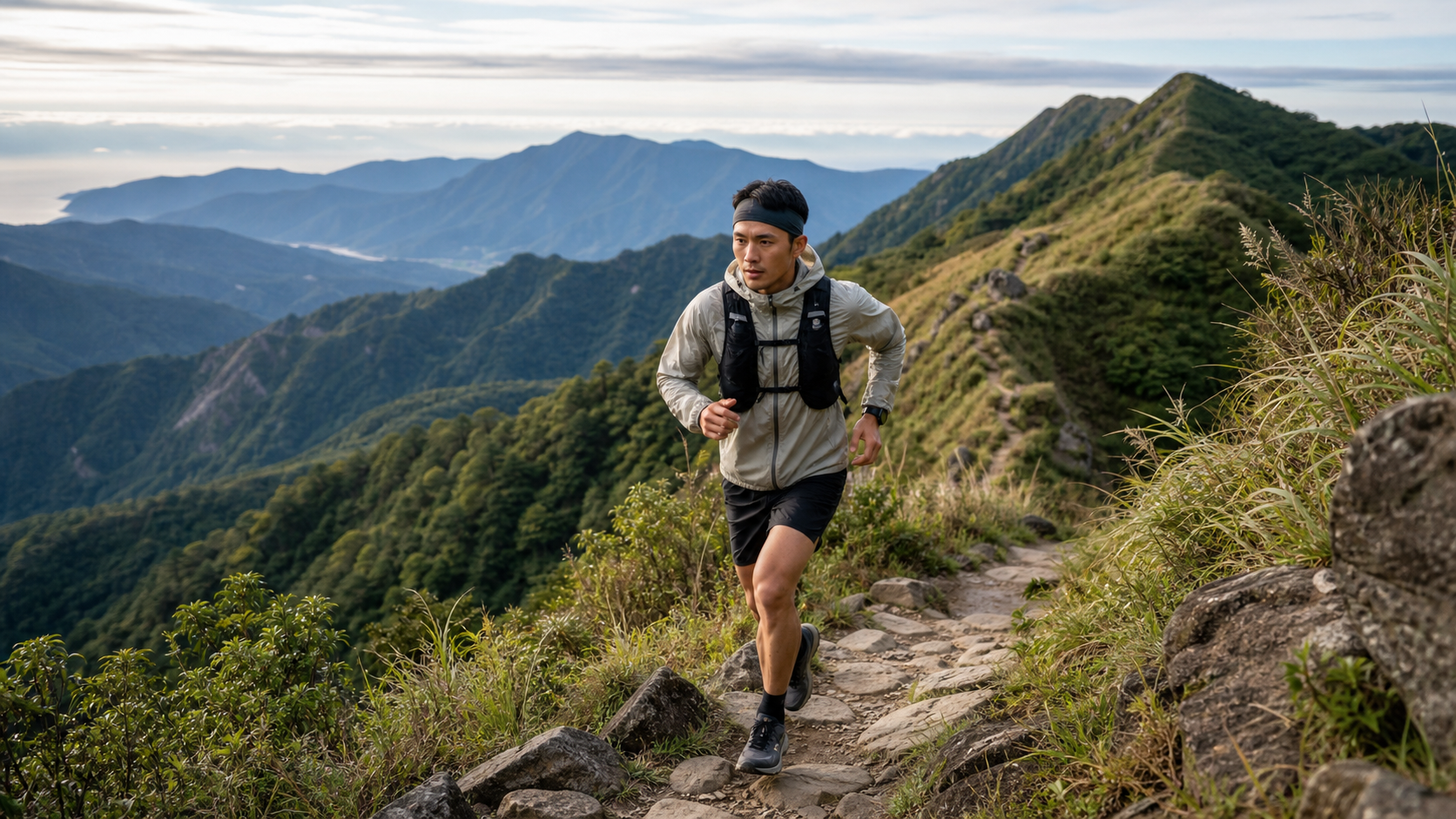
Many Taiwanese runners initially accumulate mileage on flat asphalt roads, yet during a casual mountain hike in Yangmingshan or Taipingshan, they find themselves deeply drawn to the freedom of the trail. Transitioning from road runner to trail runner is not as simple as swapping road shoes for trail shoes—the movement patterns, energy distribution, and perceptual abilities required for trail running are fundamentally different from road running.
Core Differences in Stride Rhythm and Stride Length
Road runners are accustomed to maintaining pace with a steady stride length and rhythm, but on the trail, “terrain dictates stride” is the primary principle.
| Aspect | Road Running | Trail Running |
|---|---|---|
| Stride length | Relatively fixed | Flexibly adjusted to terrain |
| Cadence | Approximately 170–180 spm | Increases on climbs, decreases on descents due to braking |
| Foot placement | Requires almost no thought | Requires active decision-making with every step |
| Pace rhythm | Based on pace (min/km) | Based on effort (RPE) |
| Heart rate stability | Relatively stable | Fluctuates dramatically with terrain |
Trail runners need to learn the climbing strategy of “high cadence, short stride”—shortening stride length and quickening the step is more energy-efficient than forcing long strides. On steep slopes, they may even need to switch to “power hiking,” which is not laziness at all, but a strategy used by professional trail athletes.
Changes in Muscle Recruitment Patterns
Road running primarily relies on the quadriceps and calves, while trail running heavily engages:
- Gluteus medius and gluteus maximus: Maintaining pelvic stability on uneven ground
- Hip flexors: Lifting the legs over rocks and tree roots
- Ankle stabilizer muscles: Preventing sprains on uneven terrain
- Core muscles: Responding to laterally unstable terrain
Runners who have just made the transition often find unusual soreness in their calves and the outer thighs (iliotibial band) after their first trail run, precisely because these “new” muscles have not yet adapted. It is recommended to first accumulate mountain training through hiking before gradually incorporating running movements.
Perceptual Abilities and Attention Allocation
Road runners can wear earphones, glance at their watch, and enjoy a “zoned-out” running sensation, but trail running demands a high level of environmental awareness:
- 2–3 meters ahead: Immediate foot placement judgment
- 5–10 meters ahead: Pre-reading the upcoming section of the trail
- Peripheral vision: Sensing gradient changes and lateral obstacles
- Proprioception: Feeling the terrain underfoot and quickly adjusting center of gravity
This ability to “read the terrain while moving” requires deliberate practice. In the beginning, slow down to give your brain enough time to process information; as experience accumulates, reaction speed will naturally improve.
Necessary Gear Upgrades
Not all road running shoes are suitable for the trail. The most important investment in the early stages of transition is a good pair of trail running shoes:
- Outsole lugs: Muddy ground and slippery rocks require deep lugs (4–6mm)
- Toe guard: Prevents injuries from kicking rocks
- Heel cup stability: Prevents ankle eversion
- Waterproof breathable membrane: Taiwan’s mountain areas are rainy, so a Gore-Tex version is worth considering
Additionally, prepare a hydration vest with a water bladder. A 5–10 liter capacity is sufficient for a half-day outing—there is no need to carry a water bottle in hand, which would affect balance.
Practical Advice
- Hike first, then run: Familiarize yourself with the route by hiking, then incorporate running rhythm once you understand the terrain
- Switch from pace to effort: On the trail, don’t look at pace; instead, assess intensity using an RPE scale of 1–10
- Be conservative on descents: Beginners should run downhill 30% slower than what feels comfortable
- Inform others of your plans: Before a trail run, always tell family or friends your destination and expected return time
- Start with popular routes: In the north, Yangmingshan Erziping Trail is recommended; in the south, Dakeng Trail No. 5 is recommended—both are clearly marked and have steady foot traffic
Conclusion
Transitioning from road running to trail running requires not just physical fitness, but a shift in mindset—from chasing speed to enjoying the process, from controlling the environment to adapting to it. Taiwan boasts world-class trail resources, from Yangmingshan in the north to Dawushan in the south; every route is a unique experience. Give yourself an 8 to 12-week adaptation period, and you will find that the sense of accomplishment from trail running is far more multidimensional and profound than a road PB.
Related Reading
- Trail Running Beginner’s Guide: Transitioning from Road to Trail
- Trail Running Techniques and Strategies: Complete Guide to Uphill/Downhill Running, Terrain Reading, Gear Navigation, and Safety Preparation
- Trail Race Strategy: Mountain Techniques, Hydration Packs, and Elevation Gain Calculation
- Taiwan Trail Running Beginner’s Guide
大武山後門26%歡樂陡坡!JJSC南台灣單車行Day2 / 被颱風追著跑 / 公路車 / CT Yeh
2 年前
單車 一日北高 ( 雙城 ) 肥宅雙人瘋狂行 紀錄片 REACTO
10 年前
單車 梅山36灣 坡度介紹 路段介紹 空拍 (相關遊記影片,請參考說明或我的頻道喔,歡迎訂閱)
6 年前
太平山單車員工旅遊 | 這樣玩CP值最高!| 公路車
5 年前
滑雪新手們慘摔學習全紀錄(請開字幕),滑雪好好玩 | Snowboard + Ski | 岩原 スキー場 | 滑雪APP使用 | GoPro Max
6 年前
西進武嶺各路段 前8000名 大數據分析 配速攻略/功率/心律/推力比/維持率/踏頻/踏瓦比/牽車率 大公開 | 建大盃 NeverStop 可參考 | 公路車 | CT Yeh
5 年前
崇越盃武嶺冠軍高手 賽前JJSC 群峰會精華!對應大數據分析,會有落差嗎?/ feat. JJSC中部公路車約騎 /公路車 / CT Yeh
2 年前
大禹嶺 到 武嶺牌樓 全程前後實況錄影 | 北進武嶺 | 東進武嶺 | KOM | 訓練台 | 坡度分析 | Taiwan KOM Last 10 km HARD | 公路車
6 年前