Introduction
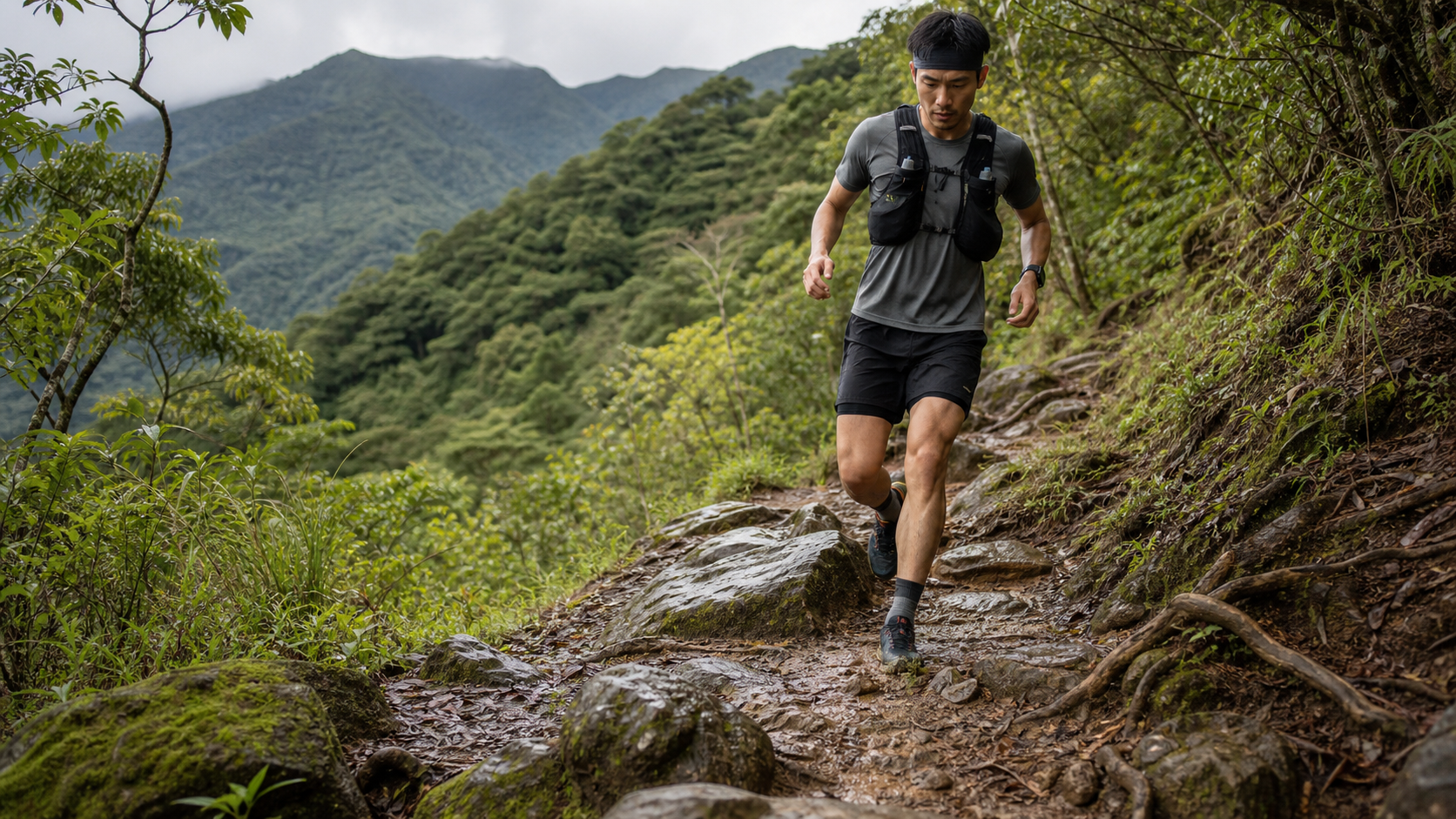
The most fundamental difference between trail running and road running lies in the unpredictability of the terrain. On Taiwanese trails, within a single kilometer, you may encounter dry scree, slippery moss-covered rock faces, tree roots hidden beneath fallen leaves, and deep mud left by the rainy season. Each terrain type has its own unique physical properties that require corresponding footwork and center-of-gravity adjustments. This article systematically breaks down the most common terrain types on Taiwanese trails and the safe strategies for navigating them.
The Basic Framework of Terrain Reading
Quick terrain reading requires training your brain to process information on three levels simultaneously:
| Level | Distance | Function | Training Focus |
|---|---|---|---|
| Immediate | 0–1m underfoot | Precise foot placement | Proprioception |
| Planning | 2–5m ahead | Route selection | Visual scanning |
| Pre-reading | 5–15m ahead | Speed adjustment | Terrain recognition |
Getting all three levels working simultaneously requires extensive practice. Beginners are advised to slow down first, giving each level ample time to process.
Techniques for Rocky Terrain
The andesite of Yangmingshan in northern Taiwan, the sandstone of the eastern coast, and the granite of mid-to-high elevations each have distinct characteristics.
Dry Rocks
- Seek the largest contact surface: Choose the flat face of a rock to maximize the contact area between your shoe sole and the rock
- Step on the center of the rock: Avoid stepping on the edges to prevent the rock from rolling or your ankle from rolling outward
- Test stability: For rocks that may shift, probe with one foot first; only commit your full weight once you’ve confirmed it won’t move
Slippery Rocks (the most common hazardous terrain in Taiwan)
- Reduce speed by 50%: No matter how skilled you are, wet rock has a friction coefficient 60–70% lower than dry rock
- Keep the sole flat: Use the entire sole surface for contact to increase friction area
- Keep your center of gravity vertical: Never lean your body sideways on wet rock
- Moss-covered rock = an ice rink: Rocks covered in moss are extremely dangerous whether wet or dry; go around them unless absolutely necessary
Boulder Hopping
- Suitable for dry, stable, large rocks
- Confirm the stability of the target rock before each jump
- Land with knees slightly bent to absorb impact, striking with the forefoot
- When in doubt, choose the conservative option—an extra step around is always better
Strategies for Muddy Terrain
Rainfall is frequent in Taiwan’s mountains, making mud almost a standard feature of every trail run. The difficulty of mud depends on its depth and water content.
Firm, Damp Mud (6–12 hours after rain)
- Optimal condition: sufficient traction, with the lugs of your shoe sole able to bite in
- Strategy: normal stride, but shorten your step length; after planting your foot, “press down” slightly to confirm stability
- Caution: mud that looks dry on the surface but is soft underneath may suddenly sink 5–10 cm when you step on it
Deep Mud (after prolonged rainfall)
- Depth exceeding 2 cm: choose adjacent vegetation or rocks instead
- When you cannot go around: walk through slowly, confirming the mud depth with each step before shifting your weight
- Pull your foot out with force but without rushing, to prevent the shoe from being sucked off by the mud
Techniques for Tree Root Terrain
The forest trails at Taiwan’s mid-to-low elevations are covered with exposed tree roots, making this a signature terrain of trail running in Taiwan.
Dry Tree Roots
- Step on the top, not the side: Place your foot on the highest point (top surface) of the root, rather than on the side or between two roots
- Use the root’s elasticity: When running over, touch the root lightly with your forefoot rather than stomping down hard, allowing the root’s spring to help propel you forward
- Anticipate root patterns: Large roots often have small branches; pre-read possible footholds
Hazard Levels of Wet Tree Roots
| Root Condition | Hazard Level | Recommended Response |
|---|---|---|
| Dry | Low | Pass normally, step on the top surface |
| Damp | Medium | Reduce speed by 30%, step on the top surface |
| Moss-covered | High | Reduce speed by 50%, prioritize going around |
| Covered by fallen leaves | Extremely high | Power-hike through, test each step |
Tree roots covered by fallen leaves are the most dangerous combination: fallen leaves offer low friction, and with the root’s position hidden, every step risks a misstep or a sideways slip. This situation is especially common in Taiwan’s autumn and winter seasons (November–January); be sure to slow down.
Overall Strategy for Mixed Terrain
Taiwanese trails are rarely a single terrain type; more commonly, a 10-meter stretch will simultaneously feature rocks, mud, and tree roots.
Core principles for handling mixed terrain:
- Base your speed on the lowest-capability terrain: if a section contains wet rock, traverse the entire section at wet-rock standards
- A conservative choice beats a risky shortcut: taking one extra step around or slowing down one step is always cheaper than falling
- Stability of your center of gravity comes first: any movement that shifts your center of gravity requires a reduction in speed
- Automatically downgrade when fatigued: terrain-reading ability declines in the later stages of a workout; proactively drop your speed by one level
Practical Advice
- Run the same route three or more times; familiarity with the terrain can dramatically improve your speed
- Deliberately practice “slow-motion” passes through difficult sections in safe locations to build muscle memory
- On rainy days, choose routes you already know, and avoid tackling slippery challenges on unfamiliar terrain
- When buying trail running shoes, choose models with 4–6mm deep lugs suited to Taiwan’s muddy conditions
Conclusion
Terrain reading is the skill in trail running that takes the most time to develop, but it is also the most rewarding investment. Every time you flow smoothly through complex terrain on the trail, it brings an indescribable sense of accomplishment. Run more, observe more, and think more—Taiwan’s trails will teach you everything you need to know.
Related Reading
- A Beginner’s Guide to Trail Running on Taiwanese Trails
- Trail Running Techniques and Strategies: A Complete Guide to Uphill and Downhill Running, Terrain Reading, Gear, Navigation, and Safety Preparation
- Trail Race Guide: Trail Techniques, Hydration Packs, and Climbing Gain Calculations
- Trail Running Beginner’s Guide: The Transition from Road to Trail
台灣登山王之路 KOM 全程參賽4K臨空錄影 PART1 穿越峽谷地形! #東進武嶺 太魯閣 / 燕子口 / 天祥 / 西寶 PART1 (公路車 / CT Yeh)
3 年前
單車 梅山36灣 坡度介紹 路段介紹 空拍 (相關遊記影片,請參考說明或我的頻道喔,歡迎訂閱)
6 年前
CT 喇低賽) 武嶺牽車 才是王道 西進牽車四小時內秘訣 攝手位置 如何判斷 防抽筋小秘訣
7 年前
單車 一日北高 ( 雙城 ) 肥宅雙人瘋狂行 紀錄片 REACTO
10 年前
大武山後門26%歡樂陡坡!JJSC南台灣單車行Day2 / 被颱風追著跑 / 公路車 / CT Yeh
2 年前
滑雪新手們慘摔學習全紀錄(請開字幕),滑雪好好玩 | Snowboard + Ski | 岩原 スキー場 | 滑雪APP使用 | GoPro Max
6 年前
大禹嶺 到 武嶺牌樓 全程前後實況錄影 | 北進武嶺 | 東進武嶺 | KOM | 訓練台 | 坡度分析 | Taiwan KOM Last 10 km HARD | 公路車
6 年前
2023 夏季KOM 參賽實況 / 穿越空拍視角 / 整車都凸台 / 太魯閣峽谷x合歡山絕美大景 / 東進武嶺 / Taiwan KOM Challenge / 公路車 / CT Yeh
3 年前