Trail Running First Aid Essentials: Emergency Response for Ankle Sprains, Getting Lost, and Hypothermia on the Trails
Introduction
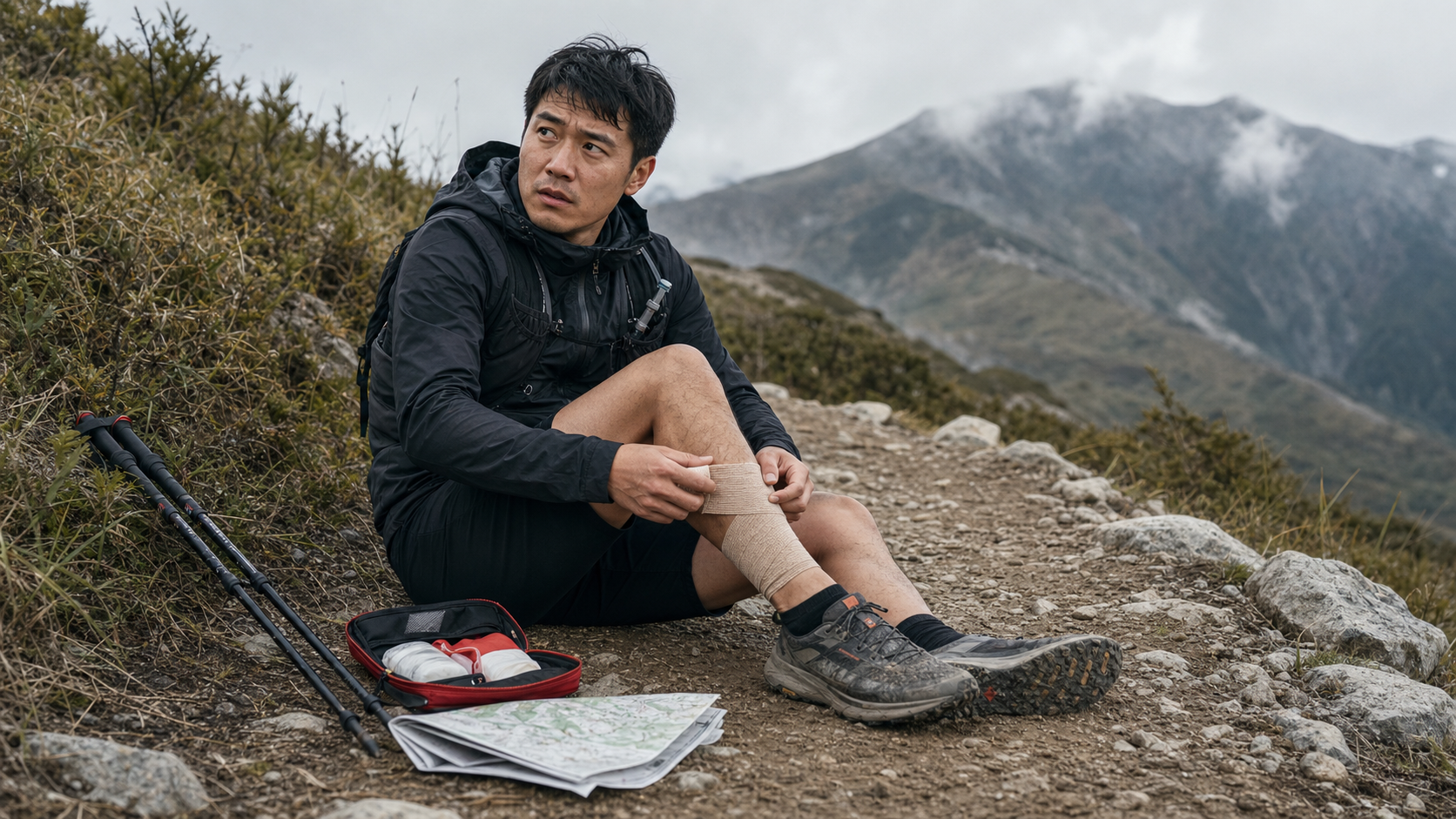
Spraining your ankle an hour’s hike from the nearest road, completely alone—this isn’t a hypothetical scenario, but a real event that happens every year on Taiwan’s mountain trails. Trail running first aid isn’t just “just-in-case” knowledge; it’s your survival skill in the mountains. This article focuses on the three most common emergencies faced by trail runners in Taiwan: ankle sprains, getting lost, and hypothermia, providing practical emergency response procedures.
Immediate Management of Ankle Sprains
Ankle sprains are the most common acute injury in trail running, accounting for over 30% of mountain trail first aid incidents.
Assessing Sprain Severity:
| Grade | Symptoms | Treatment | Can You Descend on Your Own? |
|---|---|---|---|
| Grade 1 (Mild) | Slight swelling, can bear full weight | RICE principle, continue monitoring | Yes, but at a reduced pace |
| Grade 2 (Moderate) | Noticeable swelling, partial difficulty bearing weight | Immobilize with bandaging, assisted descent | Yes, using trekking poles |
| Grade 3 (Severe) | Severe swelling, visible deformity | Immobilize, call for rescue | No, wait for rescue |
RICE Protocol (for Grade 1 and 2 sprains):
- Rest: Stop activity immediately, do not continue running
- Ice: If you carry a cooling spray, apply it to the injured area for 10–15 minutes
- Compression: Wrap with an elastic bandage from the toes upward to reduce swelling
- Elevation: When sitting, keep the injured foot elevated above heart level
Special Considerations for Ankle Sprains in Taiwan’s Mountains:
- Confirm whether the injured foot can bear weight (if it cannot touch the ground at all, consider a fracture and call for rescue)
- Use trekking poles as a crutch to assist walking
- Contact people waiting below to inform them of your situation
- If running solo, immediately call 119 and provide your location (GPS coordinates or nearby landmarks)
A Calm, Systematic Approach When Lost
The most dangerous reaction to getting lost is panicking and wandering aimlessly, which often leads you further off course. The correct response requires calm, systematic thinking.
Five Steps for Immediate Response When Lost:
- Stop: Stop moving and calm yourself down
- Think: Recall the last point where you confirmed you were on the correct route, and how long you’ve been traveling since
- Observe: Survey the surrounding terrain (direction of valleys, changes in slope, distant high points) and cross-reference with your map
- Plan: Decide whether you can return to the last confirmed point, or whether to wait for rescue
- Help: If you determine you cannot find your way back on your own, contact rescue services immediately
Rescue Resources in Taiwan’s Mountains:
- Emergency rescue: 119 (Fire Department)
- Mountain emergency rescue: Taiwan Alpine Association Emergency Rescue
- Mountain rescue operations: County/City Fire Department Mountain Rescue Teams
Strategies to Ensure You Are Found:
- Stay in an open area to make it easier for helicopters or search teams to spot you
- Blow your whistle three times every 10 minutes (international distress signal)
- If your phone signal is poor, climb to a slightly higher point and try calling
- During the day, use reflective items (phone screen, rain jacket) to reflect sunlight and attract attention
Recognizing and Treating Hypothermia
Hypothermia can occur in Taiwan’s high mountains and during autumn/winter seasons. Even in temperatures of 10–15°C, a runner who stops to rest while soaked in sweat can develop symptoms within 30 minutes.
Recognizing the Stages of Hypothermia:
- Mild Hypothermia (core temperature 32–35°C): Persistent shivering, clumsy hands and feet, slowed reactions
- Moderate Hypothermia (core temperature 28–32°C): Shivering stops (danger sign!), drowsiness, impaired judgment
- Severe Hypothermia (core temperature below 28°C): Unconsciousness, weak pulse, requires emergency medical evacuation
On-Site First Aid for Mild Hypothermia:
- Immediately get out of the wind and rain, find a sheltered spot
- Remove wet clothing and change into dry, warm layers (or wrap in an emergency blanket)
- Provide warm, high-sugar food and drink (energy gels, sports drinks)
- Have the person engage in light activity (such as slow walking) to generate body heat
- If symptoms do not improve, call for help immediately
Important Cautions:
- If the person has progressed to moderate hypothermia, do not let them walk on their own; excessive activity may trigger cardiac arrhythmias
- Skin-to-skin contact (such as two people sharing a sleeping bag) is the most effective method of rewarming in the field
- A hypothermic person may deny having a problem, so companions need to help assess the situation
Prevention Is Always Better Than Cure
| Emergency | Most Effective Preventive Measure |
|---|---|
| Ankle Sprain | Ankle strength training, slow down on fatiguing sections |
| Getting Lost | Download offline maps, confirm your position at every junction |
| Hypothermia | Carry insulation layers and emergency blanket, change out of sweat-soaked clothing |
Practical Recommendations
- Sign up for wilderness first aid courses (WAFA or mountain first aid training offered by county/city fire departments)
- Your personal first aid kit should include at least: 1 elastic bandage, 5–10 adhesive bandages, 1 emergency blanket, and a whistle
- Store local emergency contact numbers on your phone (including 119 and mountain rescue)
- Inform your running partners of any pre-existing conditions (such as a previously injured ankle) so they know what to watch out for
Conclusion
The greatest value of first aid knowledge is that in the moment you truly need it, you don’t have to think—you just act. Take the time to learn these skills and practice them until they become reflexes, not memories. On Taiwan’s mountain trails, the ability to protect yourself not only keeps you safe, but also provides greater security for your fellow runners.
Related Reading
- Ankle Sprains in Road Running: Acute Management and Rehab Training Plan
- Sprains Caused by Poor Running Form: A Complete Guide to Ankle Stability Training
- Runner’s Ankle Sprain Recovery Guide: From Acute Care to Safely Returning to Running
- Ankle Proprioception Training: The Key to Zero Sprains in Trail Running
爬陡坡被爆胎的車友跑步超車 #cycling #里佳部落
9 個月前
單車 一日北高 ( 雙城 ) 肥宅雙人瘋狂行 紀錄片 REACTO
10 年前
CT 喇低賽) 武嶺牽車 才是王道 西進牽車四小時內秘訣 攝手位置 如何判斷 防抽筋小秘訣
7 年前
Never Stop 西進武嶺 前後雙機 完整全程錄影 訓練台 實境
8 年前
摔車後補裝備: 好市多新款單車安全帽& Specialized Romin 北高整路屁股都不痛的坐墊 | 一千元居然有MIPS | CT Yeh | 公路車
4 年前
Canyon 公路車斷把手 五年老車特規還能修嗎? 維修保養全記錄 feat. 501單車監理站 | 公路車 | CT Yeh
4 年前
大禹嶺 到 武嶺牌樓 全程前後實況錄影 | 北進武嶺 | 東進武嶺 | KOM | 訓練台 | 坡度分析 | Taiwan KOM Last 10 km HARD | 公路車
6 年前
大武山後門26%歡樂陡坡!JJSC南台灣單車行Day2 / 被颱風追著跑 / 公路車 / CT Yeh
2 年前