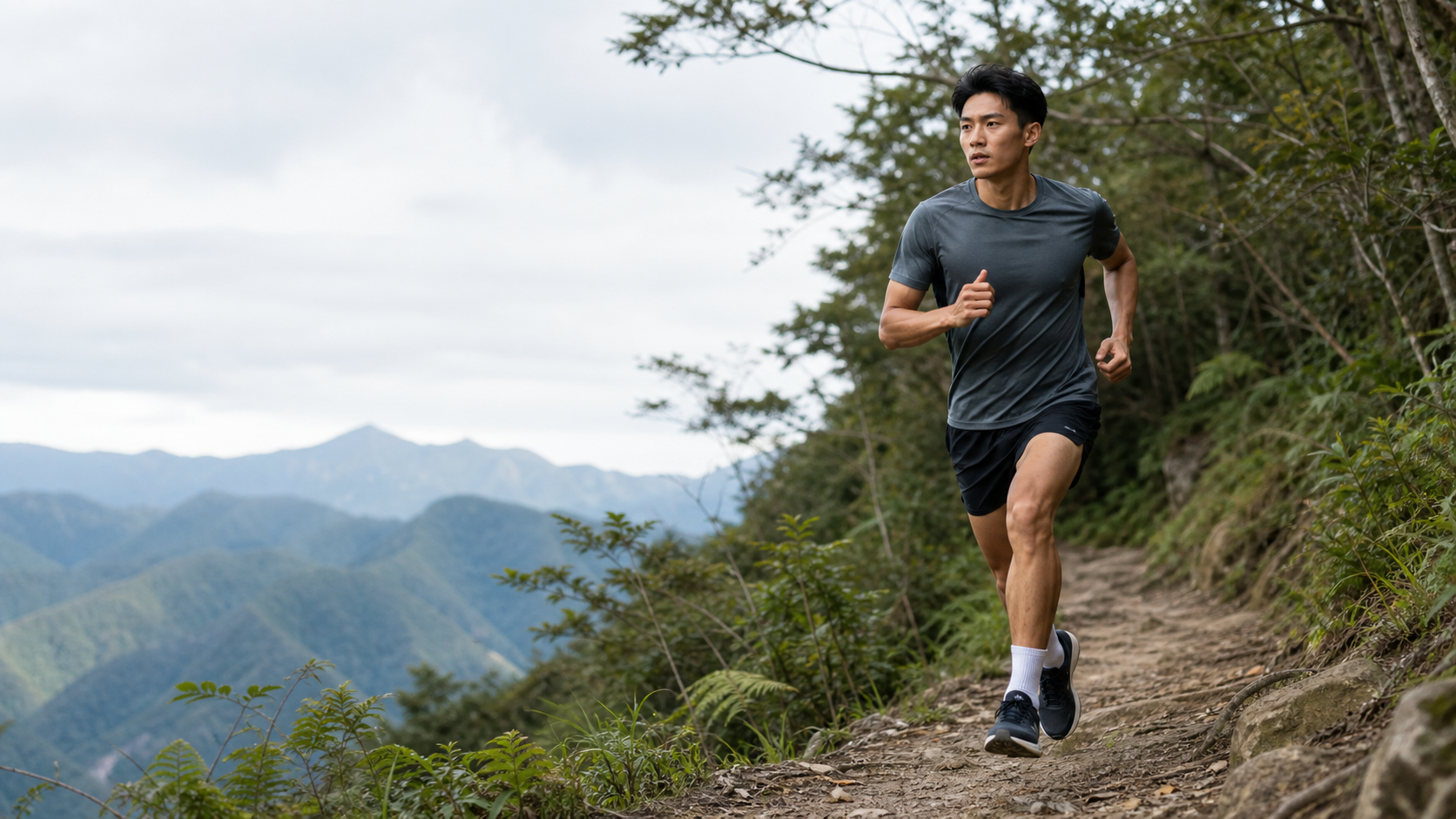
Introduction
Many Taiwanese road runners become curious about trail running after years of marathon racing. They have a solid aerobic base, yet find trail running presents entirely different challenges—steep climbs spike their heart rate instantly, downhills leave their legs sore enough the next day that descending stairs is difficult, and terrain reading constantly interrupts what was once a smooth rhythm. This 8-week schedule is designed specifically for runners with a half-marathon or longer road running base, systematically building the technique, strength, and aerobic capacity needed for trail running.
Schedule Design Principles
- Goal: Safely complete a 10–15 km beginner trail route (500–800 meters of elevation gain)
- Prerequisite: Ability to complete a half marathon, with a weekly mileage of 30–40 km
- Frequency: 4–5 training sessions per week, including 1–2 trail sessions
- Intensity: Primarily aerobic intensity (70–80% of maximum heart rate), keeping the proportion of high-intensity sessions low
Weekly Schedule Overview
| Week | Primary Focus | Weekly Mileage | Target VAM |
|---|---|---|---|
| Weeks 1–2 | Trail technique introduction | 30–35 km | 300–400m |
| Weeks 3–4 | Climbing technique + strength building | 35–40 km | 500–700m |
| Weeks 5–6 | Downhill technique + long-distance adaptation | 40–50 km | 700–1000m |
| Week 7 | Peak week (highest training volume) | 50–55 km | 1000–1200m |
| Week 8 | Taper + race simulation | 30–35 km | 500–600m |
Weeks 1–2: Trail Technique Introduction
The core goal of these two weeks is not fitness, but technical adaptation and mental preparation.
Monday (Rest or easy road run 5 km)
Tuesday (Technique training session):
- Head to a familiar mountain trail (such as Yangmingshan or Dakeng Trails 1–3)
- Distance 4–6 km, with the focus on practicing downhill technique at a slow pace
- Every 100 meters, stop and assess your foot placement choices
- Total time 60–90 minutes (pace not a factor)
Thursday (Road run + hill training):
- Flat aerobic run 8–10 km
- Additional: Find a 50–100 meter hill and repeat up and down 4–6 times (practice uphill cadence)
Saturday (Long trail run):
- Choose a trail rated ★☆☆ difficulty, distance 6–8 km
- Primarily power hiking with running as a supplement, focusing on getting familiar with the “rhythm” of the trail
- Record cumulative elevation gain
Key Reminder: Muscle soreness the day after training in weeks 1–2 is normal, especially in the calves and quadriceps. This is a sign of new muscle groups adapting, not an injury.
Weeks 3–4: Climbing Technique + Strength Building
New training elements:
- Add 1 strength training session per week (squats, glute bridges, Bulgarian split squats—3 sets each)
- Consciously practice the rhythm of “power hiking” during trail sessions
Saturday long run:
- Upgrade the route to ★★☆ difficulty, distance 8–10 km, elevation gain 400–600m
- Practice: Switch to power hiking when heart rate exceeds 85% of maximum, resume running once heart rate drops
Training Focus: Managing energy system transitions (aerobic ↔ high intensity)
Weeks 5–6: Downhill Technique + Long-Distance Adaptation
These two weeks are the period of fastest technical improvement, especially in downhill technique.
Specialized downhill training (once per week):
- Find a 200–300 meter slope (gradient approximately 15–20%)
- Focus on forward-leaning posture and cadence on the descent, repeat 6–8 times
- After each descent, hike briskly back to the top for recovery
Saturday long run upgrade:
- Distance 12–15 km, elevation gain 600–800m
- First attempt at “full technical trail running”: use trail running technique throughout, rather than mixing in hiking
- Fueling throughout: replenish with energy gels or solid food every 45–60 minutes
Week 7: Peak Week
This is the highest-load week of the entire schedule, simulating the training stress of a real trail race.
Thursday (Mid-long trail run):
- 10–12 km on trails, including the main climbing sections
- Run at “race pace” (10–15% faster than comfortable pace)
Saturday (Long run):
- 15–18 km, elevation gain 800–1000m
- Simulate fueling strategy: use a trail vest, record intake at each aid point
Week 8: Taper + Race Simulation
Monday to Friday: Reduce training volume by 40%, maintaining frequency while lowering intensity and distance
Saturday (Race simulation):
- Choose a route at 80% of your target race distance
- Full race gear (vest, mandatory equipment, fueling strategy)
- Complete rehearsal of the entire process from pre-start preparation to post-finish recovery
Supplementary Schedule Elements
Weekly strength training (weeks 3–8):
- Glute bridges: 3×15 reps
- Bulgarian split squats: 3×10 reps (per leg)
- Eccentric squats: 3×8 reps (5-second lowering phase)
- Single-leg calf raises: 3×15 reps
Recovery strategies:
- At least 1 full rest day per week
- Within 24 hours after long runs: consume adequate protein (1.6–2g per kg of body weight)
- Sufficient sleep (7–9 hours) is the most important factor in trail training recovery
Practical Advice
- If a week is too busy to complete the schedule, prioritize the Saturday long trail run
- Don’t get discouraged by slow times—after 8 weeks your pace will certainly be faster than week 1, but safety and technique matter more
- Connect with the local trail running community during these 8 weeks; they are your best source of route information
- After week 8, if you want to continue, sign up for a beginner trail race as a validation of your training progress
Conclusion
Eight weeks won’t make you a professional trail runner, but they will transform you from a road runner stumbling on the trails into a trail-running beginner who can confidently move across mountain terrain. More importantly, these 8 weeks will make you fall in love with trail running—the joy of every step requiring thought, and every summit delivering a genuine sense of accomplishment.
Related Reading
- Road Running Special Feature|8-Week Terrain Preparation Before a Trail Race (R042)」
- Road Running Special Feature|8-Week Terrain Preparation Before a Trail Race (R021)」
- Road Running Special Feature|8-Week Terrain Preparation Before a Trail Race (R084)」
- Road Running Special Feature|8-Week Terrain Preparation Before a Trail Race (R063)」
西進武嶺 免費訓練分析服務 Intervals | 練不夠還是練過頭?你哪一種類型選手?AI模型告訴你! | 備戰神器 | 公路車 訓練 | CT Yeh
4 年前
半日 小台灣 極限單車路線挑戰實錄
7 年前
FTL 與 SYB 車隊專訪 西進武嶺 實用攻略分享! 2小時 如何練?!你不知道的眉角!新手準備武嶺必看 EP1 | 實力派女車友 | 精華版 | 公路車 | CTYeh
4 年前
單車 一日北高 ( 雙城 ) 肥宅雙人瘋狂行 紀錄片 REACTO
10 年前
#公路車 #西進武嶺 配速配瓦實驗 坡度分析 四小時內攻略 建大盃 NeverStop #西進武嶺攻略
6 年前
CT趣訪 西進武嶺 2小時組 EP2 全村的希望 蔣緯緯! 訓練菜單&技巧公開 |公路車 |CT Yeh
4 年前
太平山單車員工旅遊 | 這樣玩CP值最高!| 公路車
5 年前
一日北高常見問題大集合 | 攻略 | 路線 | 訓練 | 補給 | 自行車 單車 | 一日雙城 | 雙塔 | TWB北高360 | 屁股痛
6 年前