Strength Training Plan for Runners: Weekly Schedule Design with Squats, Single-Leg Deadlifts, and Bridges
Introduction
In long-term road running training, “running only without strength work” is one of the common causes of injury among runners. Road running itself is a highly repetitive, single-joint-dominant movement pattern that can easily lead to underdevelopment of certain muscle groups (such as the gluteus maximus, gluteus medius, and quadriceps), which in turn triggers compensatory issues in the knees, hips, and lower back. Strength training not only reduces injury risk, but research also shows that moderate lower-body strength supplementation can improve running economy, allowing you to run faster and more efficiently with the same effort.
This article provides a weekly strength schedule built around “three foundational movements,” suitable for the average Taiwanese runner to perform at home or in the gym, requiring minimal equipment.
The Three Core Movements
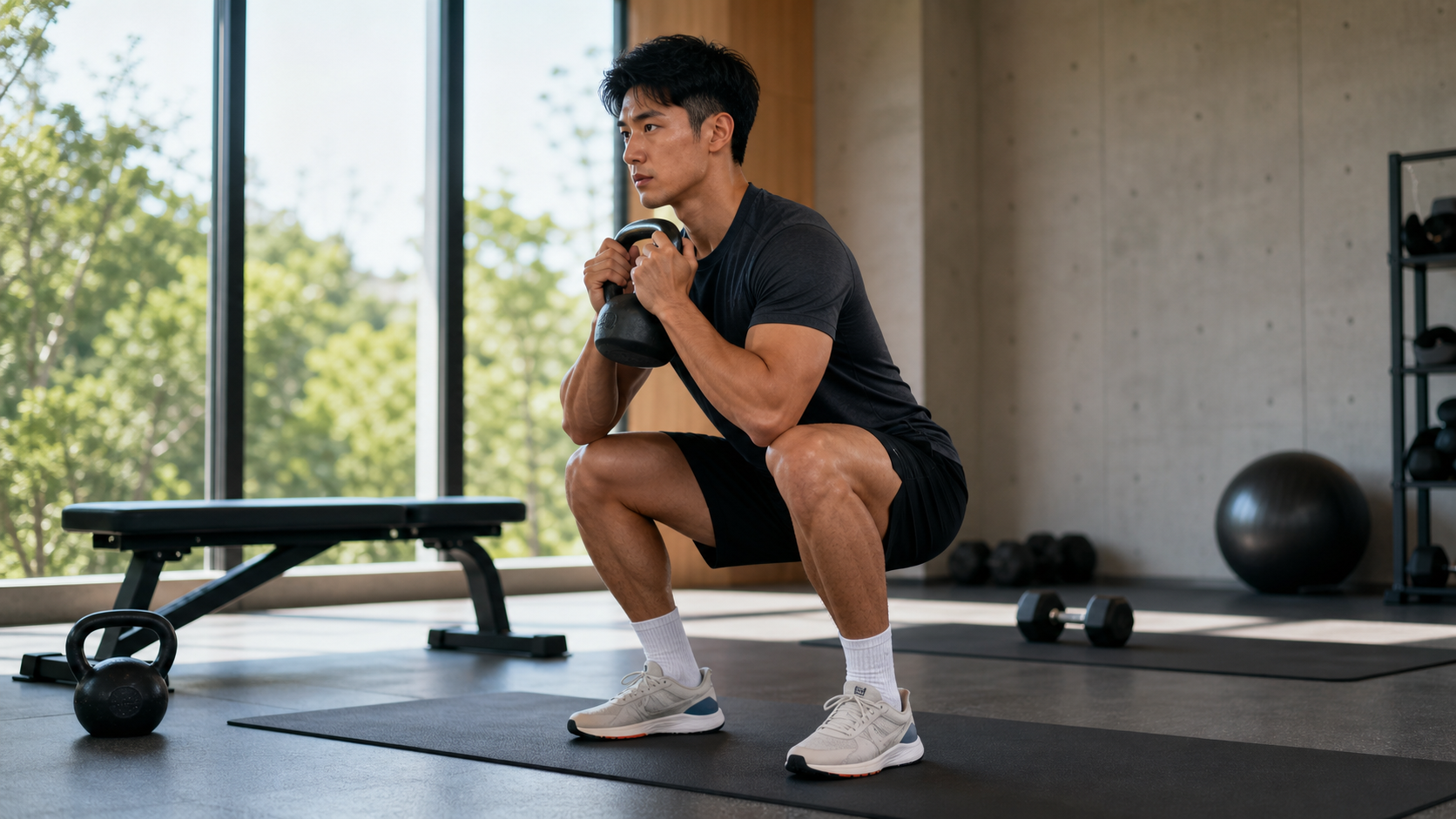
1. Squat
Target Muscles: Quadriceps, gluteus maximus, core stabilizers
The squat is the most comprehensive lower-body pushing movement and effectively strengthens the push-off power needed in road running.
Key Points:
- Stand with feet shoulder-width apart, toes slightly turned out (15–30 degrees)
- Sit the hips back, keeping knees aligned with the toes (no inward collapse)
- Lower until thighs are parallel to the ground (or adjust based on individual mobility)
- Keep the back neutral, avoiding excessive forward lean
- When standing up, “push the floor” rather than “lifting the knees”
Advanced Variation: Bulgarian split squat — more closely mimics the unilateral loading pattern of road running and provides more comprehensive training for the glutes and core.
2. Single-leg Deadlift
Target Muscles: Hamstrings, gluteus maximus, core, ankle stabilizers
Road running is a continuous sequence of movements performed on a single leg, and the single-leg deadlift is one of the best exercises for simulating this single-leg weight-bearing pattern while also training balance and proprioception.
Key Points:
- Stand on one leg with a slight bend in the knee (supporting leg)
- Hinge the torso forward while extending the other leg backward, keeping the body in a straight line
- Feel the tension in the back of the supporting thigh (hamstrings) and the glutes
- Maintain light core engagement throughout the movement to avoid spinal rotation
- Dumbbells or water bottles can be held to add resistance
Note: Beginners should start with bodyweight only, and add load only after confirming movement stability.
3. Glute Bridge
Target Muscles: Gluteus maximus, hamstrings, spinal stabilizers
Gluteal weakness is a very common issue among Taiwanese runners, and the glute bridge is the safest and most efficient starting movement for training the gluteus maximus.
Key Points:
- Lie on your back with knees bent at 90 degrees and feet flat on the floor
- Drive through the heels, pushing the hips upward until the thighs and torso form a straight line
- Hold at the top for 2–3 seconds, feeling the contraction in the glutes
- Lower slowly, and repeat without fully touching the ground
Advanced Variation: Single-leg bridge (one leg extended) — significantly increases the difficulty of unilateral glute training.
Weekly Schedule Design (Suitable for Runners Logging 3–5 Days per Week)
| Training Day | Schedule Content | Sets × Reps | Rest Time |
|---|---|---|---|
| Monday (post-run) | Glute bridge + Single-leg bridge | 3 × 12 reps | 60 seconds |
| Wednesday (1hr before or after run) | Squat + Bulgarian split squat | 3 × 10 reps | 90 seconds |
| Saturday (day after long run) | Single-leg deadlift + Glute bridge | 3 × 8 reps | 90 seconds |
Schedule Notes:
- Perform strength training 2–3 times per week, approximately 20–30 minutes per session
- Do not schedule strength training on the same day as long runs
- Beginners should start with 2 sets for the first two weeks, then progress to 3 sets after adapting
- Those with a strength training background can add load (dumbbells, barbells) starting in the second month
Periodization Principles for Training
| Training Phase | Running Volume Status | Strength Training Focus |
|---|---|---|
| Base Phase (12–16 weeks pre-race) | Moderate mileage | High reps (12–15 reps), moderate weight, building muscular endurance |
| Build Phase (8–12 weeks pre-race) | Progressive mileage | Moderate reps (8–10 reps), increased weight, enhancing power |
| Taper Phase (2–4 weeks pre-race) | Reduced mileage | Decrease strength training volume, maintain intensity but reduce sets |
| Post-race Recovery Phase | Very low mileage | Light stretching and core work, no high-intensity strength |
Practical Advice
The most common mistake in strength training is “adding weight aggressively while form is still incorrect.” It is recommended to spend 2–4 weeks using bodyweight movements to confirm the feel and muscle activation of each exercise, and only add load after you can clearly feel the target muscles working. Your phone camera can serve as a training partner — record your squats and single-leg deadlifts to self-assess against standard form.
Conclusion
Strength supplementation training is a long-term investment in a runner’s health. Although squats, single-leg deadlifts, and glute bridges may seem simple, they specifically target the muscle groups most prone to weakness in road running. Investing 60–90 minutes per week in this schedule, and after six weeks you will not only feel more stable and powerful when running, but the frequency of injuries will also significantly decrease.
Related Reading
- Strength Training Plan for Road Runners: How Squats and Deadlifts Improve Running Performance
- Strength Training for Runners: Injury Prevention Benefits and Execution Details of Glute Bridges, Single-leg Squats, and Hip Abduction
- Strength Training for Running: Complete Schedule with Squats, Lunges, and Single-leg Exercises
- Strength Movements for Runners: Single-leg Deadlifts, Bulgarian Split Squats, and Step-ups
一日北高常見問題大集合 | 攻略 | 路線 | 訓練 | 補給 | 自行車 單車 | 一日雙城 | 雙塔 | TWB北高360 | 屁股痛
6 年前
單車 一日北高 ( 雙城 ) 肥宅雙人瘋狂行 紀錄片 REACTO
10 年前
CT暗黑廚房) 車友必備 宇宙無敵鮮蚵湯 幫助訓練恢復 天然食補 好市多 超肥鮮蚵 破PR
7 年前
2019 柯P 超越北高 第一集團實錄 (11小時實錄請參考另一部影片) 一日雙城 一日北高 NeverStop Taiwan Long Distance Cycling Challenge
7 年前
一日北高前的高裝檢 | 北高 360 | 挑戰11小時的裝備 | 一日雙塔 | 補給
6 年前
西進武嶺 免費訓練分析服務 Intervals | 練不夠還是練過頭?你哪一種類型選手?AI模型告訴你! | 備戰神器 | 公路車 訓練 | CT Yeh
4 年前
Never Stop 西進武嶺 前後雙機 完整全程錄影 訓練台 實境
8 年前
實景訓練台) 彰化經典百K 高強度喵團 90分鐘 跟著一起練功 2019 Indoor workout Changhua Classic 100 Taiwan
7 年前