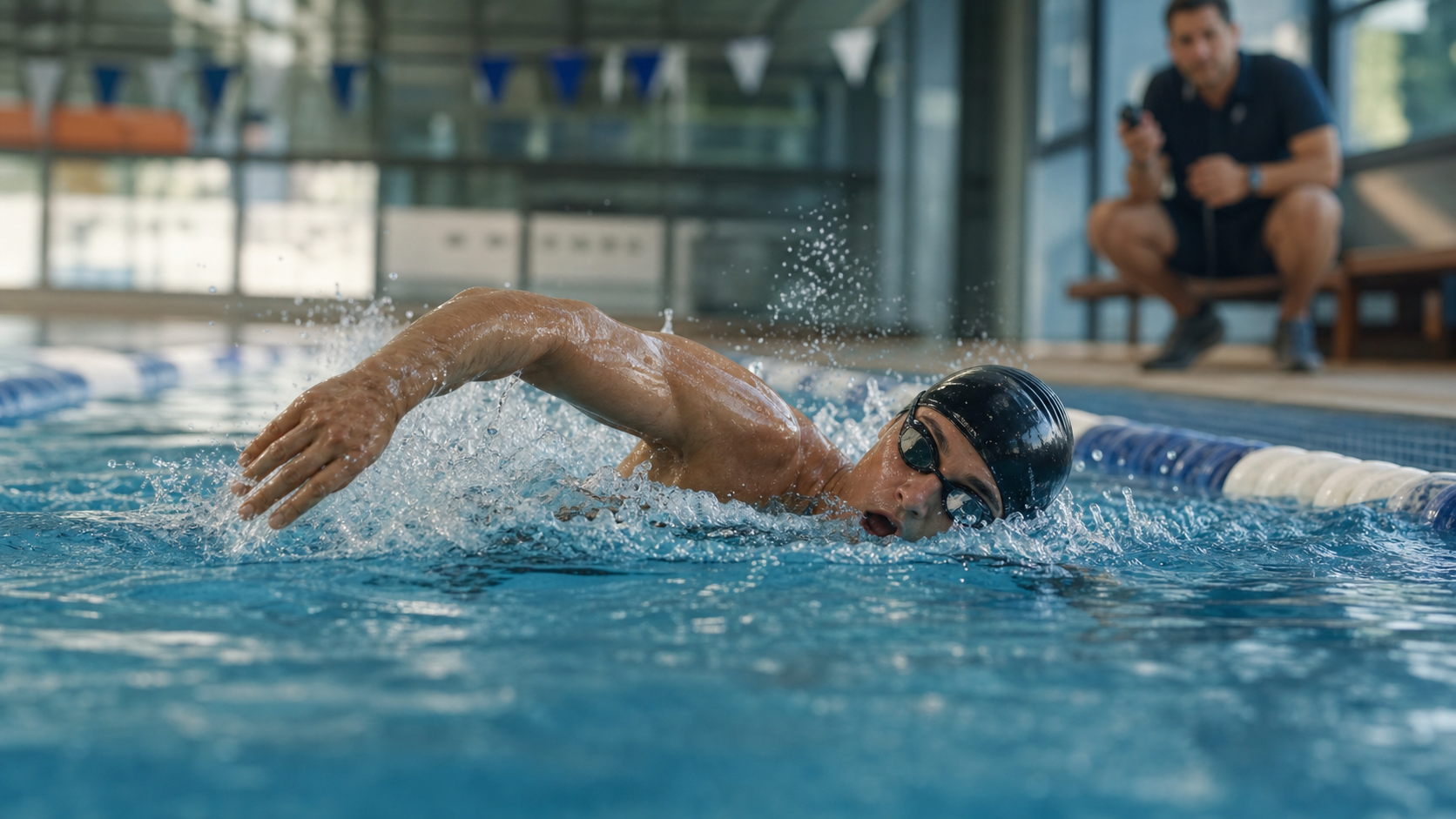
Introduction
The anaerobic threshold (AT) refers to the pace range at which, once exercise intensity reaches a certain critical point, lactate begins to accumulate rapidly and the body can no longer fully clear it. For swimmers, long-term training near the threshold can significantly enhance aerobic metabolic capacity, allowing the body to remain stable at higher speeds. T-pace (Threshold Pace) is a tool used in swim training to quantify this critical speed. This article will introduce how to conduct a T-pace test and how to design effective anaerobic threshold workouts based on the test results.
What is T-pace?
T-pace originates from the research of American swimming coach Joel Stager and was later popularized by Terry Laughlin and others. Simply put, T-pace is the fastest pace you can sustain for 30 minutes, usually expressed as minutes and seconds per 100 meters. It is similar to the “lactate threshold pace” concept in land-based sports, representing the dividing line between aerobic and anaerobic metabolism.
When swimming at this intensity, the body’s lactate production is roughly equal to its clearance rate, with blood lactate concentration maintained in a stable range of approximately 3–4 mmol/L. This pace is typically 5–8 seconds slower per 100m than your best 400m pace, and 3–5 seconds faster than your 1500m pace.
T-pace Testing Methods
Standard 30-Minute Test
After warming up, swim at as steady a pace as possible for a full 30 minutes, record the total distance, and convert it to time per 100m to obtain your T-pace. For example: if you swim 1,500m in 30 minutes, then T-pace = 30 min ÷ 15 = 2 min 00 sec/100m.
3×400m Alternative Method (suitable for swimmers with lower training volume)
Use the average pace of an all-out 400m effort as the baseline, then add 5 seconds to estimate T-pace. For example, if you swim 400m in 5 min 30 sec (average pace 1 min 22.5 sec/100m), estimated T-pace ≈ 1 min 28 sec/100m.
Designing Workouts Based on T-pace
The core principle of anaerobic threshold training is: accumulate sufficient training distance at an intensity of T-pace ±3 seconds. Below are three common workout structures:
Continuous
Suitable for beginners in threshold training, reducing the difficulty of intensity control:
- 1×1500m @ T-pace + 2 sec
- 1×2000m @ T-pace + 3 sec
- 1×1000m @ T-pace − 1 sec
Rest between sets should not exceed 30 seconds, with the goal of keeping heart rate at 82–88% of maximum heart rate.
Broken Threshold
| Sets | Distance | Intensity | Rest Between Sets |
|---|---|---|---|
| 3 | 400m | T-pace | 30 sec |
| 4 | 300m | T-pace | 20 sec |
| 5 | 200m | T-pace − 1 sec | 15 sec |
The broken threshold format allows swimmers to recover briefly before technical fatigue sets in, maintaining stroke quality. It is suitable for those still building their feel for the water.
Ascending Volume
Gradually increasing weekly training volume is the foundation of long-term systematic training:
- Weeks 1–2: threshold set distance of 800–1000m per session
- Weeks 3–4: threshold set distance of 1200–1500m per session
- Weeks 5–6: threshold set distance of 1800–2000m per session
- Week 7: deload week (threshold set distance of 600–800m per session)
Training Frequency and Weekly Schedule Recommendations
Anaerobic threshold training is recommended 1–2 times per week, and should not be overdone, to avoid accumulating fatigue at this intensity over the long term and compromising the quality of other training. Below is an example of a weekly training structure:
| Monday | Tuesday | Wednesday | Thursday | Friday | Saturday | Sunday |
|---|---|---|---|---|---|---|
| Easy aerobic swim | Threshold training | Technique session | Rest | Threshold training | Long-distance aerobic | Rest |
Allow at least 48 hours between the two threshold sessions for adequate recovery. If weekly training volume is low (below 10,000m per week), it is recommended to schedule only 1 threshold session.
Practical Tips
- Retest T-pace every 4–6 weeks: As you adapt to training, T-pace will gradually improve, and workout intensity needs to be adjusted accordingly to avoid the training plateau of “always staying in the comfort zone.”
- Monitor stroke rate and stroke length throughout: If stroke rate noticeably increases and stroke length shortens at threshold intensity, it indicates that technique is beginning to break down. At this point, slightly adjust intensity or shorten the set distance.
- Avoid “fake threshold” training: Too many swimmers mistake aerobic pace for threshold pace, and their heart rate never enters the threshold zone. It is recommended to use a heart rate monitor to confirm training intensity.
- Carbohydrate intake: 60–90 minutes before longer threshold sessions, consume low-to-moderate GI carbohydrates (such as bananas or oats) to help maintain training quality.
Conclusion
T-pace is one of the core metrics in swim fitness training. Through precise testing and systematic design, anaerobic threshold training can deliver maximum benefits. For swimming enthusiasts in Taiwan, many lack intensity quantification tools in their training and easily fall into the ineffective pattern of “slowly swimming 10,000 meters every day.” Learning to test and use T-pace to design workouts will be a key step in breaking through fitness plateaus.
Related Reading
- Swimming Lactate Threshold Testing: Complete Guide to T-pace Testing and CSS Calculation
- Swimming Anaerobic Threshold Training: Workout Design for Lactate Threshold Swimming Speed
- Building the Aerobic Base in Swimming: CSS Critical Swimming Speed Training Methods
- Swimming Pace Training: Using 100m Baseline Pace to Design Training Targets for Each Intensity
西進武嶺 免費訓練分析服務 Intervals | 練不夠還是練過頭?你哪一種類型選手?AI模型告訴你! | 備戰神器 | 公路車 訓練 | CT Yeh
4 年前
#公路車 #Vo2Max #最大攝氧量 測驗 體驗 | 心肺測試
6 年前
西進武嶺 自製新版AI配速表產生器 x 賽前攻略 抱佛腳! 沒有功率計也可以產生配速表嗎?有什麼其他眉角賽前要注意的呢? | 西進武嶺 / 東進武嶺 KOM 攻略 | 公路車 | CT Yeh
4 年前
戰略) Zwift Race 如何咬在第一集團 如何評估自己要開多少推力 (請開1.5倍速看)
7 年前
一起升級!海鷗盃LSD團練...JJSC Zone2招待 騎到手抖 / 公路車 / CT Yeh
2 天前
Garmin Edge 1050 旗艦車錶 全台首測!/ 環法冠軍指定 / 對比Edge 1040改進哪些? / 公路車 / CT Yeh
2 年前
實景訓練台) 彰化經典百K 高強度喵團 90分鐘 跟著一起練功 2019 Indoor workout Changhua Classic 100 Taiwan
7 年前
CT暗黑廚房) 車友必備 宇宙無敵鮮蚵湯 幫助訓練恢復 天然食補 好市多 超肥鮮蚵 破PR
7 年前