Marathon Carb Loading 3 Days Before Race: Complete Guide to Food Choices and Portion Calculation
Introduction
A marathon is a race against energy. Research shows that well-trained runners who properly execute carbohydrate loading before a race can increase muscle glycogen stores from roughly 80–100 mmol/kg in a normal state to 160–180 mmol/kg—nearly double the original amount. This extra energy reserve can become a critical advantage at the “hitting the wall” stage after the 30-kilometer mark.
However, Taiwanese runners often reduce their understanding of carbohydrate loading to simply “eating more white rice,” overlooking details such as food choices, portion calculation, and timing. This article will systematically guide you through what to eat, what to choose, and how much to consume in the 3 days before the race.
The Science Behind Carbohydrate Loading
The goal of carbohydrate loading is to maximize glycogen stores in the muscles and liver. Glycogen is the preferred fuel during running, especially at faster paces (within 5 minutes per kilometer), when the body relies almost entirely on glycogen for energy.
Modern sports science recommends a “modified carbohydrate loading method” that no longer requires the depletion phase of older approaches. Simply by significantly increasing carbohydrate intake starting 3 days before the race while reducing training volume, you can effectively fill your glycogen stores.
Carbohydrate intake targets:
- 3 days before the race (Day -3): 7g of carbohydrates per kilogram of body weight
- 2 days before the race (Day -2): 8–9g of carbohydrates per kilogram of body weight
- 1 day before the race (Day -1, the eve): 10–12g of carbohydrates per kilogram of body weight
For a 60 kg runner, the day before the race requires 600–720g of carbohydrates, amounting to approximately 2400–2880 kcal.
Suitable Food Choices for Carbohydrate Loading
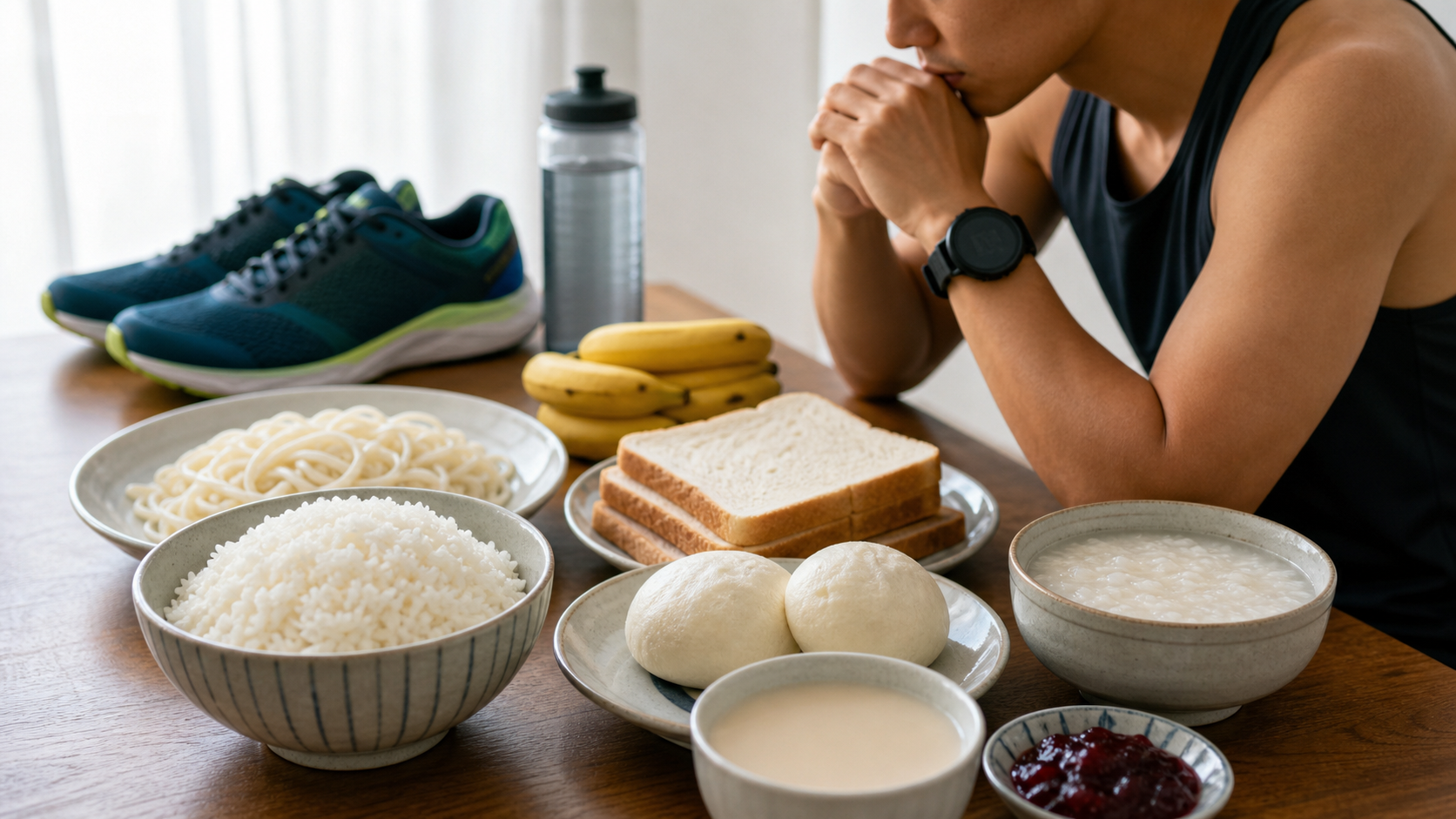
Choose carbohydrate sources that are low in fiber, low in fat, and low in residue to reduce gastrointestinal burden and pre-race intestinal gas buildup.
Recommended Foods
| Food | Carbohydrate content per 100g | Notes |
|---|---|---|
| White rice | Approx. 28g | Easy to digest; the best choice for Taiwanese runners |
| White noodles/udon | Approx. 25g | Pair with light sauces; avoid high-fat sauces |
| White toast | Approx. 50g | Add a little jam; avoid peanut butter |
| Banana | Approx. 23g | Contains potassium, moderate fiber; consume in moderation |
| Rice milk/sweet potato porridge | Approx. 15–20g | Liquid form makes it easy to consume in large amounts |
| Plain steamed buns | Approx. 45g | Available at Taiwanese convenience stores; convenient for refueling |
Foods to Avoid
- High-fiber vegetables: Broccoli, sweet potato leaves, burdock, etc., can cause gastrointestinal discomfort during the race
- Legumes: Gas-producing foods; avoid bloating
- High-fat foods: Fried chicken, hot pot meat slices; slow digestion
- New foods: Never try foods you haven’t eaten before during the 3 days before the race
Three-Day Portion Calculation Example
Using a runner weighing 65 kg as an example:
3 days before the race (target: 455g carbohydrates)
- Breakfast: 1.5 bowls of white rice (approx. 200g cooked rice) + 2 eggs + a small amount of vegetables
- Lunch: 200g white noodles (dry weight) + 100g chicken breast + a small amount of blanched vegetables
- Afternoon snack: 2 bananas + 2 slices of toast with jam
- Dinner: 2 bowls of white rice + tofu + soup
- Late-night snack: 250ml rice milk
2 days before the race (target: 520–585g carbohydrates)
Add one more bowl of rice or an extra snack compared to Day -3. Keep protein and fat at normal levels; no need to restrict excessively.
1 day before the race (target: 650–780g carbohydrates)
This day has the highest intake, but dinner should not be too late or too large (recommended to finish before 6 PM the night before the race) to avoid excessive gastrointestinal fullness before bed affecting sleep.
Practical Tips
- Spread out intake: Distribute high-carbohydrate foods across 5–6 meals to avoid large single servings that cause blood sugar spikes and gastrointestinal discomfort.
- Weight gain is normal: Every gram of stored glycogen is accompanied by approximately 3g of water, so gaining 1–2 kg during carbohydrate loading is normal—runners need not panic.
- No need to deliberately increase protein: During carbohydrate loading, maintaining protein at 1.5g per kilogram of body weight is sufficient; the focus is on carbohydrates.
- Avoid excessive fat: Fat delays gastric emptying and hinders glycogen replenishment efficiency.
- Pair with adequate hydration: During carbohydrate loading, maintain daily water intake at 35–40ml per kilogram of body weight to support glycogen storage.
- Don’t try new foods: Any food you haven’t consumed during training should not appear on your menu in the 3 days before the race.
Conclusion
Carbohydrate loading is not binge eating—it is a planned, logical energy replenishment strategy. Taiwanese runners have a natural advantage: white rice is the perfect carbohydrate-loading food, and with the variety of noodles and convenience store items available, achieving high carbohydrate intake is not difficult. The key lies in planning, execution, and trusting the scientific basis of this method. Eat correctly in the 3 days before the race, and you’ve already won half the battle at the starting line.
Related Reading
- Marathon Pre-Race Carbohydrate Supercompensation (Carbo-loading): A Practical 3-Day High-Carbohydrate Meal Plan
- Carbohydrate Supplementation Before a Road Race: A 3-Day Pre-Race Carbohydrate Stacking Strategy
- Carb-Loading 3 Days Before the Race: A Complete Plan and Practical Template
- A 14-Day Pre-Race Carb-Loading Template: Filling Your Tank with Carbohydrates
CT暗黑廚房) 車友必備 宇宙無敵鮮蚵湯 幫助訓練恢復 天然食補 好市多 超肥鮮蚵 破PR
7 年前
西進武嶺 免費訓練分析服務 Intervals | 練不夠還是練過頭?你哪一種類型選手?AI模型告訴你! | 備戰神器 | 公路車 訓練 | CT Yeh
4 年前
一日北高前的高裝檢 | 北高 360 | 挑戰11小時的裝備 | 一日雙塔 | 補給
6 年前
靠單車減肥35公斤 心得分享與整理
7 年前
單車 一日北高 ( 雙城 ) 肥宅雙人瘋狂行 紀錄片 REACTO
10 年前
Live) 備戰2019彰化經典百K 賽前攻略 (已完賽請看新影片
7 年前
2018 田中馬拉松 全程健跑 VR 360 環景錄影 體驗現場狂野加油氣氛! Insta 360
7 年前
半日 小台灣 極限單車路線挑戰實錄
7 年前