A Pilgrimage to the Sky: The Norikura Hill Climb — Japan's Ultimate Test at the Highest Paved Road
文章導覽
- Table of Contents
- Prologue: The Holy Grail Above the Clouds
- Chapter 1: Race Overview and Historical Status
- 1.1 The Race's Basic Structure and What "All Japan" Means
- 1.2 Historical Trajectory and Legendary Riders
- 1.3 Norikura vs. Mt. Fuji: Clash of the Titans
- Chapter 2: Full Course Breakdown
- 2.1 Movement One: The Forest's Temptation
Table of Contents
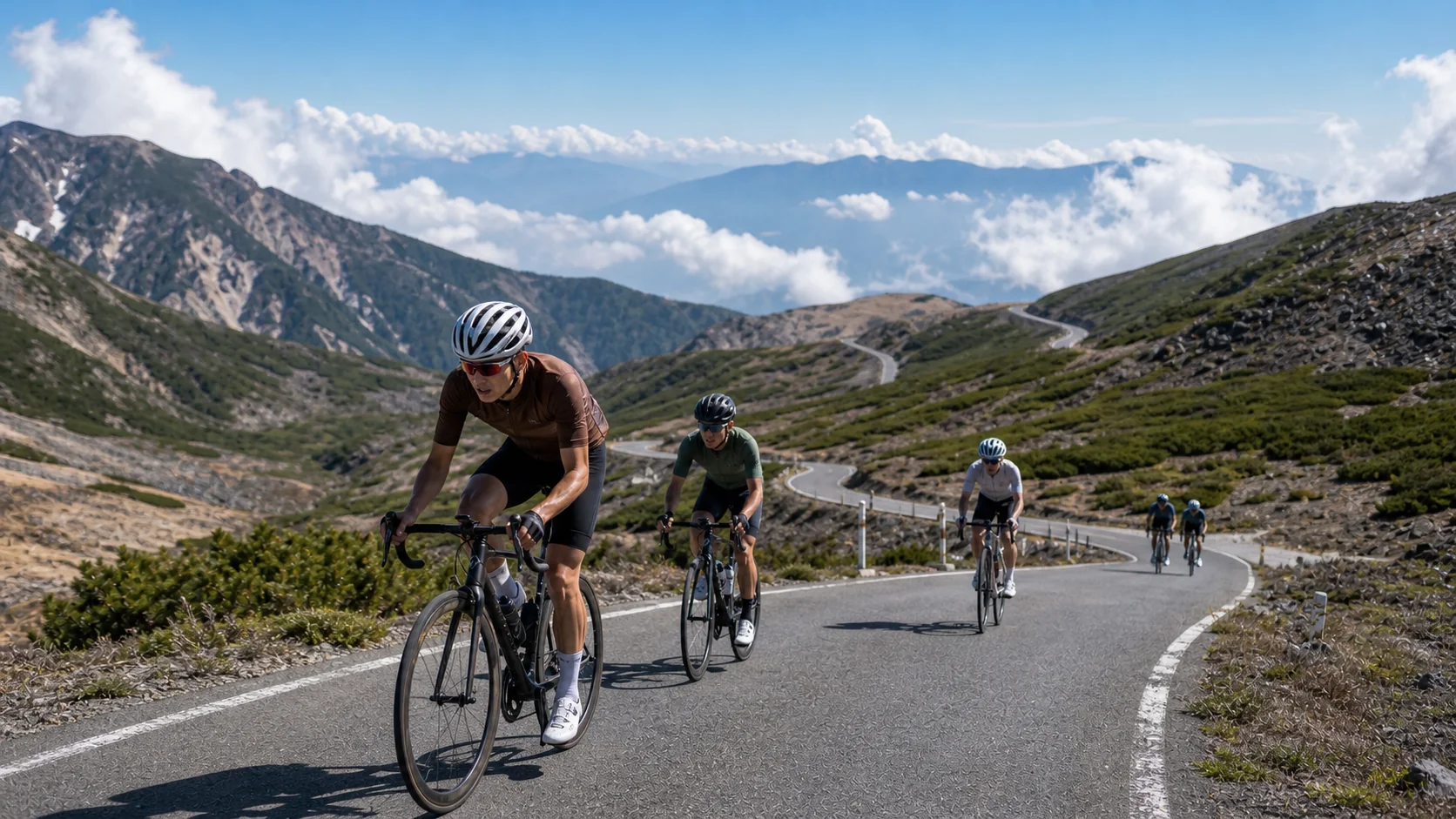
Prologue: The Holy Grail Above the Clouds
For Taiwanese cyclists, Wuling is the unshakeable holy mountain of the heart — an epic trial climbing from sea level to 3,275 meters, symbolizing the ultimate duel between rider and gravity.
But turn your gaze north to neighboring Japan, and on the border between Nagano and Gifu Prefectures, there exists a “Road to the Sky” that countless Japanese riders dream about. This road is not only the highest point on any regular public road in Japan, it has also given birth to Japan’s oldest and most fiercely contested hill climb race — Mountain Cycling in Norikura (マウンテンサイクリング in 乗鞍).
If the Mt. Fuji Hill Climb is Japanese riders’ “final exam,” used to measure a year’s training and power-to-weight gains, then the Norikura Hill Climb is undoubtedly the championship final of the “Summer Koshien.”
There is no luck here — only raw strength, precision weight engineering, and a battle of will fought under extreme oxygen deprivation. For Taiwanese riders accustomed to Wuling’s long-distance war of attrition, Norikura offers a completely different competitive experience: shorter, steeper, more violent, and not just a test of fitness, but a scientific war of equipment, pacing, and altitude adaptation.
This guide aims to give Taiwanese cycling enthusiasts, competitive racers, and challenge-loving amateurs an encyclopedic guide to Mountain Cycling in Norikura. We will trace the race’s historical arc, dissect every undulation of its tarmac, analyze the preparation philosophy of Japan’s top riders, and offer logistics and travel advice tailored for Taiwanese racers.
Chapter 1: Race Overview and Historical Status
1.1 The Race’s Basic Structure and What “All Japan” Means
Since its founding in 1986, “Mountain Cycling in Norikura” has become synonymous with hill climb racing in Japan. This race is informally crowned “All Japan” not only because of its long history, but because its finish line sits at the highest elevation of any public road in the country — 2,716 meters.
While this is somewhat lower than Taiwan’s Wuling at 3,275 meters, at Japan’s higher latitude the ecological and climatic severity is no less demanding than a 3,000-meter-class mountain.
Core Race Data
| Item | Details | Notes |
|---|---|---|
| Race Name | Mountain Cycling in Norikura (マウンテンサイクリング in 乗鞍) | One of the oldest hill climb races |
| Date | Last Sunday of August each year | Avoids typhoon and rainy seasons, though mountain weather remains unpredictable |
| Start | Norikura Kogen Tourist Center, Matsumoto City, Nagano Prefecture | Approx. 1,460m elevation |
| Finish | Tsurugaike parking lot, Nagano/Gifu border | 2,716m (Japan’s highest paved road point) |
| Course Length | 20.5 km | Moderate distance, comparable in intensity to Wuling’s second half |
| Elevation Gain | 1,260 m | Average gradient about 6.1% |
| Participants | Approx. 4,000–4,500 | Slightly smaller field than Mt. Fuji Hill Climb, but the elite field is extremely strong |
| Time Limit | 4 hours 30 minutes | Generous for casual riders |
Insight: The Secret Behind the Race Name
Notably, the race retains the name “Mountain Cycling” rather than the now-common “Hill Climb.” This reflects the era of its founding (1986), when road bikes had not yet fully taken over hill climbing, and many entrants rode mountain bikes (MTBs) to tackle this rugged mountain road. This historical trace also hints at Norikura’s course character: it isn’t merely a paved road, but a “mountain trail” cutting through pristine alpine terrain.
1.2 Historical Trajectory and Legendary Riders
Without understanding Norikura’s history, it’s impossible to grasp why Japanese riders are so obsessed with the number “55 minutes.” The evolution of Norikura’s championship times is, in effect, a microcosm of the development of cycling equipment and training science.
1.2.1 The Dawn Era (1986 – early 1990s): The Primal Struggle Between Man and Gravity
Early Norikura champions, such as Mitsuru Ohara, set their records in an era of relatively heavy equipment.
- 1986 (1st edition): Mitsuru Ohara won in 53 minutes 48 seconds (the course was 18 km at the time, different from today’s 20.5 km)
- Equipment characteristics: steel frames, down-tube shifters, heavy aluminum wheel rims
In this era, riders relied on pure muscular power and endurance.
1.2.2 The Dynasty of “Mountain God” Toshio Murayama (mid-1990s – early 2000s)
In the 1990s, a legendary figure named Toshio Murayama emerged. He won a total of 8 championships, and between 1995 and 2002 achieved an astonishing 6 consecutive titles.
- Milestone: Murayama’s 55 minutes 30 seconds set in 1998 became the “Norikura Wall” that stood unbroken for over a decade
- Influence: Murayama’s dominance was overwhelming — he defined what it meant to be a “pure climber.” His riding style and training methods became the template for those who followed
1.2.3 Makoto Morimoto and the “Engineer’s Counterattack” (2008 – 2018)
For modern fans, the name Makoto Morimoto is synonymous with Norikura. Unlike traditional athletes, Morimoto’s day job was as an engineer at a metalworking company (Kondo Machine Works). He brought engineering thinking into cycling competition.
- The GOKISO Revolution: Morimoto was not only a racer but also the test rider and figurehead of his own company’s brand, “GOKISO.” Using GOKISO’s ultra-low-friction, aerospace-grade hubs combined with extreme weight optimization, he won repeatedly between 2008 and 2017, tying Murayama’s record with 8 total championships
- Training Philosophy: Morimoto proved that a “corporate worker” could beat professional or semi-professional riders through scientific training and equipment advantages. His 55 minutes 08 seconds in 2010 remained the modern benchmark for years
1.2.4 The New Generation’s Breakthrough: Cracking the 54-Minute Barrier (2019 – present)
2019 was a watershed year in Norikura’s history. That year, Shunsuke Nakamura stunned the field by setting a new course record of 54 minutes 41.959 seconds, breaking Morimoto’s 9-year-old mark.
- Significance of the breakthrough: This 27-second improvement symbolized the total triumph of a new generation of training methods (the spread of power-based training, the adoption of hypoxic training) and equipment (aerodynamic frames, lighter carbon fiber technology)
- A leap in the women’s field: That same year, women’s champion Tsubasa Makise broke a 12-year-old women’s record with a time of 1 hour 6 minutes 48 seconds, marking a notable rise in the level of Japanese women’s cycling
- Latest developments (2023–2024): Recent competition has grown even fiercer. In 2024, Yuji Tanaka shocked the field again with 53 minutes 46 seconds (possibly aided by minor course adjustments or tailwind conditions). The championship battle has now evolved from “who can break 56 minutes” to “who can consistently deliver 54-minute performances”
1.3 Norikura vs. Mt. Fuji: Clash of the Titans
For Taiwanese riders, the most common dilemma is: “Should I go race Mt. Fuji or Norikura?” Both are hill climbs, but their character is completely different. Think of it as the relationship between Taiwan’s Tataka and Wuling — but with the contrast pushed even further.
Course Characteristics Comparison
| Comparison | Mt. Fuji Hill Climb | Norikura Hill Climb | Taiwan Wuling (West Ascent) |
|---|---|---|---|
| Elevation | Finish 2,305m | Finish 2,716m | Finish 3,275m |
| Total Distance | 24km (timed section) | 20.5km | Approx. 53km (from Puli) |
| Average Gradient | 5.2% (gentler, faster course) | 6.1% (highly variable) | Approx. 5–6% (but extremely long) |
| Finish Times | 60–90 min (gold/silver/bronze rings) | 55–90 min | 3–6 hours |
| Air Density | Thinner | Extremely thin (~75% of sea-level oxygen) | Extremely thin |
| Scenery | Mostly forest, view of Mt. Fuji’s summit at the finish | Alpine plateau, distinct tree line, sea of clouds | Alpine highway, canyons and sea of clouds |
| Race Identity | Like a “final exam” (chasing the color rings) | Like the “Koshien final” (chasing the strongest title) | Like a “pilgrimage” |
| Feel of Difficulty | Steady-power type (constant wattage) | Interval-endurance type (must handle steep pitches) | Ultra-long endurance/willpower type |
Time Conversion: What Would Your Mt. Fuji Time Be on Norikura?
Based on Japanese cyclists’ aggregated data, there is a rough conversion between the two races’ times, though body weight and gradient adaptation must be considered:
- Basic formula: Norikura finish times are generally about 5–10 minutes faster than Mt. Fuji (since the course is 3.5 km shorter), but only if you can handle the steeper gradients and thinner air
- Silver ring benchmark: If you can earn a “silver ring” at Mt. Fuji (finishing within 75 minutes), your Norikura target should be roughly 65–70 minutes
- Gold ring benchmark: A Mt. Fuji “gold ring” (under 65 minutes) corresponds to a Norikura time of roughly 58–60 minutes — also the threshold for entering the “Champion Class”
- Key difference: Mt. Fuji has a steady gradient, well-suited to “constant-wattage cruising” (time-trial mode); Norikura’s gradient varies wildly (from gentle sections to 15% pitches), demanding stronger “gear-shifting agility” and “anaerobic recovery”
Riders used to Taiwan’s steep climbs (like Meishan’s 36 Bends or Dayuling) may actually find Norikura more comfortable than Mt. Fuji.
Chapter 2: Full Course Breakdown
Norikura’s Echo Line (エコーライン) is a route where scenery and difficulty escalate together, like a work of art. We can precisely divide it into three distinct movements, each with its own geographic features, ecology, and riding rhythm.
2.1 Movement One: The Forest’s Temptation
Segment: Start → Sanbondaki (0km – 7km)
| Item | Value |
|---|---|
| Segment character | Forest bathing, relatively gentle gradient, a speed trap |
| Elevation change | 1,460m → 1,800m |
| Average gradient | About 5%–6% |
Course Details
The race departs from the Norikura Kogen Tourist Center. The first 7 km run along a wide two-lane road, flanked by dense larch and white birch forest. Morning sunlight filters through the leaves, and the air is fresh enough to make you want to breathe deeply. Road quality is excellent — typical high-quality Japanese pavement.
Scenery and Ecology
- Zengoro Falls: Shortly after the start, a sign on the left points toward “Zengoro Falls.” You won’t see the waterfall during the race, but you’ll hear its thundering roar — one of Norikura’s three great waterfalls
- Asian black bear habitat: This section is also active range for the Asian black bear (ツキノワグマ). While thousands of riders on race day will scare wildlife away, if you do a pre-race training ride here, it is strongly recommended to carry a bear bell — standard etiquette and safety practice on Japanese forest roads
Riding Strategy
This section is the biggest “psychological trap” of the entire race.
⚠️ Warning sign: Thanks to the adrenaline spike at the start, combined with a gentle gradient (with even a few flat sections), 90% of first-time entrants go too fast here. You’ll feel like you’re in great shape, and your power meter will show comfortable numbers.
✅ Expert advice: Suppress that urge. Imagine you’re just riding to the convenience store for breakfast, not racing. Keep a high cadence (90–100 rpm) and never mash the pedals. Every joule of glycogen you save here is a lifeline you’ll need for the oxygen-starved final 5 km.
2.2 Movement Two: The Trial Climb
Segment: Sanbondaki → Kurai-ga-hara Sanso (7km – 14.5km)
| Item | Value |
|---|---|
| Segment character | Wildly varying gradient, ski resort scenery, a string of hairpins |
| Elevation change | 1,800m → 2,350m |
| Average gradient | 6%–10% (highly variable) |
Course Details
After passing the checkpoint (CP1) at the Sanbondaki Rest House, the gate closes (a year-round vehicle restriction zone begins) — the real race starts now. The road narrows, and the gradient turns unfriendly.
- Ski resort section: You’ll pass through a winter ski run, wide open with no tree cover. Looking back, you can see just how high you’ve climbed — a magnificent view, but the psychological pressure builds with it
- The gate of hell: the steep pitch at 11km: Around the 11 km mark, you’ll hit roughly 1 km of steep climbing with multiple consecutive hairpins (tsuzura-ori), with instantaneous gradients reaching 12–15%
Scenery and Ecology
- Reisen Hut: Passing near Reisen Hut, a faint sulfur smell drifts through the air, a reminder that this is an active volcano
- Vegetation change: As elevation passes 2,000 meters, tall trees begin to shrink and conifers gradually replace broadleaf forest. You’ll notice the trees becoming twisted — scars from a long struggle against wind and snow
Riding Strategy
This is the decisive segment for your final time, and also the place most likely to make you “blow up.”
- Shifting technique: Facing the steep pitch at 11 km, shift into an easier gear about 20 meters before entering the switchback. Don’t wait until the pedals go heavy to shift — that will break your rhythm or even drop your chain
- Line choice: At the hairpins, the inside line is steepest (potentially over 18%), while the outside is gentler. Unless you’re racing for the win, take the outside line (out-out-out) — it’s slightly longer, but lets you maintain steady power and cadence
2.3 Movement Three: The Border Between Heaven and Hell
Segment: Kurai-ga-hara Sanso → Finish at Tsurugaike (14.5km – 20.5km)
| Item | Value |
|---|---|
| Segment character | Above the tree line, extreme hypoxia, breathtaking sea of clouds, snow-wall remnants |
| Elevation change | 2,350m → 2,716m |
| Average gradient | About 7%–9% (but feels like 12% in the thin air) |
Course Details
Past Kurai-ga-hara Sanso (CP2), you cross the tree line. This is a visually dramatic transition point: tall trees vanish instantly, replaced by low-lying Japanese stone pine (ハイマツ) and exposed volcanic rock.
The view opens up completely — you can see the road winding overhead like a white ribbon draped across reddish-brown mountain slopes. This is the legendary “Road to the Sky.”
King of Scenery and Ecology: Rock Ptarmigan and the Great Snow Valley
- The Great Snow Valley (Daisekkei): Even in the height of summer in August, massive patches of leftover snow can still linger by the roadside — the famous “Great Snow Valley.” In early summer (June–July), these snow walls can reach as high as 10 meters. For riders from subtropical Taiwan, riding past a wall of snow in short-sleeve jerseys is a striking visual shock
- Rock ptarmigan (雷鳥/Raicho): This is habitat for Japan’s natural monument, the rock ptarmigan. Known as “messengers of the gods,” these birds typically appear only in bad weather (heavy fog). If you spot one during the race, it means two things: first, you’re extraordinarily lucky — a once-in-a-lifetime encounter; second, the weather may be turning bad, so be careful of hypothermia
- Alpine plants: The purplish-pink Komakusa (Dicentra peregrina) along the roadside is the queen of alpine flowers, growing only on gravel beds — please never step on it
Riding Strategy
This is Norikura’s most brutal stretch. Although the gradient data looks similar to the previous section, above 2,500 meters the oxygen content of the air is only about 75% of sea level. Your muscles will scream, and your power output will inexplicably drop 10–15%.
- The final crux: About 1 km after Kurai-ga-hara Sanso, a straight section with a gradient near 10% and no tree cover often brings strong headwinds or crosswinds. Riding solo here is suicide — find a “train” and hide behind riders bigger than you
- The last mile before the finish: In the final 3 km, you can already see the finish-line buildings, but that visible-yet-unreachable distance can be soul-crushing. Focus on your breathing, don’t stare at your power meter, and grind through the final left bend with sheer willpower — waiting for you is the breathtaking view of Tsurugaike and the glory of finishing
Chapter 3: Race Strategy and Tactical Analysis
For Taiwanese riders’ typical style (usually more accustomed to steep gradients but with less exposure to high-altitude cold environments), we combined analysis from Japanese data experts and insights from top riders to build the following detailed strategy.
3.1 Power Pacing Strategy
According to analysis from Japanese power-data blogs, many failed attempts come down to “going out too fast, fading too hard.” At high altitude, once your heart rate exceeds your anaerobic threshold (“blowing your heart rate”), recovery takes 2–3 times longer than at sea level.
Ideal Pacing Model (Negative Split)
| Segment | Distance (km) | Target Power (% FTP) | How It Feels | Tactical Rationale |
|---|---|---|---|---|
| Start → Sanbondaki | 0 – 7 | 85–90% | “This feels too slow, everyone’s passing me” | Preserve glycogen, avoid lactate buildup. Drafting benefits are highest in this windy section |
| Sanbondaki → Kurai-ga-hara | 7 – 14.5 | 95–100% | “Getting a bit breathless, but still under control” | The main climbing segment. Brief excursions above FTP (105–110%) are permitted on steep pitches, but must drop back to Sweet Spot on gentler sections |
| Kurai-ga-hara → Finish | 14.5 – 20.5 | All Out | “Can’t catch my breath, legs are on fire” | “All out” here may only translate to 85–90% of FTP in actual wattage (due to hypoxia), but RPE (perceived effort) is 10/10. This is a battle at the edge of physiological limits |
Why this approach?
Because the “power penalty” of high altitude is a law of physics you cannot defy. Data shows that at 2,700 meters, your FTP naturally drops by about 24%. If you race the start (1,400m, roughly 13% reduced) at sea-level FTP, you’ll suffer a catastrophic power collapse by the summit.
3.2 High-Altitude Breathing Technique
This may sound esoteric, but well-known Japanese women’s racers like Shino take it very seriously.
Forced Exhalation
At high altitude, your brain senses oxygen deprivation and pushes you into rapid, shallow breathing (hyperventilation), which is highly inefficient. You must consciously force all the air out of your lungs. Only by fully expelling carbon dioxide from your lungs can fresh oxygen come in.
Rhythmic Breathing
Sync your breathing with your cadence — for example, “inhale-inhale-exhale-exhale” or “inhale-exhale-exhale.” Find a metronome-like rhythm that helps you enter a state of “flow,” letting you forget the pain in your muscles.
3.3 Tackling the Two Crux Sections
There are two sections on the course that demand special handling:
Crux One: The Consecutive Hairpins at 11km
Here the gradient suddenly exceeds 10%.
Action: Shift into your largest cog (30T or 34T), and alternate between standing (dancing on the pedals) and seated pedaling, using your body weight to fight gravity and relieve your quads.
Crux Two: The Straight After Kurai-ga-hara Sanso at 14.5km
This section doesn’t look steep, but it’s actually 9–10%, and wind resistance is usually significant.
Action: Find shelter. Riding solo here is a big disadvantage. Try to stay in a group, even if it means going a bit slower. Save your energy for an attack in the final kilometer.
Chapter 4: Japanese Riders’ Preparation Secrets
By analyzing Japanese YouTube channels (such as GOKISO’s Makoto Morimoto, Yamato Kanematsu, TOMI, and others) as well as racer blogs, we’ve summarized the preparation philosophy of Japanese riders. This differs somewhat from the Taiwanese approach of “racing as training” — Japanese riders place greater emphasis on data and science.
4.1 Training
Virtual Benchmark: Alpe du Zwift
Japanese riders widely use Zwift’s Alpe du Zwift to simulate Norikura, since the two share remarkably similar climbing and length. A rough conversion formula is:
Alpe du Zwift time × 1.1 to 1.2 ≈ Norikura finish time
If you want to break 60 minutes at Norikura (the elite threshold), you’ll need a sub-50-minute Alpe du Zwift time. This lets Taiwanese riders assess their readiness for Norikura right from their own living room.
Hypoxic Training
In recent years, top Japanese amateur riders have taken to training intervals in “hypoxic chambers,” or heading directly to high-altitude regions (like Nagano’s Sugadaira Plateau) for training camps.
For Taiwanese riders, Wuling is the best hypoxic training ground in the world! Riding experience at Wuling gives you a massive advantage when adapting to Norikura’s high altitude.
4.2 Equipment
Norikura is a showcase for “weight-weenie madness.” Because average speeds are slow (even the champion only averages around 22 km/h; average riders around 15 km/h), aerodynamics matters far less than weight.
Wheel Selection
This is a race for lightweight climbing wheels. GOKISO, Lightweight, and AX Lightness are everywhere. For Taiwanese riders, we recommend carbon wheelsets with a rim depth under 35mm — the lighter, the better.
The Rise of the 1x Drivetrain
Many Japanese riders (including Morimoto) run a single-chainring (1x) setup. For example, a front chainring of 38T or 40T paired with an 11-30T or 11-34T cassette.
Advantages: You save the weight of the front derailleur, one shift cable, and one chainring (roughly 200-300g), and you completely eliminate the risk of dropping a chain on climbs.
Gearing Recommendations
| Category | Recommended Setup |
|---|---|
| Elite class | Front 50/34T or 1x 40T, rear 11-28T or 11-30T |
| General class / Taiwanese riders | Strongly recommended to have a 34T on your cassette. Even strong riders benefit — under hypoxia, a high cadence (90rpm+) maintains speed better than mashing (60rpm) and spares your knees |
4.3 Fueling Strategy
Japanese riders calculate their fueling down to the gram.
Pre-Race Diet
- 3 days out: Carbo-loading. Eat more white rice, udon noodles, and mochi. Mochi is a favorite among Japanese riders because it’s pure starch — small in volume, calorie-dense, and quick to digest
- Race-day breakfast: Finish eating 3–4 hours before the start. Focus on rice cakes or onigiri, avoiding fat
Fueling During the Race
- Fluids: Given the cool temperatures and short duration (1–1.5 hours), two bottles aren’t necessary. A single 500ml bottle of a custom mix (BCAA + maltodextrin) is enough. Some riders carry only 300ml to shave off 200g
- Energy gel: One caffeinated gel 30 minutes before the start. During the race, one gel each at 7km (Sanbondaki) and 14km (Kurai-ga-hara)
⚠️ Key point: At high altitude, digestion weakens significantly — always choose liquid, easy-to-swallow gels and avoid solid food (like energy bars).
4.4 Cold-Weather Descent Gear
🚨 This point deserves to be written in red!
Even in summer, the temperature at Norikura’s summit (2,716m) can be as low as 5–10°C, and if it rains, the felt temperature can drop below 0°C.
Race Organizer Service
The organizers offer a “descent baggage transport service.” You must hand your cold-weather gear to the organizer’s vehicle before the start so it’s waiting for you at the summit.
Essential Checklist
| Item | Notes |
|---|---|
| ☐ Winter full-finger gloves | Essential — frozen fingers that can’t operate the brakes are deadly |
| ☐ Windproof, waterproof jacket | Rain-jacket grade; a simple windbreaker isn’t enough |
| ☐ Leg warmers or long tights | Protect your legs |
| ☐ A dry base layer | Change out of your soaked jersey in the restroom at the summit before descending — this is the key trick to avoiding hypothermia on the way down, a hidden secret among Japanese veterans |
⚠️ Many Taiwanese riders, on their first trip, descend in short sleeves and end up shaking so badly halfway down that they can’t control their handlebars — this is extremely dangerous.
Chapter 5: Reasons You Must Race It
Since Taiwan already has Wuling, why go through the trouble of traveling to Japan to ride Norikura?
Reason One: A Truly Unique “Car-Free” Experience
Wuling is spectacular, but you have to endure the exhaust and noise of vegetable trucks, tour buses, and modified motorcycles. Norikura’s Echo Line is under a year-round private-car restriction. Normally only eco-buses and taxis can use it — and on race day, even the buses stop running.
Imagine it: an entire wide alpine highway, with nothing but the click of freehubs and the breathing of a few thousand riders. That kind of pure silence and focus is a rare cycling experience anywhere in the world.
Reason Two: A “Festival” Atmosphere
The meticulous organization of Japanese races will move you. From the pre-race check-in (usually featuring a large expo where manufacturers showcase the latest climbing gear), to the warm-up guidance at the start, to the volunteers along the course (many of them local elderly men and women) cheering you on.
When you’re struggling, spectators along the road will shout “Ganbatte!” and “Nice run!” — that feeling of being supported will send an adrenaline surge through you.
Reason Three: An Encounter With Ptarmigan and Walls of Snow
In Taiwan, you’d only see snow in the depths of winter. At Norikura, you ride past massive walls of snow (the Great Snow Valley) in shorts, in the height of summer. This seasonal dissonance, combined with the purple carpet of blooming alpine plants like Komakusa, is a photographer’s dream.
Reason Four: Hot Springs and Local Food After the Finish
Once you’ve descended the mountain, “Norikura Kogen Onsen” awaits. It’s a milky-white sulfur spring, remarkably effective at soothing lactate buildup.
Recommended Local Food
- Toji Soba: A local specialty of Norikura — soba noodles dipped briefly into a boiling hot-pot broth, served with local mountain vegetables and mushrooms, instantly warming your frozen body after the descent
- Sanzoku-yaki: A Matsumoto specialty — a giant fried chicken cutlet, the perfect protein refuel
Chapter 6: Expedition Guide for Taiwanese Riders
6.1 Transportation Recommendations
Option A (Most Recommended): Chubu Centrair International Airport (NGO)
- Method: Rent a car and self-drive. About 3.5–4 hours from Nagoya to the Norikura Kogen Tourist Center
- Advantages: The most convenient way to bring a bike box, with no worries about JR train baggage restrictions. You can also detour to sightsee in the old town of Takayama along the way
Option B: Toyama Airport (TOY)
- Method: Rent a car and self-drive
- Advantages: Shorter distance, and Toyama Bay’s seafood is exceptionally delicious. Great for riders who also want to challenge the “Toyama Bay coastal route” or sightsee at Tateyama Kurobe
Option C: Public Transit (JR + Bus)
- Method: Take the JR Limited Express Shinano to “Matsumoto Station,” transfer to the Matsumoto Dentetsu Kamikochi Line to “Shin-Shimashima Station,” then transfer to a bus to Norikura Kogen
- Drawback: Transferring with a bike box is quite painful, and bus schedules are limited. Only suitable for riders traveling light or using a bicycle courier service
6.2 Lodging Strategy
Key word: fast!
The pensions near the Norikura Kogen Tourist Center are highly sought-after. They’re typically booked out by regulars six months to a year before race registration even opens.
Alternatives
| Location | Notes |
|---|---|
| Hirayu Onsen (Gifu Prefecture side) | More lodging options; on race day, drive over Anbo Tunnel (about 40 minutes) and enjoy a high-quality hot spring |
| Matsumoto City | Plenty of business hotels; drive up the mountain early on race day (about 1 hour) |
6.3 Registration Notes
Norikura registration typically goes through the “Sports Entry” website, and the roughly 4,000 spots often sell out within hours of opening.
- Timing: Registration usually opens in mid-March to early April each year
- Strategy: Register an account in advance, and have a Japanese translation browser extension ready
- Travel agency packages: Taiwanese travel agencies (such as Sports Life) offer package tours that include guaranteed entry slots. Though pricier, they eliminate the hassle of scrambling for a spot and arranging transportation, and usually include airport pickup and support-vehicle service — an excellent option for first-time overseas racers
Conclusion: Because the Mountain Is There, We Ride
Norikura is more than just a race — it’s a microcosm of Japanese cycling culture: an obsessive attention to detail, reverence for nature, and a relentless pursuit of one’s own limits.
When you cross the finish line and stand at the 2,716-meter marker, looking down at the sea of clouds below and the Northern Alps in the distance (Yarigatake, Hotakadake), you’ll understand why legends like Makoto Morimoto and Shunsuke Nakamura were willing to spend a decade perfecting these 55 minutes.
You’ll also understand why, even after your legs have gone completely numb, the corners of your mouth curl up on their own.
For Taiwanese riders, this is a grand adventure. Bring your beloved bike and go feel that thin, pure air. There’s no motorcycle noise there — just you, your bike, and boundless sky.
Ready? See you at the summit of Norikura!
Appendix: Key Data Quick Reference
Segment Pacing Recommendations
| Segment | Distance (km) | Recommended Power (% FTP) | Key Focus |
|---|---|---|---|
| Start → Sanbondaki | 0 – 7 | 85–90% | Suppress the urge to surge, enjoy the forest bathing, watch for a sudden burst of speed, carry a bear bell |
| Sanbondaki → Kurai-ga-hara | 7 – 14.5 | 95–100% | Handle the hairpins (11km mark), find a group, regulate your breathing rhythm |
| Kurai-ga-hara → Finish | 14.5 – 20.5 | All Out (perceived) | Fight hypoxia (a 15% power drop is normal), give it everything you’ve got, sprint to the line |
Essential Checklist
- [ ] Lightweight wheelset (open/tubeless preferred for easy roadside repair)
- [ ] Largest cassette cog of 32T or 34T (your lifesaver gear)
- [ ] Bear bell (for pre-race training rides; not needed during the race itself)
- [ ] Winter full-finger gloves & windproof/waterproof jacket (absolutely essential for the descent)
- [ ] A dry base layer (to change into for the descent)
- [ ] Energy gels × 3 (liquid form preferred)
- [ ] A reservation for a celebratory post-race meal (soba or yakiniku)
📝 Author’s note: This guide was compiled from a variety of sources. If you spot any updates needed or errors, riders are welcome to point them out. Wishing every rider the most beautiful memories at the summit of Norikura! 🏔️🚴♂️