Introduction
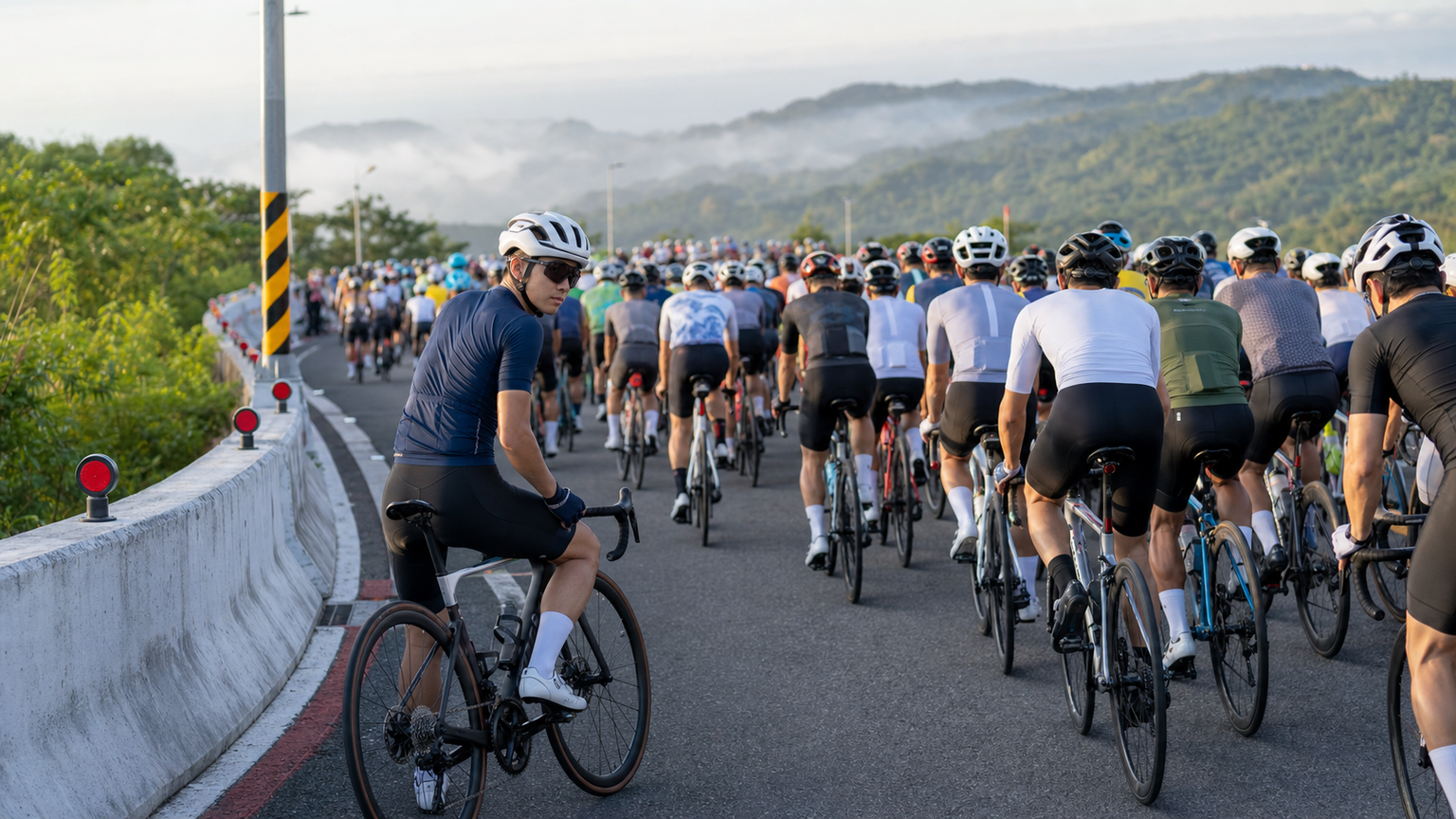
Many riders invest significant effort in training and equipment when preparing for a climbing race, yet overlook one critical detail: the starting strategy. At major climbing events in Taiwan, the starting area often gathers hundreds or even thousands of riders, and the first few minutes after the start are typically chaotic—riders are packed tightly, speeds are inconsistent, and visibility is limited. Choosing the wrong position can leave you trapped in a slow-moving crowd, forced to ride at a pace lower than planned; but starting too far forward may cause you to expend excessive energy during the initial surge, disrupting your pacing plan for later sections. The starting strategy may seem simple, but it involves real know-how.
Understanding the Wave Start System
Major climbing races in Taiwan typically organize riders into starting waves based on their registered results or estimated finish times. Taking the Wuling climbing race as an example, it is usually divided into categories such as Elite, Competitive, and Challenge, with each wave starting 5–10 minutes apart. Understanding which wave and starting group you belong to is the first step in formulating your starting strategy.
| Starting Wave | Suitable Riders | Main Challenge |
|---|---|---|
| Elite (front wave) | Strong riders with racing goals | Difficult to make up ground once dropped |
| Competitive (middle wave) | Serious amateurs with target times | Large speed differences between front and back; requires precise judgment |
| Challenge (rear wave) | Riders primarily aiming to finish | Densest crowd; patience needed after the start to find space |
If the race offers an advance wave application system, it is recommended to honestly declare your position based on your training data and target pace. Do not deliberately overstate your ability to secure a front-wave spot—being forced to match the pace of strong riders after the start is often the beginning of a collapse.
Strategies for Choosing Your Starting Position
Within your wave, how you choose your specific standing position also matters:
Left side vs. Right side:
- Roads in Taiwan are right-hand traffic, so the crowd will naturally drift to the right after the start
- If you want to find space quickly, starting on the left can sometimes be smoother than the right
- Check the road surface at the starting area and avoid standing near patches, drainage grates, or puddles
Front row vs. Middle of the pack:
- Starting in the front row helps you avoid the initial crowding, but you must endure the surge pressure from riders beside you
- Starting in the middle gives you more time to observe the dynamics ahead, making it suitable for riders who want to ride at their own pace
- Starting at the rear means a longer wait for space to open up; it typically takes 2–5 minutes to find comfortable riding room
Choosing a side channel:
- If the starting road has a shoulder or side space, starting near the edge can sometimes make it easier to find room than starting in the center
- However, watch for safety hazards on the shoulder, such as drainage grates or loose gravel
Pace Management in the First 3 Kilometers After the Start
The first few kilometers after the start are the most difficult part of the entire race to control your pace:
The first 500 meters:
- Nearly everyone starts at a higher intensity than planned, driven by the crowd and adrenaline
- Accept this reality, but consciously avoid going more than 20% above your planned intensity
- Keep your attention on the movements of riders around you to avoid collisions
500 meters to 2 kilometers:
- The crowd begins to spread out, allowing you to find your own space
- Actively ease down to your target pace; do not be tempted by the speed of riders ahead
- Confirm that your breathing rhythm is established and let your heart rate return to the target zone
2 kilometers to 5 kilometers:
- The starting congestion fades, forming relatively stable small groups
- Assess whether the pace of the group ahead matches your pacing plan
- Do not force yourself to overtake a group faster than yours, and do not get held back by riders moving too slowly
Judging When to Follow and When to Break Away
In the early stages of a climbing race, small groups of similar pace naturally form. Whether to follow a group requires quick judgment:
- Advantages of following: Reduced wind resistance (the benefit is limited on climbs but still exists), plus psychological support from riding with others
- Risks of following: The group’s pace may exceed your plan, and forcing yourself to keep up can lead to an early collapse
- Recommended judgment method: If your power while following exceeds 85% of your target FTP, immediately break away from the group and let the riders ahead move on
Practical Tips
- Arrive at the starting area 30 minutes before the race to check the road conditions and confirm your wave position
- Have an energy gel ready for quick access, tucked into a chest pocket of your jersey or a front jersey pocket; you can take it 10–15 minutes after the start
- At the start, confirm that your brakes, cycling computer, power meter, and other equipment are functioning properly
- If pace setters or rubber bands indicating target finish times are provided, look near the starting area for a rider matching your target pace to follow
- Relax—the chaos at the start usually disperses within the first kilometer
Conclusion
The starting strategy is part of the overall plan for a climbing race, not a standalone skill. Choosing the right starting position saves you unnecessary energy expenditure, and steady pace management after the start allows your pacing plan to be executed smoothly. With a good beginning, your climbing race can truly unfold according to plan.
Related Reading
- Wave Starts and Positioning Strategies in Road Running Events
- Strategy Analysis for Climbing Races: Timing for Following, Overtaking, and Saving Energy
- Pacing Strategies in Professional Cycling: Flat Breakaways and Climbing in the Pack
- Climbing in Races: Judging When to Ride in the Group vs. Going Solo
爬坡ITT實境)台中 魔王 松鼠坡 首航 6:12 大肚山 大三元 科福路
8 年前
一日北高/長距離團騎 常見問題補充篇 / 組團或跟團的眉角 / 壯車友容易被瘦車友慢性拉爆 / 原來屁股痛可能是這個原因...? / 風場配速法 / 公路車 / CT Yeh
2 年前
戰略) Zwift Race 如何咬在第一集團 如何評估自己要開多少推力 (請開1.5倍速看)
7 年前
CT 喇低賽) 武嶺牽車 才是王道 西進牽車四小時內秘訣 攝手位置 如何判斷 防抽筋小秘訣
7 年前
西進武嶺 自製新版AI配速表產生器 x 賽前攻略 抱佛腳! 沒有功率計也可以產生配速表嗎?有什麼其他眉角賽前要注意的呢? | 西進武嶺 / 東進武嶺 KOM 攻略 | 公路車 | CT Yeh
4 年前
昇陽SYB車隊 & Fuji 菁英選手們的趣味經驗分享,長知識了!市民車友必看~ 一路被拉爆後才給問 | 戀戀197 武嶺 凸台經驗分享 | 公路車 | CT Yeh
4 年前
如何 搶 #中央山脈 報名 #公路車 #報名 #搶票
7 年前
西進武嶺各路段 前8000名 大數據分析 配速攻略/功率/心律/推力比/維持率/踏頻/踏瓦比/牽車率 大公開 | 建大盃 NeverStop 可參考 | 公路車 | CT Yeh
5 年前