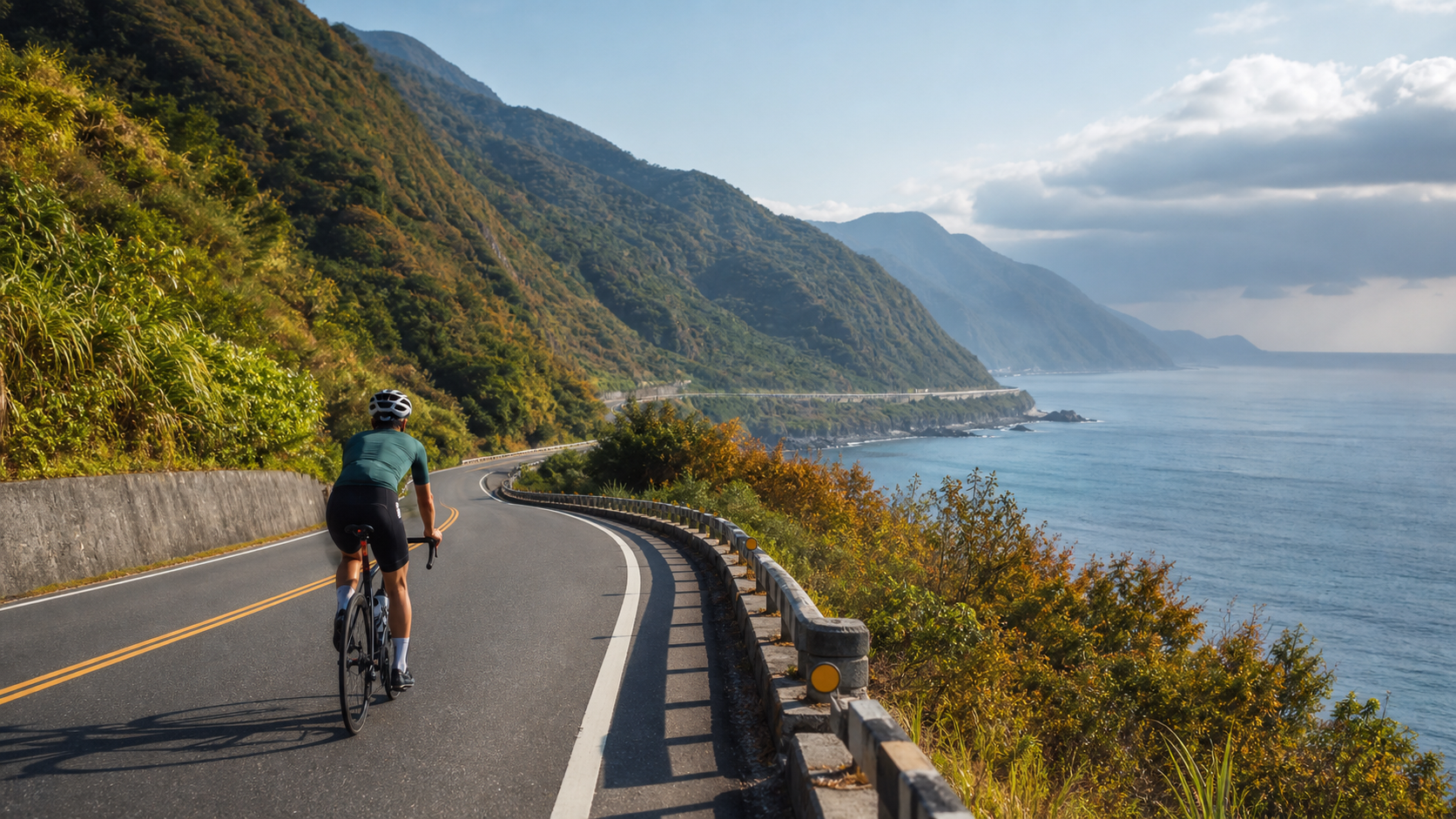
Introduction
People cycle around Taiwan in every season of the year, but picking the wrong time window can turn the whole trip from a joy into a grind. Heat waves, typhoons, the plum rain season, and the northeast monsoon can all directly affect your safety and riding experience. As someone who has ridden the full loop around the island several times, I’d argue that understanding the seasonal climate rhythm matters more than picking the right gear.
Taiwan’s Year-Round Climate and Cycling Suitability
| Month | Climate Characteristics | Cycling Suitability | Main Risks |
|---|---|---|---|
| Jan–Feb | Strong northeast monsoon, cold and rainy in the north | ★★☆☆☆ | Strong wind and showers around the Northeast Cape and Suhua |
| Mar–Apr | Warm spring, occasional early plum rain fronts | ★★★★☆ | Occasional strong wind over the Taiwan Strait |
| May | Plum rain season begins, hot and humid | ★★★☆☆ | Days of continuous rain, slippery roads |
| Jun–Sep | Typhoon season, hot and humid | ★★☆☆☆ | Typhoon road closures, heatstroke |
| Oct–Nov | Crisp autumn skies, northeast monsoon gradually strengthening | ★★★★★ | Increasing rain in the east later in the period |
| Dec | Winter begins, cold and damp in the north | ★★☆☆☆ | Cold fronts from the northeast monsoon |
The Golden Windows: Late March to April, and October
Spring (Late March to Late April)
This is the first golden window for a round-island trip. The plum rain season usually doesn’t start until May, so from mid-March onward the weather steadies out, with temperatures between roughly 18–26°C (64–79°F) — quite comfortable for long-distance riding. The northeast monsoon gradually weakens after March, which also eases the crosswind problems along the Suhua Highway.
Rural Taiwan is especially beautiful in spring — canola flower fields on the western plains bloom alongside ripening rice in the same season, while in the east, Hualien’s canola fields set off the mountain scenery of Taroko Gorge beautifully. The downside is that hotel rooms around the Tomb Sweeping (Qingming) holiday are hard to come by, so it’s worth booking about three months ahead.
Autumn (October to Early November)
Autumn is widely considered by experienced riders to be the best time for a round-island trip. Typhoon season has usually passed its peak by October, temperatures drop back to 22–28°C (72–82°F), and the punishing summer heat in the afternoons is gone. Autumn skies along the east coast are especially clear, and the golden rice fields of the East Rift Valley set against a blue ridgeline make for an unbeatable scene.
Worth noting: from late October, the northeast monsoon starts to strengthen, and the north and northeast (around Yilan, Su’ao, and Dong’ao) begin to see intermittent rain. If your itinerary falls in this stretch, it’s worth packing waterproof gear.
Summer: The Double Challenge of Heat and Typhoons
June through September is typhoon season, with Taiwan hit directly or grazed by an average of three to five typhoons a year. Cliffside stretches like the Suhua Highway and the South Link Highway can easily close due to rockslides or strong winds, and getting stranded in the Hualien-Taitung area with nowhere to go is a real risk. On top of that, daytime temperatures in summer routinely climb above 35°C (95°F), pushing heatstroke risk high, and dehydration can become dangerous fast.
If you have no choice but to ride in summer, consider these tips:
- Set off around 5 a.m. each day and aim to reach your lodging before 11 a.m.
- Drink 300–400 ml of water every 30 minutes of riding
- Check the Central Weather Administration’s typhoon track forecasts regularly, and keep some flexible buffer days
Winter: The Stubborn Resistance of the Northeast Monsoon
The northeast monsoon from December through February poses a major challenge for cyclists going “clockwise” around the island. On the stretch from Taipei toward the northeast (Tamsui → Sandiao Cape → Yilan), a strong headwind can drastically cut your pedaling efficiency, and the roads around the Northeast Cape also bring showers and low visibility. Conversely, if you choose to ride counterclockwise (heading toward Hualien first), that same winter northeast wind becomes a tailwind that pushes you along.
Practical Tips
- Forecast tools: Starting about 10 days before departure, track the Central Weather Administration’s county/city forecasts and the wind maps on Windy.com
- Build in a buffer day: For a 9-day itinerary, plan for 10 days, keeping one day free to adjust for weather
- Typhoon cutoff point: If a typhoon is confirmed to make landfall in Taiwan, plan ahead for the nearest Taiwan Railway station so you can retreat using the “bicycle carry-on” service
- Sun and wind protection: Spring and autumn mornings can be chilly, so a light jacket you can remove later is worth packing; on the western plains in summer, full sun protection is essential
- Booking guesthouses in Yilan: Riders on the Suhua stretch usually overnight in Yilan, and Yilan guesthouses fill up fast on weekends, so book early
Conclusion
There’s no absolute right or wrong season, but your choice determines whether you’ll be riding with the elements or against them. Cruising past Chihshang’s Bolang Boulevard under an October autumn sun, or watching the sun set over the Taiwan Strait in the soft light of April — these are moments reserved for those who set off at the right time. Study the climate, plan your schedule, and let the rest of the journey unfold as it will.
Related Reading
- Weather Strategy for the Round-Island Ride: Seasonal Timing and Gear for Sudden Rain
- Planning a Round-Taiwan Cycling Route: Clockwise vs. Counterclockwise
- Guide to Spring Cycling in Taiwan: Best Routes and Climate Analysis for March–May
- Weather Strategy for Cycling Trips in Taiwan: Best Riding Climate and Notes by Month
微東進 太魯閣 蘇花 單車兩日遊 ! 颱風過後路況超刺激 行程大亂 | 最狂的鹹酥雞訂單 | CT Yeh | 4K 高畫質空拍絕景!
4 年前
2023桃園團體繞圈賽 / 海鷗繞圈賽 | 全程空拍數據版 | 公路車 | CT Yeh
2 年前
JJSC南台灣單車走春三日行 DAY 1 / 強度 x 美食 x 節慶體驗 / 公路車 CT Yeh
5 個月前
大武山後門26%歡樂陡坡!JJSC南台灣單車行Day2 / 被颱風追著跑 / 公路車 / CT Yeh
2 年前
5 ℃ 櫻花之旅 / 75萬單車直接雨中洗車.../ 平菁街 / 北迴歸小隊 / 公路車 / CT Yeh
5 個月前
浪漫 #臺三線 #單車 員工旅遊 桃園到台中 老少咸宜 環台賽 路線探索
6 年前
高雄綠園道鐵路自行車道 / 外地人能輕鬆駕馭 還是整路崩潰? / 2025 全線開通 春節實地探索一次!(附GPS連結)/ 公路車 / CT Yeh
1 年前
2023桃園團體繞圈賽/環台賽等級拍攝/賽事精華/ 10人一隊缺一不可!50隊廝殺大場面 / 第三屆 海鷗繞圈賽 /公路車/CT Yeh
2 年前