Round-Island Luggage Setup: Weight Distribution Strategies for Front/Rear Rack Packs and Bike Trailers
Introduction
On my first round-island trip, I carried a 60-liter backpack the entire way. Three days in, a rash appeared on my back; by day five, the shoulder pain nearly forced me to quit. This is the most common mistake beginners make: instead of distributing the weight onto the bike, they concentrate it on their own body. Luggage setup may seem like a basic issue, but it can determine whether you finish your round-island trip happily.
The Golden Rule of Luggage Weight
The goal of round-island luggage is to keep the bike’s center of gravity low and balanced while minimizing the burden on the rider. Here are the basic principles of weight distribution:
| Position | Suitable Items | Recommended Weight Limit |
|---|---|---|
| Rear panniers (both sides) | Change of clothes, spare parts, tools, charging equipment | 5–7 kg each |
| Rear pannier (top bag) | Sleeping bag, dry bag, rain jacket | 3–5 kg |
| Front panniers (both sides) | Food, water, lightweight odds and ends | 2–3 kg each |
| Fork bag/Handlebar bag | Maps, phone, loose change, power bank | 1–2 kg |
| Saddle bag | Spare tubes, tire repair tools | 0.5–1 kg |
| Backpack/on body | Ideally zero (at most ID and documents) | 0–2 kg |
Keep total weight between 12 and 18 kg; anything over 20 kg will turn climbing into torture.
Front and Rear Pannier Systems
Rear Panniers: The Main Load-Bearing Area
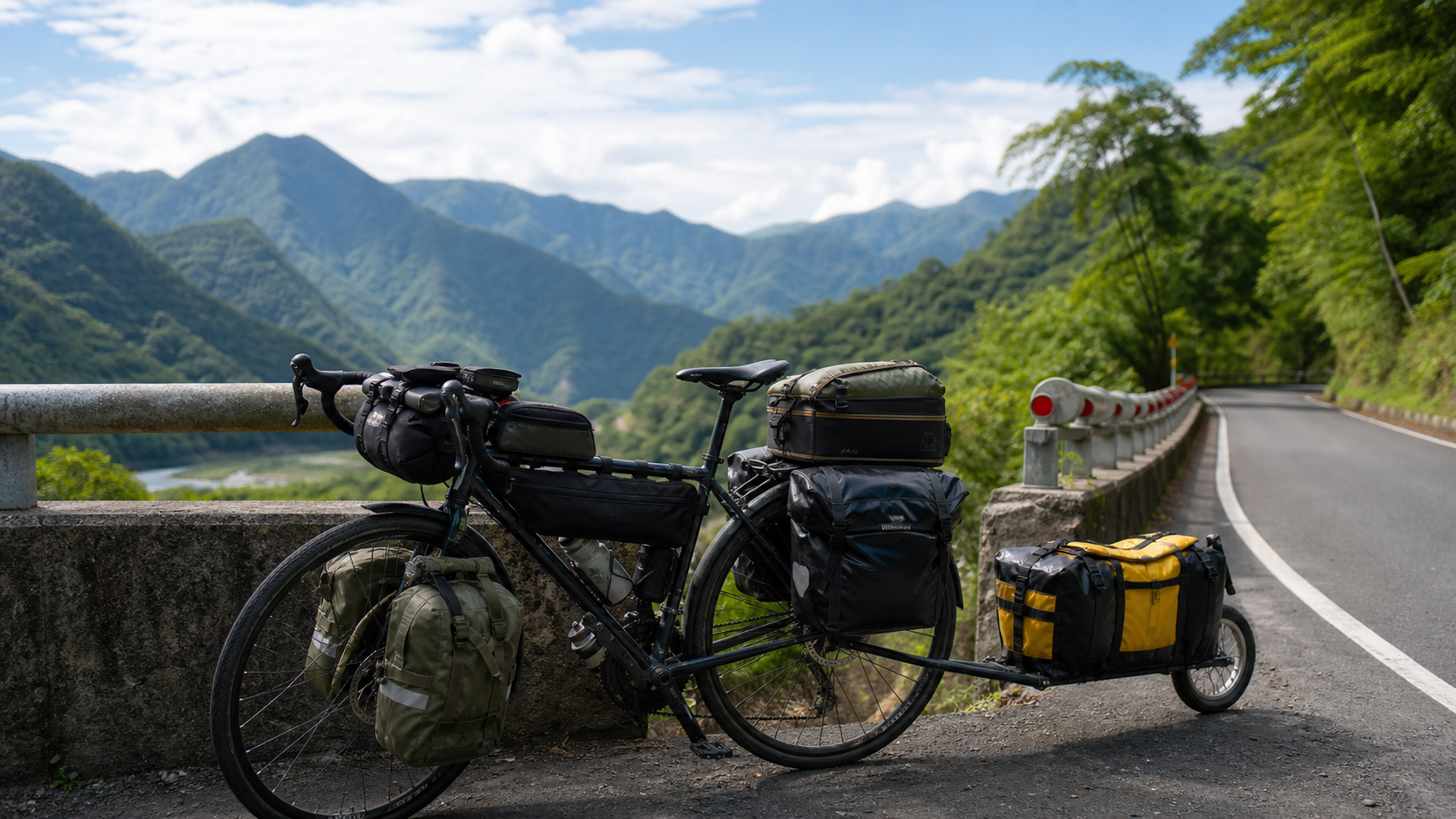
The panniers on both sides of the rear rack (typically 15–25 liters each) are the primary storage space. Heavier items (spare parts, charging bricks, spare parts bags) should go at the bottom, close to the bike’s center of gravity. Clothing and lightweight items go on top.
Taiwanese brands such as the Rixen & Kaul Taiwan distributor and German Ortlieb waterproof bags are available in major cities. If you’re on a budget, imitation waterproof panniers from Taobao or Shopee are serviceable, but check the stitching quality carefully.
Front Panniers: Stability Through a Low Center of Gravity
Many riders do a round-island trip with only rear panniers, which leaves the front wheel too lightly loaded and reduces steering responsiveness on descents and corners. It’s recommended to install at least a 3–5 liter fork bag on the front fork for food or water bottles, keeping proper downward pressure on the front wheel for better riding stability.
If you use a full front rack (four-bag system), the recommended front-to-rear weight split is 40% front, 60% rear.
Bike Trailers: Another Option
Bike trailers such as the BOB Yak or Tout Terrain Singletrailer let you carry large amounts of luggage without modifying your frame. The trailer is towed on one or two wheels, concentrating the weight at a single point without affecting the frame’s geometry.
Advantages:
- No need to drill rack mounts into the frame
- Suitable for road bike or racing bike riders who want to carry a lot of luggage
- Easy to unload; you can wheel the whole thing into your room upon arrival
Disadvantages:
- Adds overall length, making handling difficult on narrow shoulders
- The weight pulls from behind, creating a noticeable “dragging back” sensation on climbs
- On the winding mountain roads of the South Link Highway combined with strong side winds, a trailer can cause a drifting feeling
It’s recommended to use a trailer only when you’re certain every stop along the way has parking space and the route is mostly flat.
Must-Bring List and Items You Can Skip
Absolutely must bring:
- Spare inner tubes (at least 2)
- Tire patch kit + CO2 inflator or mini pump
- Multi-tool (including 3–8mm hex wrenches, screwdrivers)
- Chain lube and cleaning cloth
- Rain jacket (in Taiwan, sudden showers can happen even on sunny days)
- Sunscreen, lip balm (the western plains get intense sun)
- Taiwan NHI card, National ID (in case you get injured and need medical care)
Items you can skip:
- A heavy tent (Taiwan has dense accommodation options; camping is almost never necessary)
- More than 3 sets of change of clothes (every lodging stop has laundry and drying options)
- A laptop (a phone is enough to record your trip)
- Paper maps (Google Maps offline downloads are sufficient)
Practical Tips
- Waterproof packing: Even with waterproof panniers, use dry bags inside to sort items and prevent water seeping through zipper seams
- Organized storage: Use compression bags in different colors to separate clothing, tools, and food, so you don’t have to dig through the whole bag to find something
- Do a test ride: The day before departure, load all your luggage onto the bike and ride 10 km near home to feel whether the weight is reasonable
- Daily reset: When you arrive at your lodging, take out all devices that need charging first to avoid forgetting them
Conclusion
Luggage setup is the most overlooked part of round-island trip preparation. People spend hours researching routes and accommodations, yet ignore the luggage that will be riding with them for over 100 km every day. A sensible weight distribution isn’t just about riding more comfortably—it’s about letting you focus on the scenery along the way instead of the nagging detail of “why is this bag sliding back again.” Pack well, then ride.
Related Reading
- Round-island gear checklist: minimalist packing principles for bag systems, essential tools, and clothing
- The logistics of bike touring: complete planning for luggage, resupply, and accommodation
- Round-island packing checklist: 20 essential items for minimalist luggage
- Bike touring gear list: the packing philosophy of a one-week bikepacking load
靠單車減肥35公斤 心得分享與整理
7 年前
單車 一日北高 ( 雙城 ) 肥宅雙人瘋狂行 紀錄片 REACTO
10 年前
一日北高/長距離團騎 常見問題補充篇 / 組團或跟團的眉角 / 壯車友容易被瘦車友慢性拉爆 / 原來屁股痛可能是這個原因...? / 風場配速法 / 公路車 / CT Yeh
2 年前
再一組! 全碳幅條 碟煞/無內胎輪組 開箱! 到底好騎嗎? UNAAS X40 | 公路車 | CT Yeh
4 年前
摔車後補裝備: 好市多新款單車安全帽& Specialized Romin 北高整路屁股都不痛的坐墊 | 一千元居然有MIPS | CT Yeh | 公路車
4 年前
金門 ! 我騎過最棒的離島了 / 最後可以騎車上金門大橋的機會!?/ 公路車 / CT Yeh
1 年前
大家都在開箱的...單車用藍芽對講耳機真的有幫助嗎? SENA BiKom 20 長距離旅遊 & 海鷗繞圈賽 實際體驗心得 / 公路車 / CT Yeh
9 個月前
多到選擇障礙... 換個單車把帶想一個小時 / BTP / 編織&軟木特有材質超吸睛! / 公路車 / CT Yeh
1 年前