Introduction
The weight of an ultramarathon pack is a decision every runner faces: pack all the safety gear and the pack may exceed 3 kg; go ultra-light, and you may find yourself helpless in an emergency on the mountain. Many ultramarathon events in Taiwan reference ITRA (International Trail Running Association) standards and enforce a mandatory gear list. Runners must complete a gear check at registration, and missing any item results in disqualification. This article breaks down the logic behind mandatory and optional gear to help you find the optimal balance between safety and lightness.
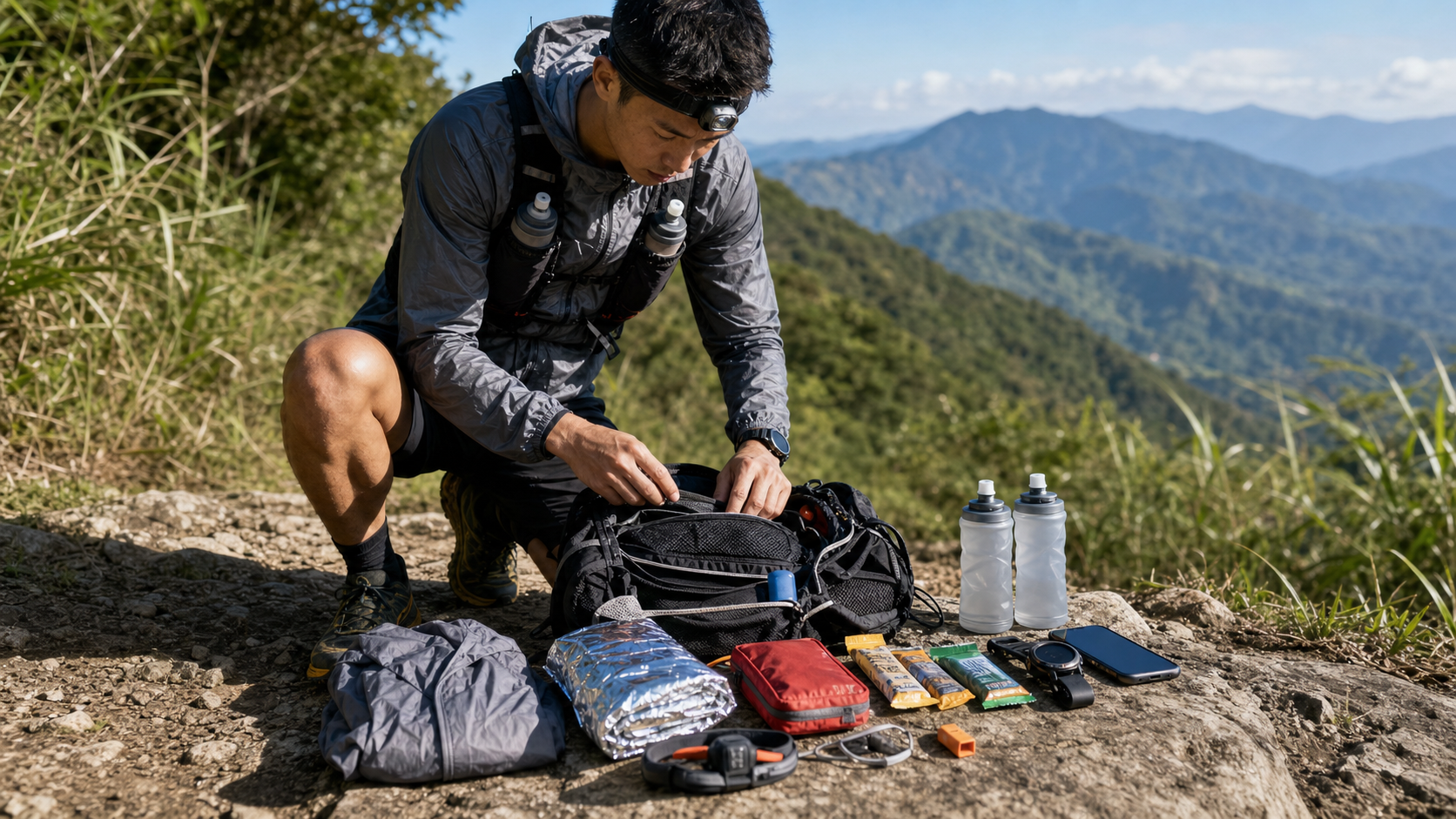
Common Mandatory Gear List for Ultramarathons in Taiwan
The following is the mandatory gear typically required by major ultramarathon events in Taiwan (each event may vary slightly; refer to official announcements):
| Category | Gear Item | Minimum Specification Recommendation |
|---|---|---|
| Hydration | Hydration pack or water bottles (total capacity 1L or more) | Soft flasks × 2 (500ml each) are the lightest |
| Lighting | Headlamp + backup light source | At least 200 lumens; phone flashlight can serve as backup |
| Rainwear | Waterproof jacket | A lightweight rain shell under 200g is most suitable |
| First Aid | Emergency blanket (survival blanket) | Disposable foil blanket < 50g |
| Communication | Phone (fully charged) | Bring a power bank as backup |
| Food | At least one emergency ration | 100–200 kcal energy bar or gel |
| Map | Event route map (paper or watch) | GPS watch strongly recommended |
| Whistle | Emergency whistle | Weight is almost negligible |
Pack Selection: Capacity and Fit
The choice of ultramarathon pack directly affects your running experience:
- 8–12L pack: Suitable for races under 50K with frequent aid stations
- 12–20L pack: Suitable for 50–80K trail races requiring more supplies
- 20L and above: For 100K+ or self-sufficient events
Mainstream ultramarathon pack brands:
- Salomon Advanced Skin: The most common in the ultramarathon world, with integrated soft flask design and numerous front pockets
- Ultimate Direction (UD): American ultramarathon brand, lightweight with flexible design
- Nathan: Value-for-money choice, commonly used by beginner ultramarathon runners
- Taiwanese brand SPECTER: Rising in recent years, with a better fit for Asian body types
Core principle for choosing a pack: Fill the pack during a test run and confirm there is zero bouncing after adjusting the chest and waist straps. Pack bouncing over long distances will chafe your skin raw.
Lightweight Strategies for Mandatory Gear
Mandatory gear cannot be omitted, but it can be lightened:
- Rainwear: Choose an ultralight rain shell of 100–200g (e.g., Montbell EX Light Wind Anorak) instead of a heavy waterproof jacket
- Emergency blanket: Choose a disposable foil blanket (30–50g) instead of a thick reusable one
- Headlamp: Rechargeable lightweight headlamp (e.g., Petzl Bindi, 26g), with phone flashlight mode as backup power
- Water capacity: Choose collapsible soft flasks that weigh almost nothing when empty
Lightweight Trade-offs for Personal Gear
Beyond mandatory gear, everyone’s optional list varies by individual. Here are the weight trade-offs for common optional gear:
- Trekking poles (160–220g/pole): Strongly recommended for climbs exceeding 2,000 meters, saving 10–15% of leg energy expenditure; they add burden on flat ultramarathons
- Spare shoes/spare socks (150–300g): Essential for races over 100K; optional for 50K and below depending on personal preference
- Knee sleeves/thigh sleeves (50–100g): Bring if you have IT band issues; others can skip them
- Cap/buff (30–100g): Essential for sun protection in summer; essential for night running in winter
- Sunscreen (30–60g): Absolutely necessary for Taiwan summer ultramarathons; applied to skin, not counted in pack weight
- Vaseline/anti-chafe balm (30–50g): Prevents chafing on inner thighs and underarms in prolonged hot, humid conditions
Weight Targets and Mental Preparation
A general recommendation is that the ultramarathon pack (including water) should not exceed 10% of body weight. For a 60 kg runner, the target pack weight is within 6 kg (including 1–1.5 kg of water).
| Pack Type | Target Weight Including Water |
|---|---|
| 50K trail | 2.5–4 kg |
| 80K trail | 4–6 kg |
| 100K+ self-sufficient | 6–10 kg |
Practical Advice
- Do a full simulation check before race day: Verify each item against the mandatory list one by one; don’t discover something missing at registration
- Test your pack weight firsthand: Load all gear into your pack and weigh it on a kitchen scale; only a tangible weight allows you to make decisions
- Carry emergency contact information: Write it on a waterproof card and keep it in your pack for search and rescue personnel in an emergency
- Confirm all electronic gear is charged one week before the race: Headlamp, GPS watch, and power bank should all start fully charged
- Never bring new, untested gear to a race: New gear may cause chafing, discomfort, or other issues
Conclusion
The core philosophy of ultramarathon gear is: bring what you need, not what you think you need. Every unnecessary gram becomes extra burden on your legs after 50 kilometers. But safety gear can never be compromised—mountain weather changes in an instant, and an emergency blanket might be the most important investment you make one day. Take time to research gear, test it repeatedly, and find the balance point between lightness and safety that works best for you and your pack.
Related Reading
- Ultramarathon Pack Nutrition Strategy: Mandatory Gear List and Weight Management
- Trail Running Hydration Pack Selection: Mandatory Gear and Weight Minimization Strategies
- Trail Running Gear Requirements: Mandatory Gear List and Pack Selection
- Ultramarathon Race Preparation: Complete Guide to Gear List and Training Cycles for Taiwan 100K Ultramarathons
一日北高前的高裝檢 | 北高 360 | 挑戰11小時的裝備 | 一日雙塔 | 補給
6 年前
單車 一日北高 ( 雙城 ) 肥宅雙人瘋狂行 紀錄片 REACTO
10 年前
多到選擇障礙... 換個單車把帶想一個小時 / BTP / 編織&軟木特有材質超吸睛! / 公路車 / CT Yeh
1 年前
摔車後補裝備: 好市多新款單車安全帽& Specialized Romin 北高整路屁股都不痛的坐墊 | 一千元居然有MIPS | CT Yeh | 公路車
4 年前
馬祖北竿單車體驗遊 | 被歐兜賣集體80差點摧不動 | 兩台公路車上飛機超重費...? 4K高畫質
5 年前
洗單車神器 吹水機! 實際洗車用用看 暴力洗鍊條大法 | 公路車 | CT Yeh
4 年前
再快都跟的上!? 單車跟隨攝影機之王 HOVERAir X1 PROMAX 全面實測 / 唯一!8K畫質&自行車專用模式和跟蹤信標&前後避障 / DJI Neo 可參考/ 公路車 / CT Yeh
1 年前
雨戰! 西進武嶺員工旅遊 加料 各路段大數據分析 | 同事端出5公斤的公路車來挑戰!? EP1
4 年前