Introduction
Twenty years ago, riding a bicycle on the roads of Taiwan required considerable courage. There were no dedicated lanes on highways, scooters and cars shared the road, and the shoulders were narrow and rough. Today, Taiwan boasts over 4,000 kilometers of dedicated bicycle paths, a complete network covering riverbanks, coastlines, mountains, and cities across all counties and cities, and has been listed by multiple international cycling media as one of “Asia’s Best Cycling Destinations.”
Behind this transformation lies two decades of policy planning, budget investment, and local implementation.
The Policy Context of Taiwan’s Bicycle Path Construction
Taiwan’s systematic bicycle path construction began in the early 2000s. In 2002, the Sports Affairs Council of the Executive Yuan (now the Sports Administration under the Ministry of Education) launched the “Overall Bicycle Path Network Plan,” the first official document to plan a nationwide bicycle path network at the policy level.
Since then, successive governments have continued to promote related programs:
| Program Name | Years | Key Construction |
|---|---|---|
| National Bicycle Path Overall Network Plan | 2002–2007 | Basic riverbank path infrastructure in all counties and cities |
| Bicycle Path and Facility Construction Plan | 2009–2012 | Cross-county route connections |
| Island-Wide Bicycle Network Construction Plan | 2013– | Promoting the EasyRide island-wide route |
| Forward-Looking Infrastructure Development Program (Bicycle) | 2017–2025 | Adding over 700 km of new paths |
Taiwan’s Most Important Bicycle Path Networks
Riverside Path System (Greater Taipei Area)
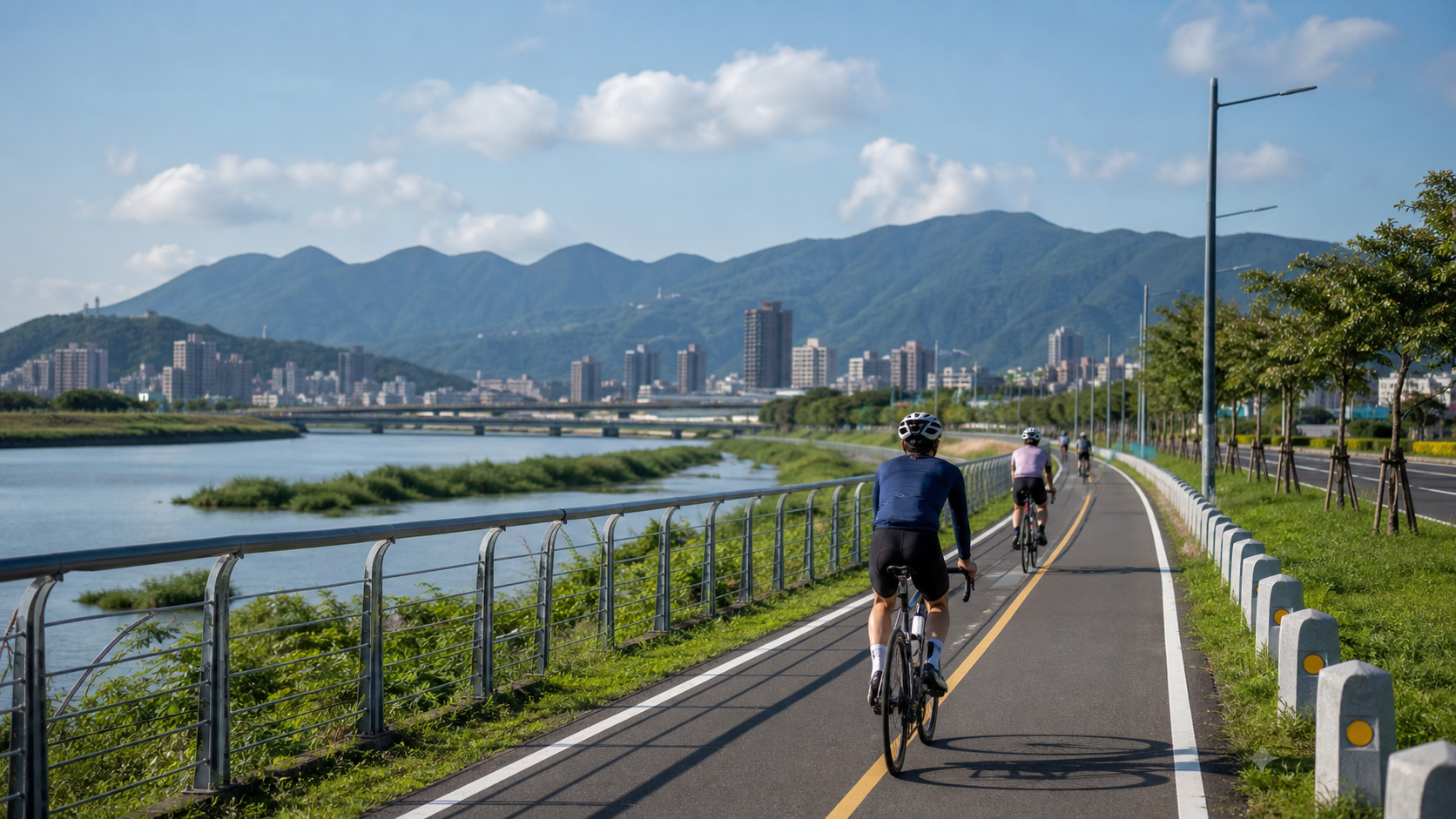
The riverside paths of the Greater Taipei area are the most mature example of urban cycling infrastructure in Taiwan. Following the Tamsui River, Xindian River, Keelung River, and Dahan River, the riverside bicycle paths total over 100 kilometers, completely flat with no climbs, wide surfaces, and almost entirely separated from motor vehicle traffic.
This system allows Greater Taipei residents to enjoy cycling in an environment free of traffic pressure, and is also the preferred starting point for many novice riders. On weekends, the riverside paths are among the happiest public spaces in all of Taipei.
The EasyRide Taiwan Bicycle Network
The “EasyRide Taiwan” program promoted by the Tourism Bureau of the Ministry of Transportation and Communications integrates bicycle paths from all counties and cities across Taiwan, planning a main island-wide route with branch lines in various regions. Supported by app navigation and service stations along the way, riders can depart from Taipei and complete an island-wide tour along the planned routes.
The main routes include:
- Northern Taiwan Section: Taipei→Yilan, crossing the Beiyi Highway or taking the coastal route
- Eastern Taiwan Section: Yilan→Taitung, the Provincial Highway 9 longitudinal valley section or the Hualien-Taitung coastal route
- Southern Taiwan Section: Taitung→Pingtung→Kaohsiung, Provincial Highway 1 plus provincial roads
- Western Taiwan Section: Kaohsiung→Tainan→Taichung→Taipei, mainly flatland sections
The Cycling Paradise of the Outlying Islands
Several of Taiwan’s outlying islands, being smaller in area and with relatively simpler traffic, have become cycling paradises:
- Penghu: The island-wide bicycle path is approximately 90 km in total, paired with the sea views of Xiyu and Baisha, offering a distinctly different character
- Kinmen: Known for its wartime culture, the island has a complete bicycle rental system, with military history sites accompanying riders along the way
- Xiao Liuqiu: A one-day island loop of about 12 km, with coral reef terrain and crystal-clear waters that keep visitors lingering
Construction Challenges: More Than Just Paving Roads
Taiwan’s bicycle path construction has not been without challenges. In actual implementation, common difficulties include:
- Land acquisition issues: Some sections pass through private land, making negotiation time-consuming and laborious
- Cross-agency coordination: A single cross-county path may involve multiple agencies including the Ministry of Transportation and Communications, the Council of Agriculture, and local governments
- Insufficient maintenance funding: Building is easy, maintaining is hard; some paths have deteriorated due to long-term lack of upkeep
- Pedestrian-cyclist conflicts: When shared-surface designs are poorly planned, conflicts between pedestrians and cyclists are not uncommon
Beyond Hardware: The Importance of Supporting Services
A quality bicycle path requires more than just hardware; supporting services are equally crucial:
- YouBike Public Bicycle System: Coverage in Taipei, New Taipei, Taoyuan, Taichung, and other cities is already quite comprehensive
- Supply and repair stations: The EasyRide routes include planned supply and rest points along the way
- Luggage delivery services: Island-wide riders can use logistics providers such as Kerry Express to ship luggage in advance
- Emergency roadside assistance: Some paths are equipped with emergency call phones or QR-code reporting systems
Practical Advice
- Use the official app: The Tourism Bureau’s “EasyRide Taiwan” app provides complete route navigation; it is recommended to download it before departure
- Check path conditions: After typhoons or heavy rain, some riverside paths may be flooded and closed; check the latest conditions before setting out
- Service station information along the route: Before planning a long-distance ride, mark the locations of convenience stores and bike repair shops along the way for emergencies
Conclusion
The construction journey of Taiwan’s bicycle paths is a positive cycle of mutual reinforcement between government policy and grassroots cycling culture. The government invested in construction because it saw the demand for cycling; the improved infrastructure attracted more people to take up cycling; and the growth in the cycling population strengthened the public mandate for further policy initiatives. Two decades of sustained investment have made Taiwan one of the regions with the most complete cycling infrastructure in Asia—an achievement worth being grateful for with every pedal stroke.
Related Reading
- Taiwan Bicycle Path Planning: Government Investment and Future Development Outlook
- A Complete Analysis of Taiwan’s Bicycle Policy: A Rider’s Rights Guide from Path Construction to Legal Protection
- The History of Taiwan’s Cycling Infrastructure Development: The Long Road from Riverside Paths to Commuter Networks
- An Introduction to Taiwan’s Bicycle Path System: The Features and Connections of Bicycle Paths Across Counties and Cities
高雄綠園道鐵路自行車道 / 外地人能輕鬆駕馭 還是整路崩潰? / 2025 全線開通 春節實地探索一次!(附GPS連結)/ 公路車 / CT Yeh
1 年前
日本公路最高登山賽,台灣首位YT挑戰實錄,乘鞍登山賽40週年,賽前篇完整版,請到我的YT收看 #公路車 #cycling
10 個月前
山港 環東台北160K 自行車約騎活動
9 年前
半日 小台灣 極限單車路線挑戰實錄
7 年前
2023自行車展!與環台賽選手一同表演賽 / 全自動AI Fitting?/ TIME新車發表/神秘充電桌等 精華分享 VLOG | CT Yeh | 公路車
3 年前
虎豹潭!日本老師來台一日約騎 台灣車友熱情招待私房路線 / CT Yeh
20 天前
日本島波海道 EP1 / 五大絕景路線之一! / 私房溫泉 x 豪華單車客棧 / 今治 to 大三島 / 公路車 / CT Yeh
2 年前
2025 乘鞍 KOM 登山賽挑戰實錄 / 日本公路最高 ! 賽前探路篇 / 比富士山厲害,無敵絕景!/ 40週年 / 中文YT首發 / 公路車 / CT Yeh #乘鞍ヒルクライム
10 個月前