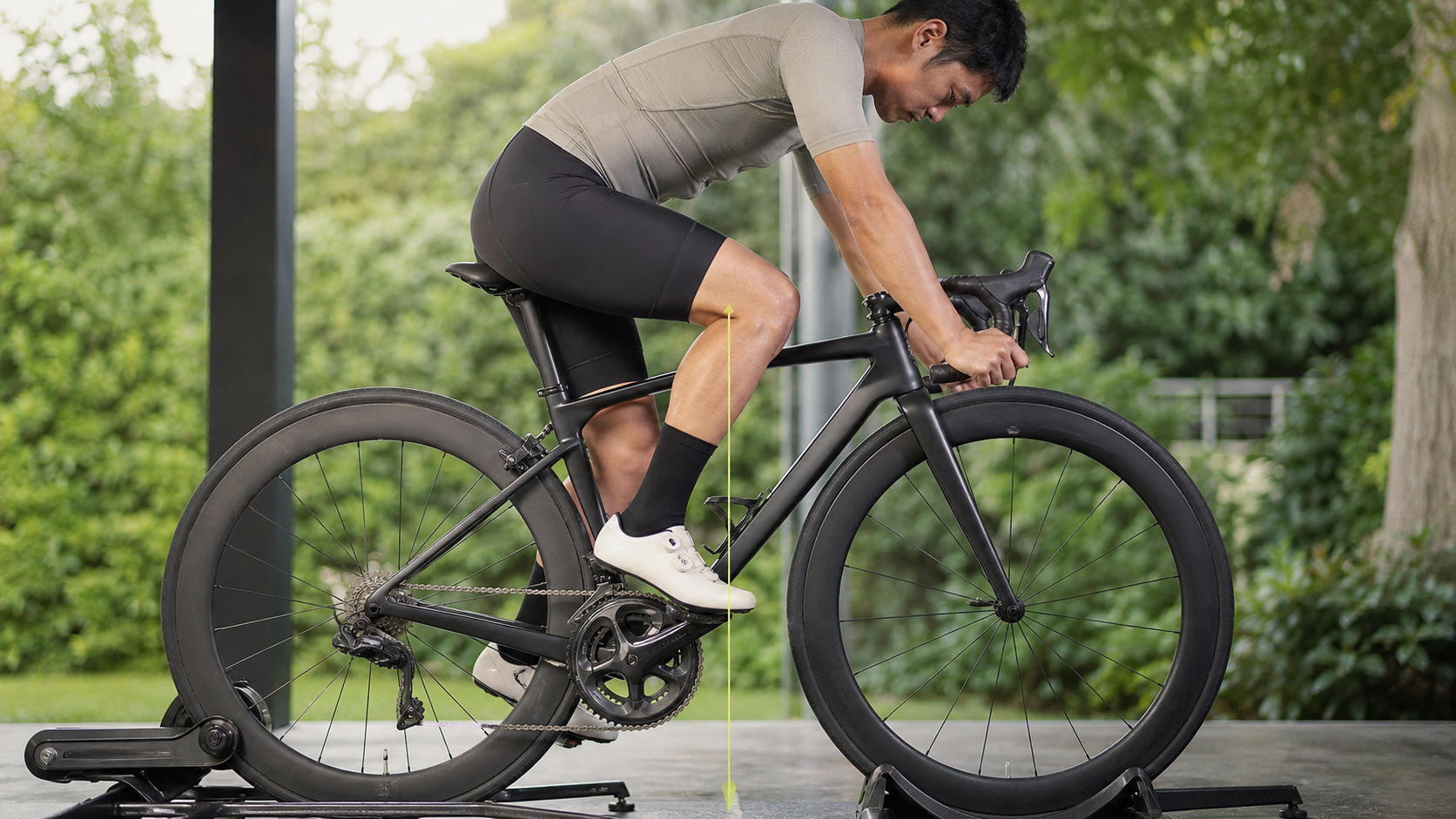
Fore-Aft Saddle Position Adjustment: What “Knee Over Pedal Spindle” Really Means
Introduction
Most riders know to adjust saddle height, but often overlook that the saddle can also move forward and backward. The fore-aft adjustment range provided by saddle rails is typically only about ±2–3 cm, which seems small, yet it has a profound effect on knee joint loading patterns, pedaling efficiency, and lower-back comfort.
The Physical Meaning of Fore-Aft Saddle Position
When the saddle is pushed forward, the rider’s center of gravity shifts forward and the knee ends up ahead of the pedal spindle — this increases the moment arm on the knee extensors (quadriceps), which may boost short-term power output but accelerates patellar cartilage wear over the long term.
When the saddle is moved backward, the rider’s center of gravity shifts back and the glutes contribute more to power output, which suits long-distance endurance riding. However, if the saddle moves too far back, the heel tends to drop habitually, increasing tension on the Achilles tendon and the back of the calf.
Fore-aft adjustment is essentially about finding the balance between a “knee-dominant” and a “glute-dominant” pedaling style.
The KOPS Principle Explained
KOPS = Knee Over Pedal Spindle, performed as follows:
- Put on your cycling shoes and clip into the pedals
- Rotate the crank to horizontal (3 o’clock position), with toes pointing forward
- Hang a plumb line from the bottom edge of the kneecap (the tip of the patella), or use a level
- The plumb line should align with the pedal spindle
What the three outcomes mean:
| Knee Position | What It Indicates | Recommended Action |
|---|---|---|
| Knee ahead of the pedal spindle | Saddle too far forward, increased quadriceps load | Move saddle backward |
| Knee aligned with the pedal spindle | Standard KOPS position | Maintain current position |
| Knee behind the pedal spindle | Saddle too far back, more glute involvement | Decide whether to adjust based on riding goals |
When Should You Deviate from KOPS?
KOPS is a starting point, not an endpoint. The following scenarios call for deliberate deviation:
Further Back (Knee Behind the Spindle)
- Ultra-long-distance riders (e.g., round-island rides, triathlon): Moving the saddle back lets the glutes take on more of the workload, reducing knee load
- Riders with a “pull-back” pedaling style: For those with a naturally rearward heel-push habit, moving back can better match the natural pedaling arc
Further Forward (Knee Ahead of the Spindle)
- Short-distance track cyclists: Moving forward increases power output, suited to sprinting
- Climbing-specific setups: Some climbing coaches recommend moving forward to support high-cadence climbing efforts
The Relationship Between Fore-Aft Position and the Lower Back
Fore-aft saddle position doesn’t just affect the knee — it also changes:
- Effective reach from handlebar to saddle: Moving the saddle forward 1cm is equivalent to bringing the handlebar 1cm closer
- Pelvic tilt angle: Moving the saddle back helps promote anterior pelvic tilt, maintaining the spine’s natural curve
- Weight distribution ratio: Moving forward increases weight on the hands, moving back increases weight on the saddle
Practical Adjustment Steps
- Loosen the saddle clamp (two bolts) without removing it completely
- Move no more than 5mm at a time
- After retightening, use a level to confirm the saddle is still level (fore-aft movement can sometimes change the tilt angle)
- After riding for 30 minutes, redo the KOPS check
- Mark the relative position on the rail (using a permanent marker)
Common Mistakes
- Using fore-aft position to compensate for incorrect saddle height: This is wrong! Height and fore-aft position should be adjusted separately
- Ignoring the effect of cleat position: Fore-aft cleat position also changes effective leg length, so fix cleat position first before adjusting the saddle
- Only performing static KOPS checks without dynamic verification: Static KOPS is a starting point — it’s recommended to also observe dynamically whether the pelvis rocks
Conclusion
Fore-aft saddle position is one of the most easily overlooked adjustments in bike fitting. KOPS provides a rational starting benchmark, but the ultimate optimal position needs to be determined by combining your individual pedaling style, riding goals, and functional physical conditions. Spending ten minutes on a KOPS check could save you years of knee pain on long rides.
Related Reading
- Complete Guide to Bicycle Seatpost and Saddle Adjustment: The Ultimate Solution for Saddle Sore
- Cleat Position Adjustment: Improving Knee Health and Pedaling Efficiency
- Road Bike Saddle Adjustment: A Complete Setup Guide for Fore-Aft Position, Angle, and Height
- Complete Guide to Bike Fitting: Why You Need a Professional Fitting
#公路車 #Fitting 靠人工智慧APP 幫你調整單車
6 年前
來都來了!改好改滿 / CS大導輪 + BB 可以省幾瓦? / 同場加映 TIME XPRO卡踏 / #公路車 #ceramicspeed / CT Yeh
1 年前
Nepest NOVA 碳條輪組:輕量、空力、舒適一次滿足!/ 公路車 / CT Yeh
7 個月前
靠單車減肥35公斤 心得分享與整理
7 年前
訓練台體驗) 2019台北自行車展 三大家 訓練台體驗 Tacx Neo Flux 2 Xepdo Apx Wahoo Kickr
7 年前
DJI OSMO 360單車攝影 教學&技巧分享 / 概念、攝影手法、架設、後製 / 公路車 / CT Yeh
10 個月前
車錶新黑馬? / 超狂續航 / 超好用錶冠 / 無敵準定位 / Dash圖表合成!?/ COROS DURA 評測!/ 公路車 / CT Yeh
2 年前
再一組! 全碳幅條 碟煞/無內胎輪組 開箱! 到底好騎嗎? UNAAS X40 | 公路車 | CT Yeh
4 年前