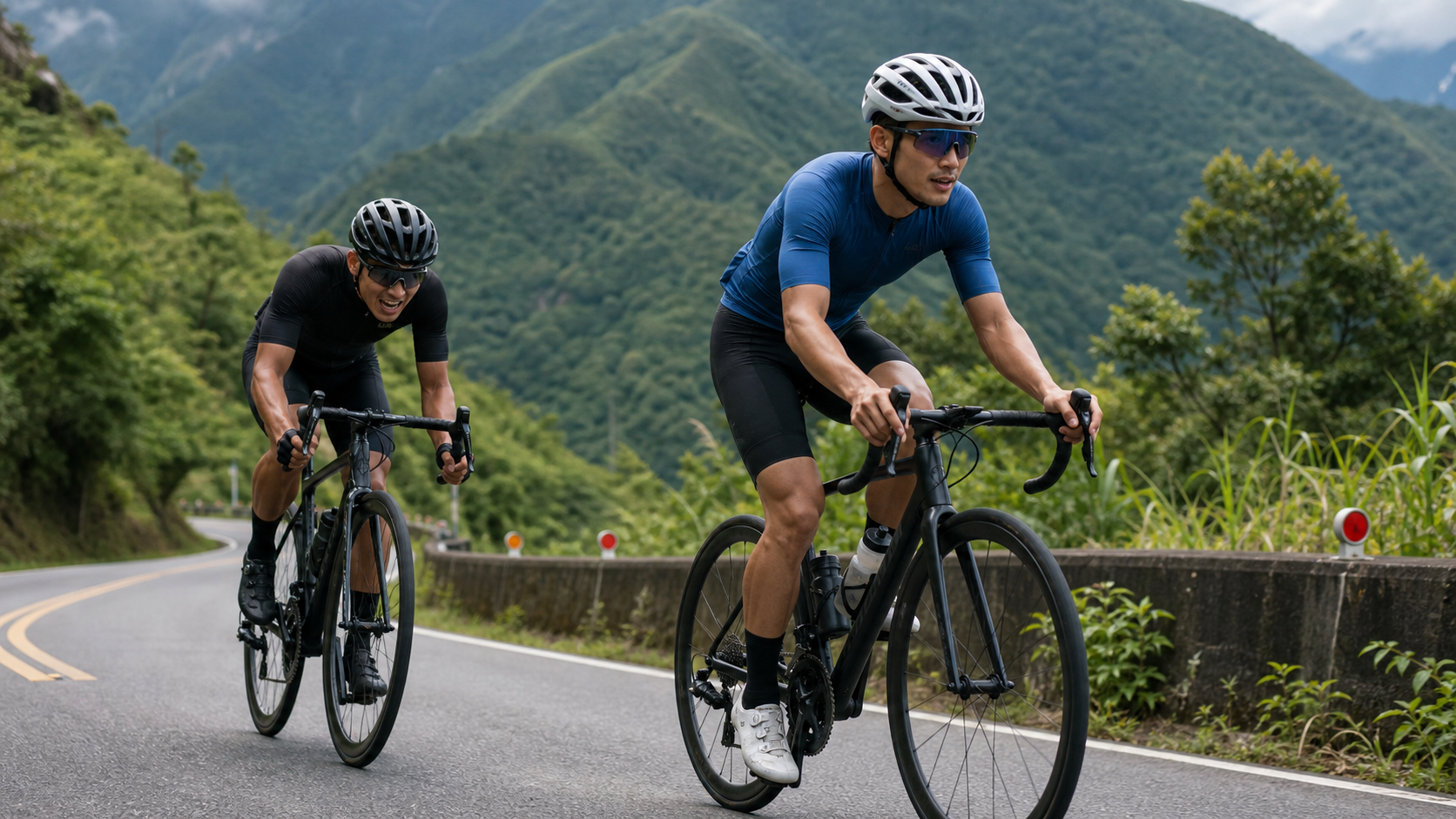
Climbing Cadence Choices: The Impact of High vs. Low Cadence Climbing on Muscle Groups
Introduction
On Taiwan’s climbing roads, you’ll often see two distinctly different types of riders: one spinning briskly at 90+ rpm, looking effortless and smooth; the other grinding steadily upward at a slow 60–70 rpm with powerful pedal strokes. Which approach is correct? The answer depends on your physiological profile, training background, and the characteristics of the climb.
The Fundamentals of Cadence and Muscle Recruitment
Cadence determines the number of muscle contractions per minute, as well as the force required for each contraction. Power = Torque × Cadence (angular velocity). At the same power output:
- High cadence (85–100+ rpm): Each pedal stroke requires less force, relying on aerobic (Type I) slow-twitch muscle fibers, placing a greater demand on the cardiorespiratory system.
- Low cadence (60–75 rpm): Each pedal stroke requires more force, recruiting more anaerobic (Type II) fast-twitch muscle fibers, placing less stress on the cardiorespiratory system but causing faster muscle fatigue.
Differential Impact on Major Muscle Groups
Climbing primarily engages the following muscle groups, but the contribution ratio of each group varies significantly with cadence:
| Muscle Group | High Cadence (>85 rpm) | Low Cadence (<75 rpm) | Primary Function |
|---|---|---|---|
| Quadriceps | Moderate load | High load | Knee extension (downward push) |
| Gluteus maximus | Moderate | High | Hip extension |
| Gastrocnemius | Low–moderate | Moderate–high | Ankle plantarflexion |
| Hip flexors | Moderate–high | Low | Pedal recovery and pull-up |
| Cardiorespiratory system | High demand | Moderate demand | Oxygen delivery |
Pros and Cons of High Cadence Climbing
Advantages:
- Reduces the muscular force required per pedal stroke, delaying fast-twitch muscle fatigue.
- Maintains better blood flow through the muscles, aiding in lactate clearance.
- On long climbs (such as the Wuling section exceeding 40 kilometers), it can significantly extend the time before “blowing up.”
Disadvantages:
- Greater cardiorespiratory burden, with heart rate rising more quickly.
- On gradients exceeding 10%, high cadence is often constrained by gear ratios and cannot be effectively executed.
- Requires a higher aerobic base (VO2max) to sustain.
Pros and Cons of Low Cadence Climbing
Advantages:
- Relatively lower cardiorespiratory stress, suitable for riders with weaker aerobic capacity but strong leg strength.
- On short sprints or sudden steep sections, low cadence with powerful pedaling can quickly generate high power output.
Disadvantages:
- The quadriceps and glutes accumulate delayed-onset muscle soreness more quickly after repeated high-force contractions.
- On the latter part of long climbs, legs are more prone to “locking up,” with muscles unable to recover effectively.
- Higher load per pedal stroke increases the risk of knee injury (especially when low cadence is combined with insufficient forward positioning in the saddle).
Finding Your Optimal Cadence
Different riders have different “preferred cadences,” which typically reflect individual muscle fiber composition and training history. Here are some simple self-testing methods:
- Lactate testing method: Choose a steady 5–8% climb and ride at 70, 80, and 90 rpm for 10 minutes each, recording heart rate and perceived exertion. The cadence at which your heart rate is lowest while feeling most comfortable is your initial target cadence.
- Fatigue location assessment: If the front of your thighs (quadriceps) are sorest after climbing → cadence is too low; if your heart rate is too high and you’re gasping for breath → cadence is too high.
Cadence Strategies for Different Gradient Sections
- 5–7% gentle slopes: Target 80–90 rpm, fully utilizing the aerobic system.
- 8–10% moderate slopes: Target 70–80 rpm, striking a balance between muscular strength and cardiorespiratory demand.
- 11%+ steep slopes: Target 60–70 rpm, accepting a lower cadence to avoid grinding due to insufficient gear ratios.
- Summit sprint: Temporarily increase cadence and climb out of the saddle, recruiting fast-twitch fibers for the final push.
Training Recommendations
- At least one high-cadence climbing session per week (85–95 rpm) to improve the aerobic efficiency and coordination of slow-twitch fibers.
- Low-cadence strength training (60–65 rpm @ 90–100% FTP) 2–3 times per month to strengthen muscular power output.
- Force reps: Using an easy gear ratio, climb slowly for 10–15 seconds, consciously engaging the glutes with each pedal stroke, performing 5–8 reps per set. This is an excellent method for improving low-cadence efficiency.
Conclusion
There is no absolutely correct climbing cadence—only the choice that best suits the situation at hand. It is recommended to deliberately practice different cadences in training to expand your “cadence control range,” allowing you to respond flexibly across all types of climbs. In the long run, improving your high-cadence climbing ability is often the key breakthrough to making climbing easier and more sustainable.
Related Reading
- Cadence Strategies for Climbing: High Cadence vs. Low Cadence Choices in the Mountains
- Small Gear High Cadence vs. Big Gear Low Cadence: The Scientific Choice of Climbing Cadence
- Cadence Selection When Climbing: 60rpm Power Type vs. 90rpm Cardio Type
- Climbing Pedaling Rhythm: The Physiological Differences Between High and Low Cadence
一日北高/長距離團騎 常見問題補充篇 / 組團或跟團的眉角 / 壯車友容易被瘦車友慢性拉爆 / 原來屁股痛可能是這個原因...? / 風場配速法 / 公路車 / CT Yeh
2 年前
一日北高常見問題大集合 | 攻略 | 路線 | 訓練 | 補給 | 自行車 單車 | 一日雙城 | 雙塔 | TWB北高360 | 屁股痛
6 年前
單車 梅山36灣 坡度介紹 路段介紹 空拍 (相關遊記影片,請參考說明或我的頻道喔,歡迎訂閱)
6 年前
單車 一日北高 ( 雙城 ) 肥宅雙人瘋狂行 紀錄片 REACTO
10 年前
白沙屯媽祖進香在家走!UREVO 坡度自調走步機 / 可連接訓練遊戲APP MyWhoosh / 邊看直播邊走起來 / CT Yeh
11 個月前
如果Pogačar騎西進武嶺可以多快?會破2嗎?各種情況深度推估探討 / 公路車 / CT Yeh
2 年前
#公路車 #Fitting 靠人工智慧APP 幫你調整單車
6 年前
全台首發!邁金P715踏板功率計!市場價格撼動者再出招 / 功率對比實測 / FAVERO ASSIOMA 可參考! / 公路車 / CT Yeh
1 年前